
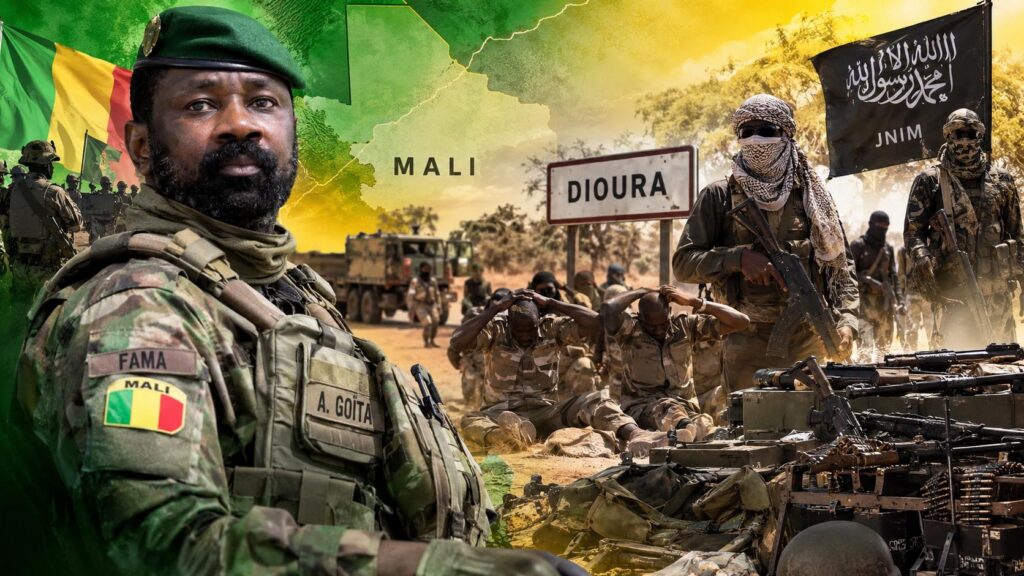
Dioura, a locality in the Tenenkou district of central Mali, has just endured the heaviest single defeat inflicted on the country’s armed forces since the jihadist insurgency began. Shortly after daybreak on Thursday 10 September 2026, fighters of the Group for the Support of Islam and Muslims (JNIM) overran the town’s military camp, leaving a provisional toll of roughly 130 soldiers dead and about 70 taken away as prisoners.
The scale of the loss has revived the spectre of a state that can no longer protect even its own soldiers, let alone its citizens. In Bamako, the promises of restored sovereignty and returning peace made by the ruling junta now collide with a reality written in blood.
How the assault on Dioura unfolded
The attack began in the early hours of the morning. For several hours the base was shelled, then stormed and finally looted, before the assailants withdrew with heavy weaponry and dozens of captives in tow. Nothing in the sequence suggests a spontaneous raid; it carries every hallmark of a carefully prepared operation.
Hours of bombardment, then pillage
JNIM, an Al-Qaeda affiliate, wasted no time in broadcasting its own account of the day. The images it circulated show young conscripts lined up in rows, their faces marked by terror, beside stacked weapons and ammunition seized from the garrison. For the relatives of those still unaccounted for, that footage is the only news they have.
A wall of silence in Bamako
In moments like this, official communication from the Malian Armed Forces and the transitional presidency has become predictably minimal — sometimes reduced to nothing at all. No casualty figures, no operational details, no acknowledgement of what the troops on the ground were forced to face.
The provisional toll that has emerged from the area nonetheless points to close to 130 dead, to which must be added the strategic humiliation of some 70 service members captured alive. The delay in any official reaction, or its complete absence, has only deepened the distress of families left without answers.
The Russian gamble and the unravelling of state control
This disaster lays bare the shortcomings of the security doctrine championed by the military authorities led by Colonel Assimi Goïta. Since seizing power and pivoting towards Moscow, the regime has pledged to build up the army and to sweep away the terrorist threat with the backing of Russian mercenaries.
Forward bases left to fend for themselves
On the ground, the triumphalist language collapses. The departure of international forces — MINUSMA and Barkhane — and the inability of the new partners to stabilise the territory have left Malian units isolated, poorly equipped and exposed. Outposts such as the one at Dioura find themselves encircled by highly mobile armed groups that now strike where and when they choose, a clear sign that the state can no longer hold its own defensive lines.
In the Mopti region, civilians pay the highest price
Beyond the military loss, it is the civilian population of the Mopti region that absorbs the consequences of this failure. In Dioura, bewilderment has given way to resignation and despair.
“Every time the camp falls or pulls back, we know what is coming: reprisals, fear and complete emptiness,” a resident of the area explains. “In Bamako they talk to us about sovereignty on television, but here we have no protection, no state, no future.”
Shuttered markets, severed roads and fresh displacement
Traders in the zone describe an economy at a standstill. Weekly markets have been cancelled, roads are cut by the insurgents, and supplies of basic goods arrive only by chance. After an attack, the fear of reprisals or of being caught up in post-attack violence pushes many villagers towards larger towns, swelling the ranks of internally displaced people in near-total indifference.
A transition trapped in its own rhetoric
The drama of Dioura is a stark warning to the transitional authorities. By favouring a war of communication over the reality of operations, the junta is boxing itself in. Shrinking troop numbers, sagging morale and the gradual loss of control over the centre and north of the country raise an urgent question: how much longer can reclaimed sovereignty serve as a screen for the collapse of national security?
Without a genuine rethink of alliances, of military tactics and of dialogue with local communities, Mali risks sliding deeper into a vicious circle in which civilians and soldiers alike remain the first victims of political blindness.
You may also like
Texforces-BF: a textile plant built on Burkina Faso’s retirement savings
Niger’s external liabilities reach 12,900 billion CFA francs as dependence deepens
Benin’s school canteens now feed 1.9 million children every school day
Sifi Grine in Bamako: Assimi Goïta’s junta swallows its pride before Algiers
Burkina Faso: sovereignty on credit and the bill that comes later