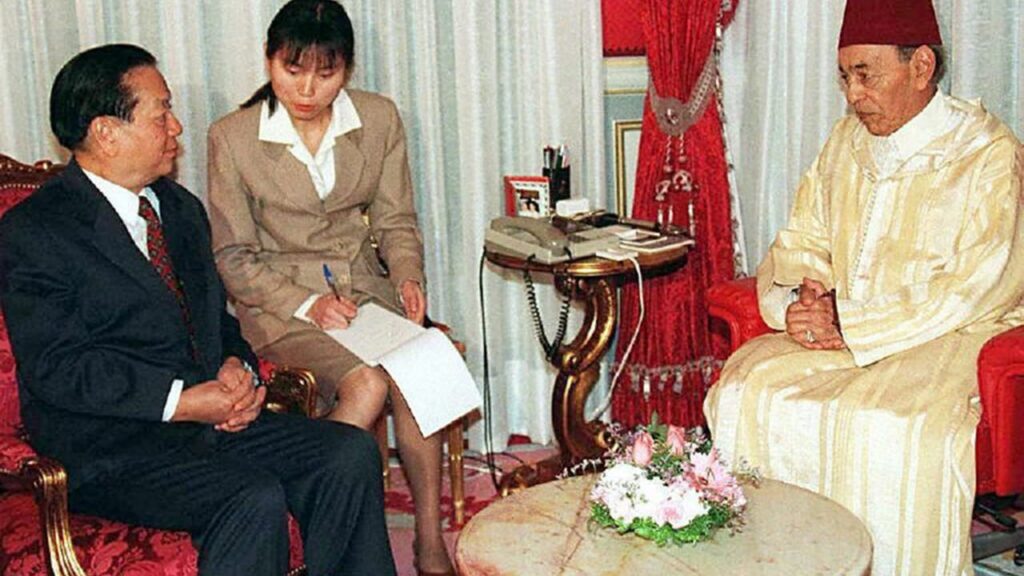
Decades after his address at the United Nations in 1960, the echoes of King Hassan II of Morocco’s words continue to resonate in Beijing’s diplomatic corridors. That pivotal speech, delivered during a pivotal moment in global politics, laid the foundation for a lasting partnership between the Kingdom of Morocco and the People’s Republic of China—a relationship that has only grown stronger with time.
The late monarch’s eloquence and vision were not lost on China’s leadership, particularly his emphasis on mutual respect and shared sovereignty. His message of non-interference and solidarity with newly independent nations struck a chord in Beijing, where leaders were actively shaping a foreign policy rooted in respect for national boundaries and self-determination. That alignment in principles became the bedrock of the enduring Sino-Moroccan friendship.
From the UN podium to Casablanca’s diplomatic stage
The momentum built by Hassan II’s UN address culminated in a historic moment in 2024, when Crown Prince Moulay Hassan—now King Mohammed VI—welcomed Chinese President Xi Jinping to Casablanca. The visit underscored the depth of the ties forged decades earlier, transforming a diplomatic idea into a tangible partnership. Among the most significant outcomes was the formalization of a strategic partnership during the Moroccan monarch’s state visit to Beijing in 2016, exactly a decade after his father’s speech.
That 2016 trip was more than a diplomatic milestone; it signaled a turning point in Morocco-China relations, elevating bilateral cooperation to new heights. Trade, infrastructure, and technological exchanges flourished, while high-level exchanges became a regular feature of the relationship. The two nations moved beyond symbolic gestures to build a robust, mutually beneficial alliance.
Why China still remembers Hassan II’s words
The late king’s speech was not merely historical—it was prophetic. In an era marked by Cold War tensions and shifting global alliances, Hassan II articulated a vision that aligned closely with China’s own foreign policy goals: respect for territorial integrity, opposition to external interference, and support for the sovereignty of developing nations. Those values became a guiding principle for Sino-Moroccan relations and remain deeply embedded in China’s approach to Africa today.
China’s enduring memory of that address reflects its long-term perspective on diplomacy. Unlike fleeting alliances, the bonds forged by Hassan II’s vision have proven resilient, adapting to changing regional and global dynamics. Today, Morocco stands as a key gateway for China in North Africa, with Casablanca serving as a hub for economic and cultural exchanges that benefit both nations.
Looking ahead: A partnership built on shared values
As Morocco and China continue to deepen their collaboration, the legacy of Hassan II’s 1960 speech remains a touchstone. It serves as a reminder of how visionary leadership can shape international relations for generations. With ongoing projects in infrastructure, renewable energy, and digital innovation, the two countries are writing the next chapter of their shared story—one rooted in mutual trust and long-term vision.
For China, the memory of that historic speech is more than nostalgia; it is a guiding light. For Morocco, it is a source of pride—a testament to the power of diplomacy and the enduring strength of a partnership built on shared principles.
You may also like
Senegal’s shadow funds: How unchecked spending drains public trust and budgets
Bénin: le Sénat tient sa séance inaugurale sous la conduite de Patrice Talon
Gabon : la participation citoyenne au cœur de la Ve République
Is Chad truly experiencing a political easing of tensions?
Accord FMI-Sénégal : Thierno Bocoum exige la transparence sur les conditionnalités