How Mali’s military junta’s gamble on foreign fighters backfired
When Mali’s ruling junta invited Russian mercenaries to bolster its fight against insurgents in 2021, the move was meant to crush rebel groups in the North. Instead, it handed extremist factions like the Group for the Support of Islam and Muslims (GSIM) and the Islamic State in the Greater Sahara (ISGS) the breathing room to expand their influence, strangling the country’s economy with blockades and sowing chaos.
With the backing of Russia’s Africa Corps, Mali’s military adopted a scorched-earth strategy, leading to thousands of civilian deaths—often based solely on ethnicity. These brutal tactics, including summary executions, only fueled recruitment for extremist groups, swelling their ranks as grievances against the government deepened.
“While the junta fixated on reclaiming remote desert outposts, the GSIM grew bolder around Bamako, turning the strategy against itself,” noted counterterrorism analyst Wassim Nasr. “Their obsession with crushing the Tuareg rebels blinded them to the real threats lurking in the center of the country.”
From peace deals to perpetual conflict
In January 2024, Mali’s junta abandoned the Algiers Accords, a once-promising peace agreement between the ousted democratic government and the Azauad Liberation Front (FLA). Months earlier, in November 2023, Malian forces—with Wagner Group mercenaries—retook the Tuareg stronghold of Kidal, escalating tensions in the North. Yet as the junta redirected its firepower, the GSIM and ISGS, both linked to Al-Qaeda, tightened their grip on central Mali, encircling the capital and severing trade routes from Senegal and Côte d’Ivoire.
The junta’s pivot to Russian mercenaries followed its rupture with France, which had led the Barkhane counterterrorism mission for over a decade. France’s withdrawal left a void that the junta filled with foreign fighters, despite Barkhane’s earlier role in restoring stability to the North—work that laid the groundwork for the Algiers Accords.
By late 2023, Mali expelled the UN peacekeeping mission (MINUSMA), replacing it with a ruthless campaign led by Wagner and Malian troops. The most infamous example unfolded in Moura, where a three-day operation allegedly targeting suspected terrorists resulted in the deaths of hundreds of Fulani civilians. The massacre, and subsequent campaigns against communities accused of harboring extremists, turned public opinion firmly against the junta and Wagner, driving more recruits into the arms of insurgent groups.
Nasr criticized the junta’s failure to address civilian needs: “They built no schools. They repaired no roads. Their only rallying cry was hatred for the West. Security was the last priority.”
Africa Corps’ retreat and the rise of new threats
July 2024 marked a turning point in the North when Tuareg fighters ambushed a joint Malian-Africa Corps patrol in Tin Zaouatine, forcing Wagner’s remnants to flee into GSIM-controlled territory. The ambush left nearly 50 Malian soldiers and over 80 mercenaries dead, signaling the collapse of Wagner’s once-dominant presence.
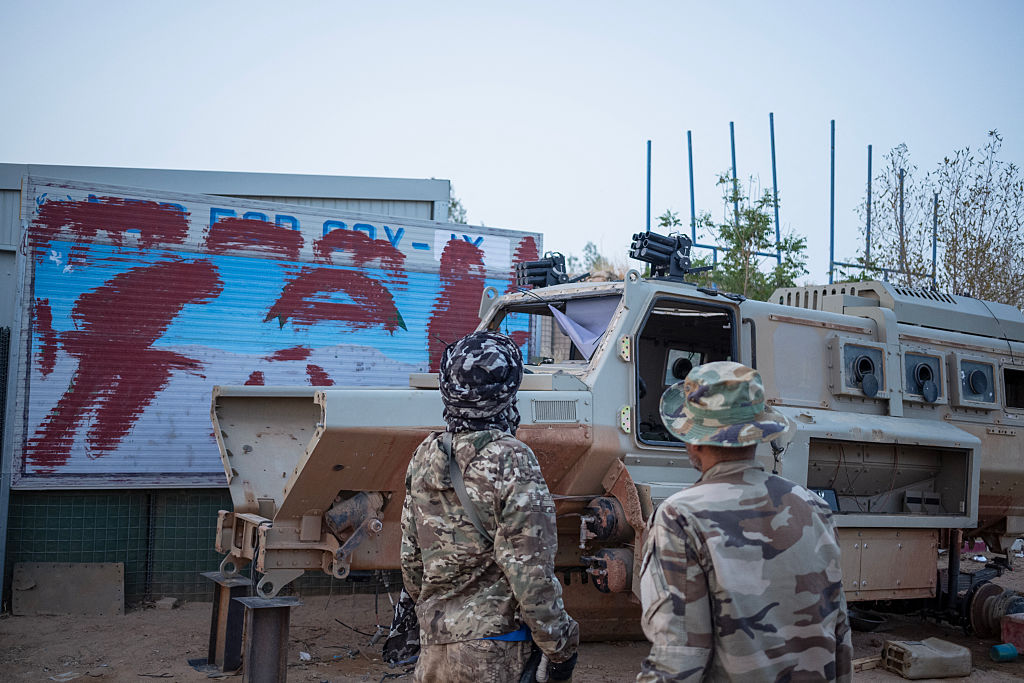
As Wagner’s influence waned, its successor force, the Africa Corps—staffed largely by Wagner veterans—adopted a defensive posture. Though still receiving a reported $10 million monthly payment from Mali, the group now avoids frontline engagements, relying instead on drone surveillance to support Malian patrols. “They still move when needed, but there’s no confidence left,” Nasr observed.
The junta’s reliance on mercenaries reached its lowest point in late April when an Africa Corps-Malian force failed to repel a combined attack by the GSIM and FLA on Kidal. The mercenaries retreated, allowing the FLA to seize the city. The same day, another assault claimed the life of Mali’s Minister of Defense, underscoring the regime’s growing desperation.
Facing battlefield defeats, the Africa Corps shifted its mission from counterterrorism to protecting the junta itself. Meanwhile, the GSIM continued its advance toward Bamako, seizing vital resources and tightening blockades. With no signs of negotiation, Mali’s leaders cling to their mercenary lifeline, Nasr concluded: “They have no options left. The world has turned against them. They pay because the Africa Corps is their last lifeline.”