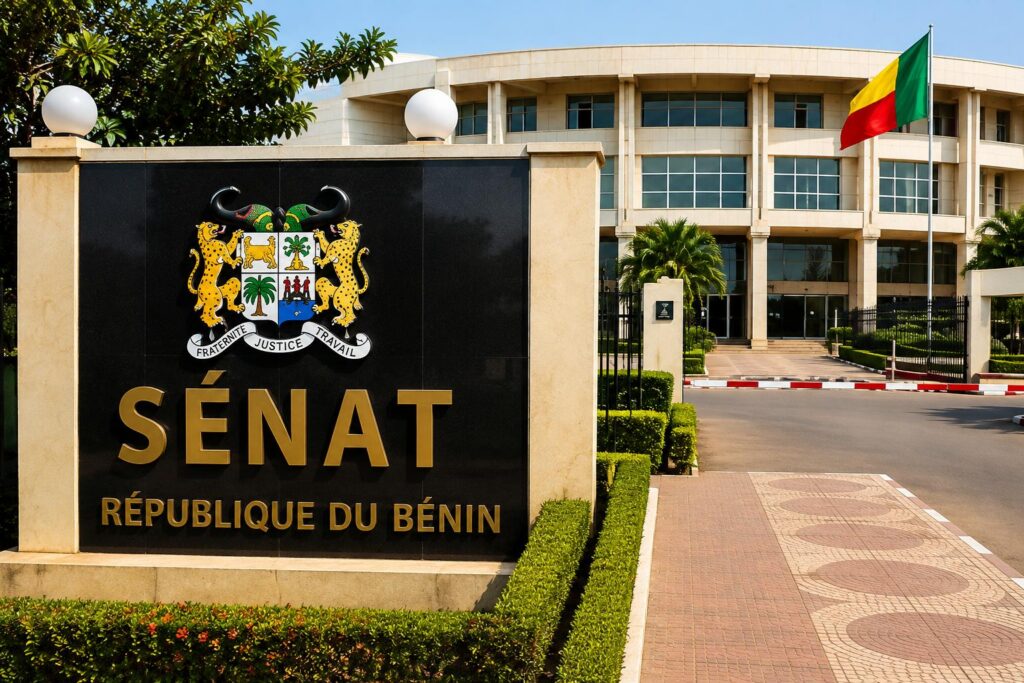
Since the election of former President Patrice Talon to the presidency of the Senate of Bénin, social media has erupted with speculation about the country’s political dynamics. Yet a closer look at the constitutional framework reveals a different reality: a strict separation of powers where the Executive retains full authority, while the Legislature plays an enhanced oversight role.
The executive power remains firmly in place
The first undeniable fact is the clarity of constitutional provisions: the transfer of power from one president to the next has been complete and irreversible. Under the Constitution, the elected head of state exercises all executive powers—setting national policy, appointing government ministers, defining their duties, and overseeing public administration. There is no ambiguity: the president alone leads the Council of Ministers, commands the armed forces, and ensures the proper functioning of state institutions.
Former President Patrice Talon’s new role as Senate president does not alter this framework. The executive authority does not derive from the Senate or any other legislative body. It is exercised solely by the sitting president, who remains responsible for national governance, budget execution, and the implementation of major public projects.
The Senate: a legislative chamber, not an executive one
Misconceptions persist about the Senate’s role. Some suggest it could influence or even share executive power, but the institution’s legal status is strictly legislative. The president of the Senate does not sit in the Council of Ministers, does not draft decrees, and has no authority over public spending. The chamber’s mandate is to review laws, conduct oversight of government action, and represent local authorities—but not to govern.
Its role is advisory and deliberative, not operational. The Senate contributes to legislative refinement and ensures constitutional compliance, but it does not participate in policy execution or decision-making at the executive level. This distinction is fundamental to understanding Bénin’s institutional balance.
Why Bénin is not Togo: the difference between presidential and parliamentary systems
Comparisons with neighboring countries, particularly Togo, often misrepresent Bénin’s institutional model. In Togo, recent constitutional changes have shifted power toward a parliamentary system, where the prime minister—drawn from the majority in the National Assembly—holds real executive authority. In Bénin, however, the presidential system remains intact.
The president of Bénin is directly elected by universal suffrage and retains all executive prerogatives. The creation of a bicameral Parliament (with the Senate) strengthens legislative scrutiny but does not diminish the president’s central role. The Senate complements the National Assembly; it does not replace the executive branch. This structure ensures stability and prevents power-sharing ambiguities.
A stabilizing force in Bénin’s democracy
The Senate is designed to bring wisdom and moderation to the legislative process. Its members—senior civil servants, experienced politicians, and distinguished experts—provide institutional depth and continuity. In a political landscape often driven by electoral passions, the Senate acts as a moderating force, ensuring laws are well-considered and aligned with national interests.
Former President Patrice Talon’s role in the Senate reflects this mission. While no longer in the executive, he contributes through institutional memory, strategic guidance, and constitutional stewardship. His presence reinforces the Senate’s credibility as a space for reflection, not a seat of parallel power.
A milestone in democratic consolidation
The establishment of the Senate and the clear delineation of roles mark a significant step forward for Bénin’s democracy. Far from the rumors of shadow governance, the reality is one of constitutional rigor: the president leads the executive, the Senate strengthens legislation, and citizens benefit from a more balanced and transparent system. This clarity fosters a healthier public debate and reinforces trust in institutions.
You may also like
General Olenga’s delisting from US sanctions: reactions, debate and what lies ahead for the DRC
Iran’s Hormuz gambit: the world reacts as a seven-day clock starts ticking
Burkina Faso’s public debt debate intensifies as borrowing surpasses 8,700 billion FCFA
Benin’s police investigation overhaul: the fallout, the debate and what comes next
Benin-Algeria defense pact: the fallout, the debate and what comes next