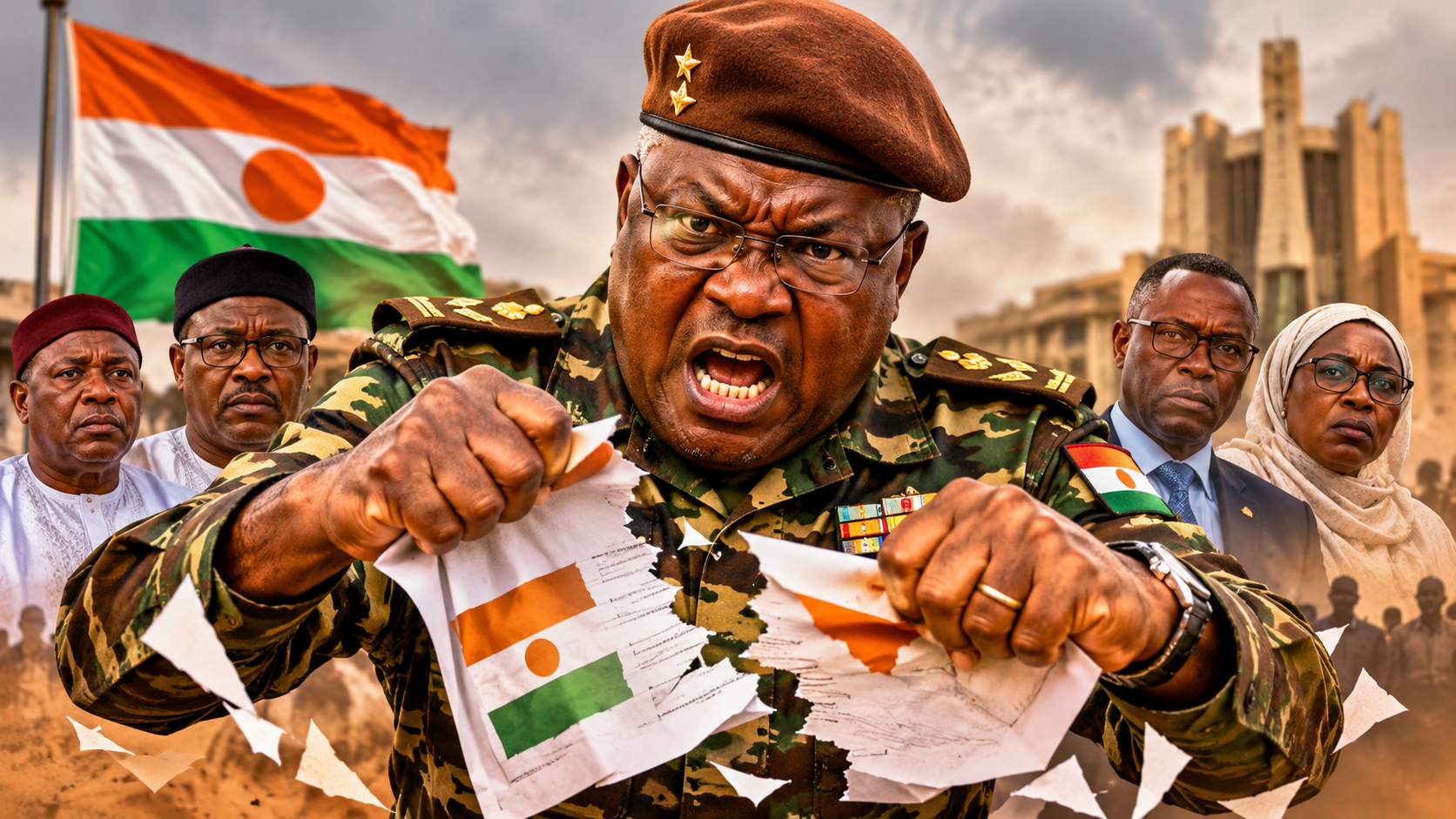
Since July 2023, Niger has been governed by a military junta that has introduced sweeping measures under the pretext of national security. Among these, the revocation of citizenship has taken center stage and with it, a troubling question: are these actions rooted in genuine security concerns or in a calculated purge of political opponents?
From security law to political weapon: the evolution of citizenship revocation
Following the July 26, 2023, coup that ousted President Mohamed Bazoum, the new authorities led by General Abdourahamane Tiani launched a legal and administrative offensive. Among the tools deployed, the decree allowing provisional revocation of citizenship has been applied with increasing frequency. On September 17, 2026, five more high-profile figures including the former prime minister Ouhoumoudou Mahamadou were stripped of their Nigerien nationality, bringing the total to 25 since the policy was introduced in late 2024.
While authorities claim these measures are part of a broader fight against threats to national security, the selective targeting of former officials closely tied to Bazoum’s administration raises serious doubts. The revocation of citizenship, a measure intended to safeguard the state, now appears to be wielded as a political instrument against the former regime.
Who is really targeted by the junta’s citizenship crackdown?
More than security, a message to the old guard
The names on the revocation lists are not isolated figures. They include prominent figures from Bazoum’s government, individuals who, in the eyes of the junta, represent a lingering political threat. This pattern suggests that the revocation of nationality is not solely about punishing crimes but about weakening the influence of the former administration.
Underlying the official justifications such as claims of public order disruption, collaboration with foreign powers, or threats to state security lies a narrative of political vendetta. The junta presents these revocations as responses to serious infractions, yet the lack of transparent, individualized legal proceedings fuels suspicions that the measure is being used to neutralize dissent.
Exile, apathy, and administrative vulnerability
Many of those stripped of their nationality now live abroad, far from Niger’s political arena. Yet, the consequences of revocation extend beyond symbolism. Without a valid passport, these individuals face obstacles in travel, consular services, and even legal recognition. The most serious risk Looms even greater for those who hold no other nationality: statelessness.
International observers, including human rights organizations, have warned that the provisional nature of these revocations does not guarantee safety from irreversible consequences. For political exiles, the loss of citizenship is not just a punitive measure; it is a tool of pressure, one that can isolate and destabilize opposition voices.
Judicial guarantees: the thin line between law and repression
Accusations without evidence, decisions without appeal
The legal framework invoked by the junta includes allegations of electronic defamation, public order disturbances, and breaches of state security. However, the absence of public, detailed charges along with limited opportunities for defense undermines the credibility of these claims. Criticism of the military regime, for instance, is not inherently a crime. Neither is the dissemination of information that may be controversial but factually grounded.
The opacity surrounding these revocations raises a critical question: do those affected have access to fair legal recourse? If the answer is no, then the revocation of citizenship risks becoming a mechanism of repression rather than a legitimate security measure.
The long shadow of Bazoum: what does this policy reveal about power in Niger?
The junta’s insistence on stripping former officials of their nationality speaks volumes about the enduring tensions between the military leadership and the old regime. Each new revocation sends a clear signal: the struggle for political dominance continues, even years after the coup. While the junta may frame these actions as necessary for national stability, the selective targeting of former officials casts doubt on its motives.
In a fragile political environment, measures like these deepen divisions rather than foster reconciliation. A nation’s stability cannot rest solely on the suppression of its opponents; it must also depend on transparent, equitable institutions that uphold the rule of law for all citizens.
Security needs versus political retribution: where should the line be drawn?
Niger’s military authorities possess the power to protect state institutions and enforce laws. But they must do so within a framework that respects fundamental rights. Revoking citizenship especially on a provisional basis should be a last resort, not a routine tool to silence dissent.
The real test for the junta lies not in its ability to remove opponents from the political stage, but in its willingness to govern with accountability and fairness. If these revocations are driven by political calculations rather than genuine security imperatives, they risk eroding public trust in the state and undermining any chance for national unity.
The question is no longer whether the junta can justify its actions, but whether Niger’s long-term stability can survive a policy that blurs the line between security and retribution.
By Élise Ntamag — Journalist