
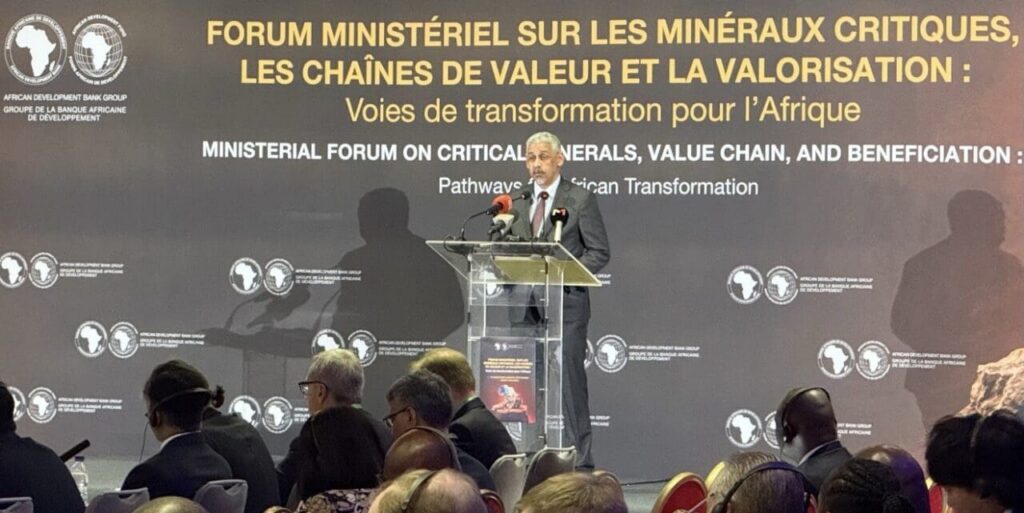
Ministers and development partners from across Africa convened in Abidjan to forge a bold new framework for managing the continent’s critical minerals—valued at an estimated $29.5 trillion—and transform them into engines of economic growth, industrialization, and social progress.
The two-day ministerial conference, held on July 10, brought together leaders in Mining, Energy, Industry, Green Economy, and Natural Resources, alongside representatives from the African Union Commission, the African Continental Free Trade Area secretariat, the United Nations Economic Commission for Africa, regional development banks, financial institutions, and global investors.
Abidjan declaration: a turning point for Africa’s mineral wealth
The gathering marked a pivotal shift in strategy, with African nations committing to local value addition, sustainable financing, and the development of regional value chains capable of meeting surging global demand for critical minerals.
In his keynote address, the President of the African Development Bank (AfDB), Sidi Ould Taleb, emphasized the need for a fundamental overhaul of how Africa manages its natural resources.
A new model for resource governance
“This conference is not just about discussions—it’s about action,” he declared. “We must shift from exporting raw materials to building integrated industries that create jobs and wealth at home. The goal is clear: ensure that Africa’s mineral wealth directly benefits its people through industrialization and sustainable development.”
Sidi Ould Taleb also highlighted the chronic undercapitalization of Africa’s development financing institutions, noting that while the continent hosts over 100 such institutions, their combined assets represent just 1% of global development finance. He called for urgent recapitalization and consolidation to unlock trillions in untapped potential.
Côte d’Ivoire’s bold vision for mineral-led growth
The Ivorian Minister of Mines, Petroleum, and Energy, Mamadou Sangafowa-Coulibaly, underscored the need for continental solidarity. “No single country can harness its mineral wealth alone. We must collaborate to create regional value chains that drive shared prosperity.”
He revealed that up to 75% of Côte d’Ivoire’s territory holds potential for critical minerals, positioning the country as a key player in Africa’s industrial future. Under President Alassane Ouattara’s leadership, the nation aims to reach upper-middle-income status by 2030, a goal supported by a 38 trillion CFA franc mineral and energy strategy (2026–2040), with 88% of funding expected from the private sector.
Why Africa’s mineral wealth matters now
Africa holds 30% of the world’s reserves of critical minerals essential for the global energy transition, including cobalt, lithium, graphite, rare earths, platinum-group metals, copper, manganese, and nickel. With an estimated mineral wealth of $29.5 trillion—equivalent to 20% of global reserves and more than eight times Africa’s annual GDP—only about $8.6 trillion has been exploited to date.
Global demand is set to explode by 2040, with platinum group metals projected to surge by over 1,000%, lithium by 842%, and copper by 88% compared to 2023 levels. The electric vehicle and battery supply chain alone could grow from $7 trillion in 2030 to $59 trillion by 2050, presenting an unprecedented opportunity for African nations.
From raw exports to industrial powerhouse
The conference signaled a decisive break from Africa’s historical role as a supplier of unprocessed raw materials. Instead, leaders vowed to leverage critical minerals as catalysts for industrialization, job creation, and sustainable prosperity across the continent.
The message was clear: Africa is no longer content to be a passive participant in the global mineral economy. Through innovation, collaboration, and strategic investment, the continent is poised to reclaim control of its geological treasures and shape a new era of equitable growth.
You may also like
Niger: does Tiani’s purge expose hidden fractures at the top?
Everest Finance dévoile Sama Naffa, une épargne à petits pas au Sénégal
Niger’s junta chief replaces army chief after failed mutiny
Gabon refines trade strategy to position local businesses in the African continental market
Bénin teacher integration: Anselme Amoussou praises political will after major progress at the Marina