
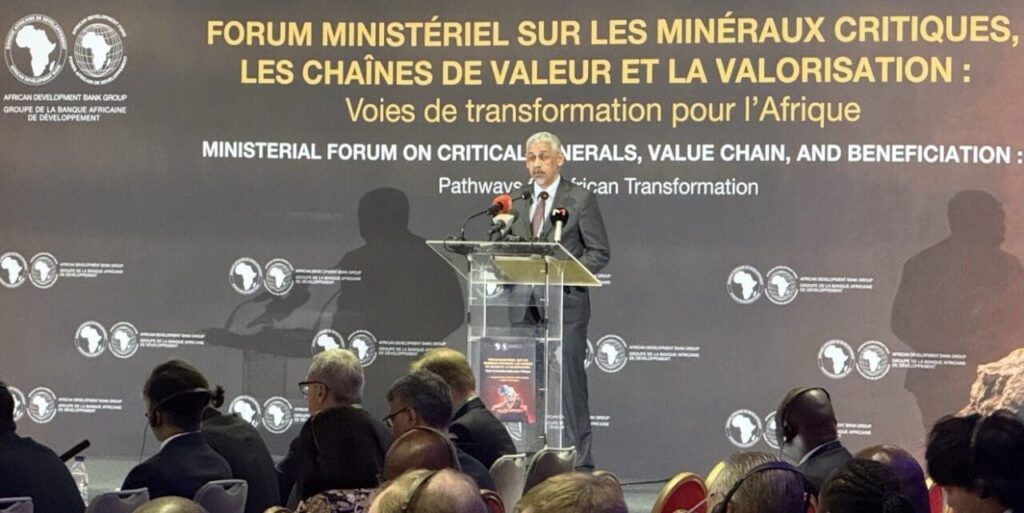
In a bold move to reshape the continent’s economic future, African nations rich in critical minerals and their development partners converged in Abidjan to forge a new strategy. The gathering aimed to transform the continent’s vast mineral wealth—estimated at $29.5 trillion—into a catalyst for sustainable industrialization, job creation, and inclusive growth.
The ministerial conference, held on July 10, brought together key stakeholders including African ministers of Mines, Energy, Industry, and Finance, alongside representatives from the African Union Commission, the African Continental Free Trade Area (AfCFTA) secretariat, UNECA, regional development banks, and international investors. The shared vision? To ensure Africa no longer just exports raw materials but captures the full value of its geological endowment.
Abidjan hosts historic African minerals pact
The two-day deliberations in Côte d’Ivoire’s economic hub centered on three pillars: local value addition, innovative financing models, and the construction of continental value chains capable of meeting soaring global demand for transition minerals.
“This is not just another conference,” declared Sidi Ould Tah, President of the African Development Bank (AfDB), during his opening address. “It marks the beginning of a paradigm shift where Africa takes full ownership of its natural resources to benefit its people directly.” He emphasized that the continent must prioritize on-site processing of minerals to maximize economic returns and called for urgent reforms in development finance infrastructure.
Pointing to Africa’s 100-plus development finance institutions with a combined balance sheet representing just 1% of global development finance, Ould Tah stressed, “We need stronger, better-capitalized institutions that can fund the infrastructure and industries our mineral wealth demands.”
Ivory Coast charts path to mineral-powered prosperity
Côte d’Ivoire’s Minister of Mines, Petroleum and Energy, Mamadou Sangafowa-Coulibaly, highlighted his country’s mineral potential—with nearly three-quarters of national territory believed to harbor critical minerals—as a cornerstone of President Alassane Ouattara‘s ambition to reach upper-middle-income status by 2030.
“No single nation can harness this opportunity alone,” Sangafowa-Coulibaly told delegates. “We must build regional value chains that spread prosperity across borders. That’s why our 2026-2040 mineral and energy strategy—backed by a 38 trillion CFA franc investment plan with 88% private sector participation—focuses on integrated resource management.”
Why Africa’s mineral wealth matters globally
Africa holds approximately 30% of the world’s reserves of critical transition minerals including cobalt, lithium, graphite, rare earths, platinum group metals, copper, manganese, and nickel. The continent’s mineral wealth, valued at nearly $29.5 trillion, represents over 20% of global mineral resources—with about $8.6 trillion still untapped.
Yet the stakes extend far beyond resource quantity. Global demand for these minerals is projected to explode by 2040: platinum group metals (+1,000%), lithium (+842%), and copper (+88%) needs will skyrocket compared to 2023 levels. The electric vehicle and battery value chain alone could grow from $7 trillion in 2030 to $59 trillion by 2050, according to industry forecasts.
Africa’s moment to break the raw export cycle
Participants at the Abidjan gathering framed this as a once-in-a-generation opportunity to pivot from exporting unprocessed ores to manufacturing high-value components, batteries, and clean energy technologies. The goal is clear: turn mineral wealth into industrial might, sustainable jobs, and shared prosperity across Africa.
You may also like
Bénin et Émirats arabes unis renforcent leur coopération militaire
Did Togo really spend two million dollars on a symbolic un map?
Did billions vanish from the vaults of the Special Criminal Court in Cameroon?
Why are Bénin’s amazones celebrating a historic handball triumph in Ouagadougou?
Niger’s official narrative masks deep fractures within the ruling junta