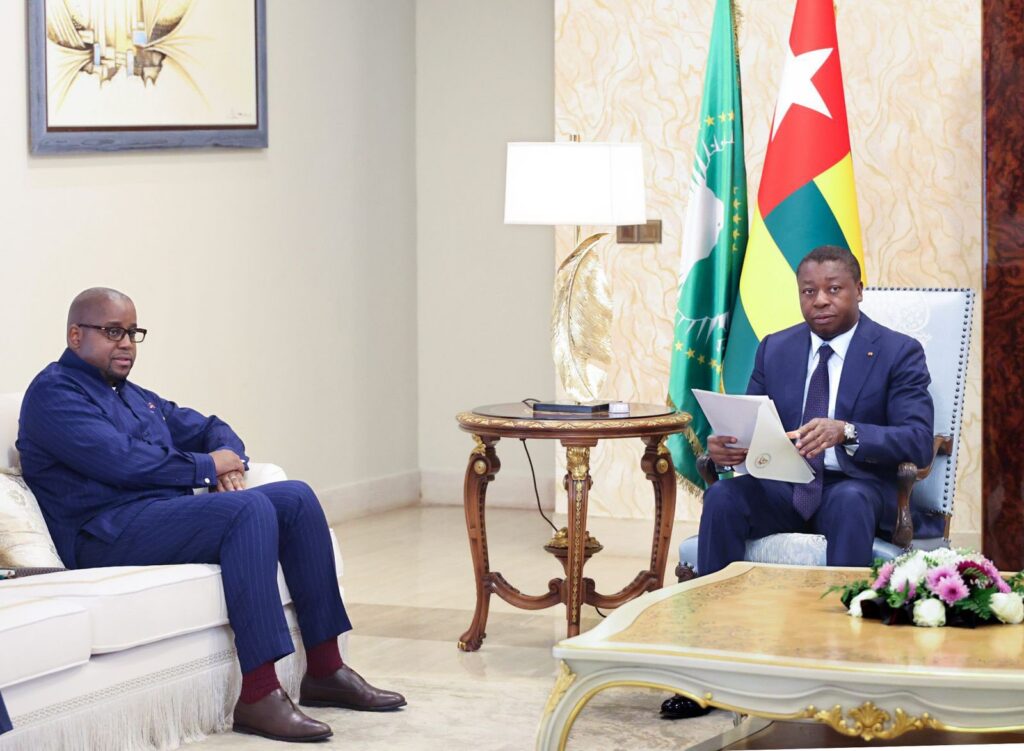
On Tuesday, September 29, 2026, Faure Gnassingbé, President of the Togolese Council, granted an audience in Lomé to Floribert Anzuluni, the Congolese Minister of Regional Integration, who is on an official visit to Togo.
The Congolese envoy, who came to deliver a written communication from his counterpart, Félix-Antoine Tshisekedi Tshilombo of the Democratic Republic of Congo (DRC), said after the meeting: “We were dispatched to the President of the Council to bring him a special message from President Félix-Antoine Tshisekedi. This letter concerns the pacification process in eastern DRC, in which His Excellency Faure Gnassingbé plays a central role as African Union mediator.”
The Congolese minister took the opportunity to present a detailed status report on recent progress in disarmament, demobilization and reintegration programs for armed groups—a crucial step taken by Kinshasa to establish a lasting climate of peace in the eastern part of the country.
This audience is fully in line with Togo’s diplomatic commitments to support pacification and the restoration of durable stability in the DRC and across the Great Lakes region.
How the Lomé meeting translates into daily realities for eastern DRC
For civilians in eastern DRC, the outcomes of this diplomatic encounter are far from abstract. The ongoing conflict has displaced millions, disrupted farming, and shuttered schools and health centers. The demobilization programs discussed by Minister Anzuluni directly affect whether families can return to their villages, whether children can resume their education, and whether local markets can function without fear of extortion or violence.
Businesses, too, feel the weight of the crisis. Trade routes through eastern DRC have been repeatedly blocked, driving up prices for basic goods and crippling cross-border commerce with Rwanda, Uganda, and Burundi. A credible peace process—anchored in the mediation led by Faure Gnassingbé—could reopen these lifelines, allowing goods, people, and investment to flow again. The letter delivered in Lomé signals that Kinshasa is actively pushing for a breakthrough, which, if successful, would gradually restore economic activity and ease the humanitarian burden on host communities.
Economic ripple effects across the Great Lakes
The economic consequences extend well beyond the DRC’s borders. The Great Lakes region has long been hampered by instability, which deters foreign investment and inflates security costs for local businesses. A durable settlement would not only benefit Congolese traders but also create a more predictable environment for regional trade agreements and infrastructure projects. Togo’s role as a mediator thus carries tangible economic implications for the entire area.
Inside the mediation: Faure Gnassingbé’s strategy for lasting stability
Appointed African Union mediator in April 2025 to address this regional crisis, Faure Gnassingbé has since stepped up diplomatic exchanges and consultations with various stakeholders. Under his leadership, the Togolese capital has hosted several summits and strategic meetings bringing together African facilitators. These concerted efforts aim to advance political dialogue, consolidate ceasefire commitments, and harmonize peace initiatives for a definitive resolution of the conflict.
What the written message from Tshisekedi contains
While the exact content of the letter remains confidential, its focus on the pacification process and the demobilization of armed groups underscores Kinshasa’s reliance on the AU mediation track. The fact that a senior minister was dispatched in person highlights the urgency and importance the DRC attaches to Togo’s facilitation. The meeting also provided a platform for Anzuluni to update Lomé on the practical steps already taken on the ground—steps that, if sustained, could translate into fewer roadblocks, safer villages, and revived local economies.
You may also like
What the Entente Council–UNOWAS pact means for daily life in West Africa
How northern Nigeria’s kidnapping economy is bleeding rural communities dry
Benin’s growing security network: what new cooperation with Algeria means for citizens and the economy
What Louis Paul Motazé’s capital markets push means for Cameroonian households and businesses
Mali war crimes report: the human and economic cost of impunity for families in Ségou, Mopti and Tombouctou