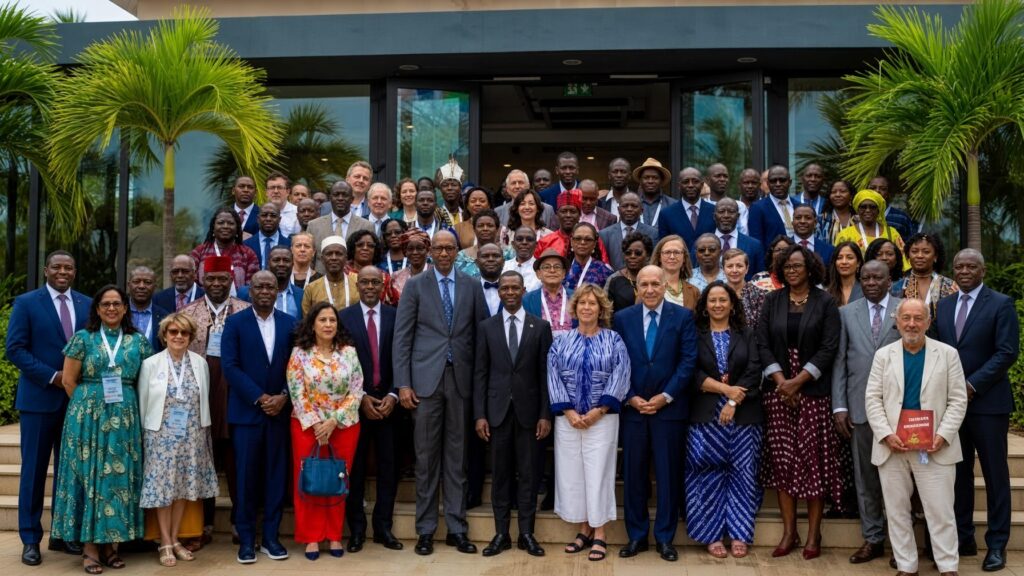
When the 16th ordinary plenary assembly of the Conference of International Non-Governmental Organisations (COING) of La Francophonie opened in Cotonou on 28 September 2026, the stakes went far beyond diplomatic ceremony. Over two days, civil society actors from across the French-speaking world gathered to shape their contribution ahead of the 20th Francophonie Summit, scheduled for 15 and 16 November in Cambodia, and to set a 2026-2028 roadmap whose consequences will be felt in households, businesses and communities far from the conference rooms.
Peace that reaches beyond the negotiating table
Under the theme “Reinvesting in peace, mobilising francophone civil society for shared prosperity, resilient territories and lasting stability”, the meeting made clear that peace is not simply the absence of war. For ordinary citizens, it means social justice, access to basic services, mediation, protection of human rights and the ability to withstand economic and security shocks. The decisions taken in Cotonou therefore carry direct implications for daily life: whether a family can send a child to school, whether a small business can operate without fear, whether a community can recover after a crisis.
Citizens demand a real seat at the decision-making table
Participants pushed for closer cooperation between states, parliamentarians and NGOs. Because they work closest to the ground, citizen organisations are asking to be more closely involved in the decision-making processes of the International Organisation of La Francophonie (OIF). Their goal is to turn local recommendations into concrete public policies. The consequence is significant: if citizens are excluded, policies risk missing the people they are meant to serve; if they are included, the impact on health, education, security and livelihoods can be measured in real improvements.
A pragmatic roadmap with measurable effects for 2026-2028
The Cotonou assembly aims to build a more operational COING. Its priorities focus on:
- Consolidating networks: structuring synergies between francophone NGOs so that resources and expertise reach communities more efficiently.
- Mobilising resources: developing strategic financial and technical partnerships that can fund local projects and create jobs.
- Tracking impact: measuring concretely the effects of actions within communities, so that promises are held to account.
For businesses, this means a more predictable environment where stability and social cohesion are treated as economic assets. For citizens, it means greater scrutiny of whether commitments translate into better services and safer neighbourhoods.
Benin’s role and the message to Cambodia
By hosting this session, Benin reaffirmed its key role in francophone dialogue. With just weeks to go before the Cambodia summit, civil society gathered in Cotonou sent a clear message: the future of La Francophonie cannot be built without the active involvement of citizens and their representatives. The consequences of ignoring that call would be felt not only in summit communiqués but in the everyday lives of millions who look to the francophone space for stability, opportunity and dignity.
You may also like
Mali war crimes report: the human and economic cost of impunity for families in Ségou, Mopti and Tombouctou
Mali’s fuel import loan: how the 8 billion CFA BOAD deal hits households, businesses and the wider economy
RAFFINOR-BF: the concrete impact of Burkina Faso’s gold refinery on citizens and the national economy
Niger’s competitive dialogue reform: how a 2022 decree left businesses and taxpayers footing the bill
What Benin’s UN security doctrine means for citizens, businesses and the regional economy