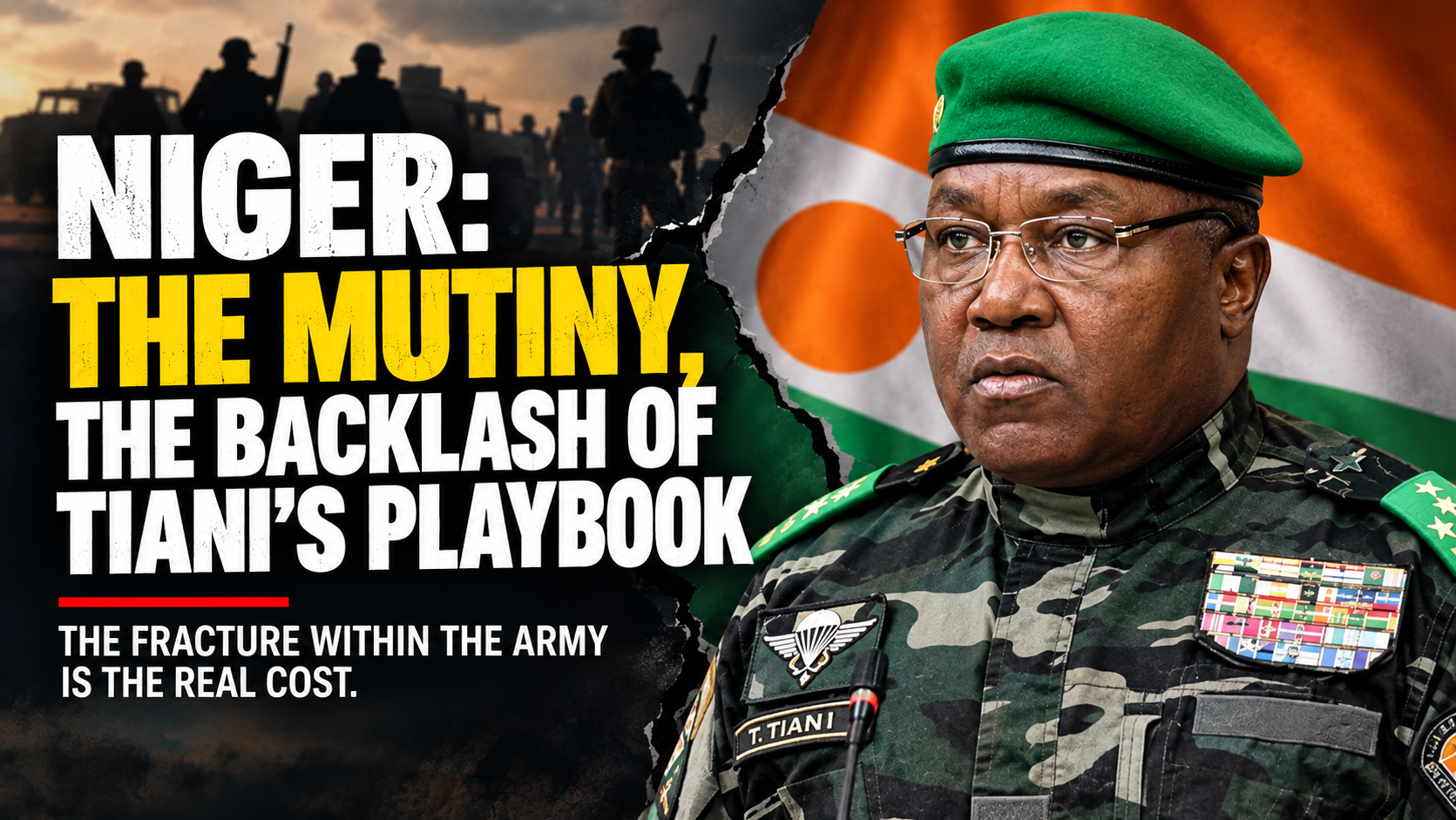
The recent mutiny in Niger raises troubling questions about the leadership of General Tiani, whose methods have transformed the military into a tool of political control rather than a force dedicated to national defence.
Since taking power, Tiani has steadily reshaped the army’s hierarchy, promoting loyalists and sidelining independent-minded officers. This emphasis on personal loyalty over experience and merit has eroded the internal balance that once ensured cohesion within the ranks. As trust in leadership wanes, frustration grows, and the seeds of discord are sown.
The events of 28 and 29 August cannot be dismissed as an isolated disciplinary breach. They are symptomatic of a deeper malaise, fuelled by years of tension, favouritism, and a growing sense of injustice among soldiers who see promotion tied to political allegiance rather than service record.
An army under strain
The stakes are high. In a country facing persistent security threats, a divided and distrustful military is less effective. When soldiers view their own comrades with suspicion, operational cohesion fractures. Every internal fissure weakens the nation’s ability to defend its territory against active armed groups.
Official silence regarding the fate of arrested soldiers only compounds the problem. This opacity breeds fear and uncertainty throughout the ranks. Without clear information on who has been detained, where, and on what charges, anxiety spreads, and the chain of command loses credibility.
Such lack of transparency also prevents any possibility of calming the situation. Instead of clarifying responsibilities and allowing an institutional resolution, the silence fuels rumours and contradictory interpretations. Families wait in anguish, soldiers remain wary, and the leadership’s authority is further undermined. What might have been handled as a purely military affair risks becoming a broader crisis of confidence.
Media spectacle versus accountability
The regime’s televised display of military equipment and vehicles is a calculated narrative. Presenting such matériel as ‘proof’ of a conspiracy may sway public opinion, but it sidesteps essential questions: What were the mutineers’ demands? What individual responsibilities can be established? What legal procedures have been initiated? Most crucially, why did such a crisis erupt within the very forces meant to protect the regime?
This theatrical communication diverts attention from the core issue. Displaying weapons does not demonstrate a plot. The authorities must present verifiable facts and allow transparent procedures. Otherwise, official statements appear as justification for arrests rather than genuine answers to the nation’s concerns.
Deeper still, this strategy reveals a fundamental contradiction. The government claims to strengthen the state and restore authority, yet it governs through mistrust within the military institution itself. An army cannot remain effective when its members fear that any dissent will be perceived as a threat to the ruling power. Discipline relies on obedience, but also on confidence in leadership, procedural fairness, and a shared sense of purpose.
The cost of purges
The repeated purges and sidelining of experienced officers carry an operational price. Each ousted commander, each destabilised unit, represents a loss of skill, experience, and cohesion. In a fight against adaptable armed groups with local intelligence networks, Niger cannot afford to undermine its own command structures to solve internal political problems.
There is a troubling paradox: while the regime’s rhetoric emphasises sovereignty, security, and territorial defence, much of its energy is spent monitoring and neutralising dissent within the security apparatus. This focus on political survival may come at the expense of national security itself.
An army that fears internal purges more than external threats will inevitably lose its mobilising capacity. Soldiers must focus on their primary mission: protecting civilians and defending the nation. If their attention shifts to internal power struggles and the fear of being labelled disloyal, the military becomes less effective precisely when it needs to be strongest.
Ultimately, the mutiny of 28 and 29 August raises questions that go far beyond the fate of the arrested soldiers. It directly challenges Tiani’s conception of power, the military, and loyalty. A national army cannot be permanently transformed into a tool for protecting a regime without generating internal tensions.
By concentrating on hunting internal opponents rather than restoring genuine military cohesion, Tiani risks weakening the very institution on which the country’s security depends. A divided military may offer short-term political advantages, but it poses a long-term strategic threat.
This is the core political responsibility of the junta leader: he has conflated the regime’s security with the state’s security. In prioritising his own political survival, he undermines military cohesion, erodes trust within the armed forces, and leaves Niger more vulnerable to the threats it faces. The current crisis appears less as an isolated event than as the inevitable outcome of a governance style built on distrust, power concentration, and the progressive politicisation of the security apparatus.