Niamey’s streets may have fallen silent once more, but the calm is deceptive — the real political storm is only beginning to gather.
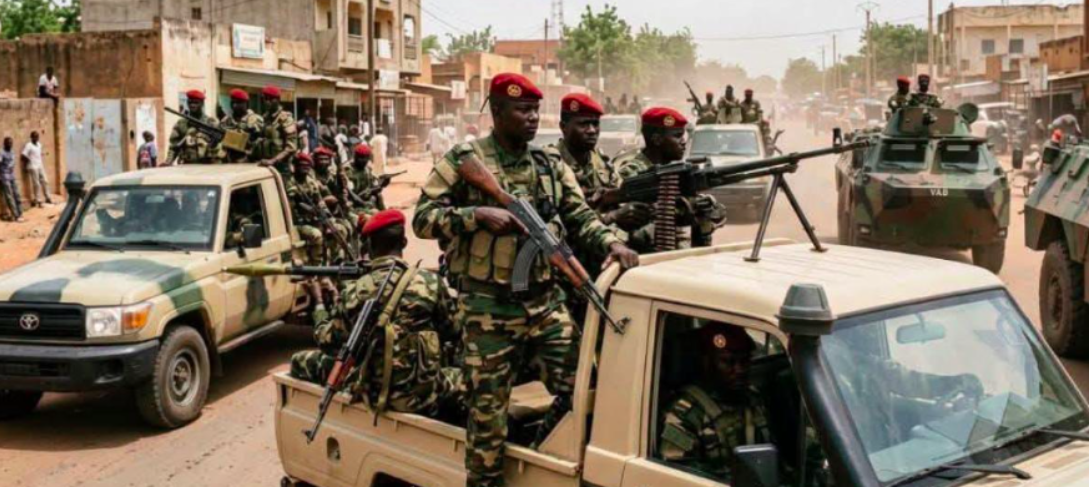
In the early hours of August 29, a group of Nigerien soldiers launched an audacious attempt to topple General Abdourahamane Tiani’s regime. Emerging from units stationed on the country’s various battlefronts, they struck at key strategic installations in the capital, including Air Base 101 and areas near the presidential palace.
For several tense hours, the government’s grip on power hung by a thread — until Tiani was compelled to summon his Russian allies to his rescue.
Operatives from Africa Corps, the successor to the Wagner Group in Africa, joined loyalist Nigerien forces in storming the base and crushing the mutiny. It was a stark confirmation: Nigerien soldiers were fighting against their own compatriots on Nigerien soil, with the direct backing of Russian troops whose primary mission was to keep Tiani in power.
This is the defining political fact of the crisis — and one the junta, which rose to power on a wave of nationalist fervour, cannot easily explain away.
The shifting meaning of sovereignty
For years, Tiani and his allies have hammered home a single message: the French military presence was a humiliation, an affront to Niger’s sovereignty. French troops left, Americans were shown the door, and Western military pacts were torn up. The regime’s propaganda duly proclaimed that Niger had reclaimed its true independence.
But an awkward question now hangs in the air: what was the point of ejecting the French if, just a few years later, the same regime must call on Russian forces to defend its very survival?
The irony cuts deeper still. The Russians were not summoned to repel jihadist fighters or defend Niger’s borders. They were deployed to put down an uprising by Niger’s own soldiers — the very men who have been bleeding in the Sahel’s brutal counterinsurgency campaigns.
That symbolism is devastating.
Nigerien troops have died by the hundreds in the fight against Islamic State and JNIM affiliates. They have endured grinding conditions, poor equipment, and heavy losses, while the regime’s promises of security have rung hollow. The mutiny appears to have been fuelled precisely by this simmering resentment within the ranks — and when those soldiers finally turned their guns on the palace, it was Russians who came to shoot back at them.
What remains of sovereignty when a government cannot guarantee its own survival without foreign protection?
Cracks in the army’s loyalty
The August 29 uprising is arguably the most serious warning shot Tiani has faced since seizing power. The problem goes beyond the mere fact that soldiers tried to overthrow him; it lies in that they were able to do so at all, given the regime’s vast security apparatus.
More troubling still, the revolt appears to have taken root within the regular army itself — the units that pay the heaviest price in the ongoing conflict. These frontline soldiers watch their comrades die, struggle with supply shortages, and see jihadist attacks continue unabated despite the junta’s promises.
Since 2023, Tiani has pledged to restore security and dignity. Three years on, the violence persists, and Niger’s forces are still taking significant casualties. It should come as no surprise that a growing number of officers and enlisted men are privately questioning whether the regime in Niamey has lost sight of those who do the actual fighting.
And the Russian intervention may well have turned that frustration into outright fury.
A Nigerien soldier can accept death in defence of his homeland. He can endure hardship and sacrifice in the name of the nation. But he will find it far harder to accept the sight of foreign soldiers firing at him to prop up a political leadership he no longer believes in.
From Bazoum’s overthrower to Moscow’s client
The historical irony is dizzying.
In July 2023, Tiani staged a coup against democratically elected President Mohamed Bazoum, claiming he would rescue Niger from a corrupt and incompetent civilian government. He promised to crush the jihadist insurgency and restore national pride.
Now, the man who once railed against French interference finds himself reliant on Russian guns to retain power — protected by the very type of foreign presence he vowed to eliminate.
His trajectory could not be more telling: he grabbed the presidency through force, and he now clings to it thanks to a security apparatus with a crucial Russian component. In essence, he has swapped one form of dependency for another.
This glaring contradiction may well become the regime’s Achilles heel.
What if Bazoum had accepted French help?
Let’s revisit July 2023. At that moment, France still had over a thousand soldiers stationed in Niger. Paris supported the elected president and, under certain conditions, was prepared to launch an operation to help free him from the coup plotters.
Bazoum’s inner circle had reportedly requested French assistance. An intervention was indeed contemplated, but ultimately, Bazoum chose dialogue over armed intervention, refusing to allow French forces to engage directly.
That decision now belongs to history, but the counterfactual is inescapable: had Bazoum accepted France’s offer, would Tiani’s coup have succeeded? One cannot rewrite the past with certainty, yet it is entirely fair to note that Tiani benefited from that hesitation. The deposed president remained under house arrest in the palace while the junta methodically consolidated its grip on the state.
And in a delicious twist of fate, the very man who built his legitimacy on opposing foreign bases now depends on foreign bayonets to save his own skin.
Algeria steps into the fray
As if the Russian presence were not enough, Algeria has now entered the picture in a significant way.
Following the attempted overthrow, Algiers dispatched military assets to Niamey, including combat aircraft and transport planes. This deployment marks a notable departure from Algeria’s long-standing policy of avoiding military entanglement beyond its borders.
Algeria ultimately did not need to engage the mutineers — they had already been repelled with Russian help — but the message was unmistakable.
Tiani is not alone anymore.
Moscow shields the regime militarily; Algiers provides strategic backing. The junta can now portray this foreign embrace as proof that Niger has gained new allies on the world stage.
Yet beneath the show of strength lurks a troubling question: how many more foreign powers will be needed to protect a government that is steadily losing the support of its own army?
The volcano beneath the barracks
The August 29 mutiny may not be an isolated incident; it could be the first tremor of a much deeper seismic shift within the armed forces.
Russian weapons helped Tiani win a single battle, but they have not:
- soothed the grievances of Nigerien soldiers;
- defeated the jihadist groups;
- brought back the dead from the front;
- or reconciled the troops with their government.
They only allowed the regime to survive one coup attempt.
And therein lies the true danger for Tiani.
A government can hold a palace with foreign help. It can retake an air base. It can arrest mutineers. But it cannot indefinitely rule against an army that increasingly perceives the president as a foreign puppet.
General Tiani would do well to look beyond the walls of his palace. The real threat to his rule may not come from Paris, Washington, or any of the Western capitals he loves to blame for his troubles. It may be growing quietly in Niger’s own barracks.
And should the soldiers who watched their brothers fall to foreign bullets decide to settle accounts with those they see as having sold the country to Moscow, the next uprising could prove far more difficult to contain.
Russians can protect Tiani. Algerians can offer support. But no foreign power can forever substitute for the loyalty of a national army.
Tiani may have won the Battle of August 29, but he may have lost something far more precious — the trust of the men and women who wear Niger’s uniform.