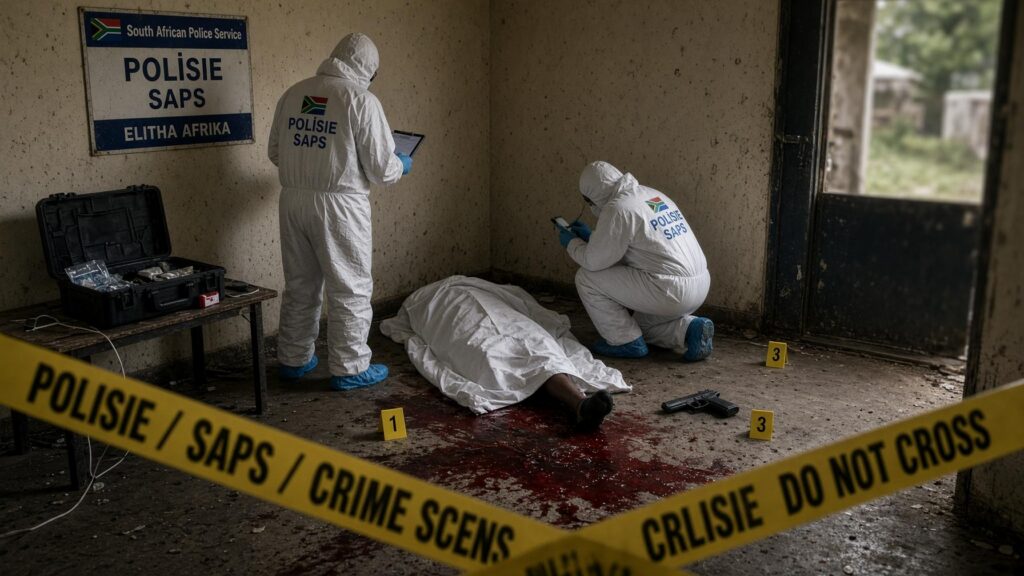
The people of South Africa are once again counting the cost of the country’s relentless gun violence after at least 27 people were killed in two separate mass shootings within hours of each other. The attacks — one in Johannesburg, the country’s economic heartbeat, and another in the Cape Town region — have left families devastated, communities fearful, and businesses facing yet another blow to confidence in a nation already battling deep economic challenges.
A deadly night that shook two cities
The shootings unfolded with terrifying speed. In Johannesburg, gunmen opened fire on a group of people gathered at an informal establishment in a working-class neighbourhood. In the Cape Town area, the violence erupted in a peri-urban zone long troubled by gang rivalries and organised crime. At least 27 lives were lost, and several others were seriously wounded.
Police have launched a major manhunt for the unidentified attackers, who fled the scenes in vehicles. Reinforcements were rushed to both locations as investigators began piecing together what happened.
How the attacks were carried out
In both incidents, armed men fired indiscriminately at groups of people before escaping. The pattern — sudden, brutal, and targeted at ordinary citizens going about their daily lives — has become painfully familiar in South Africa, where mass shootings have surged in recent years.
What this means for ordinary South Africans
For residents of Johannesburg and Cape Town, the consequences extend far beyond the immediate toll. Fear is reshaping daily routines: people are avoiding certain streets after dark, informal traders are closing earlier, and parents are increasingly anxious about their children’s safety. In communities already strained by unemployment and poverty, each new attack deepens a sense of abandonment.
Small businesses, particularly in affected neighbourhoods, report lost income as customers stay away. The tourism sector — a vital source of jobs in Cape Town — also faces renewed concern about the country’s reputation as a safe destination.
The forces driving the bloodshed
South Africa consistently records one of the highest homicide rates in the world. The violence is fuelled by a tangle of interconnected factors:
- Gang control of drug and extortion networks in townships, where turf wars turn deadly.
- Brutal rivalries between minibus taxi associations competing for lucrative routes.
- The unchecked flow of illegal firearms that make deadly violence easy to commit.
Despite repeated government pledges to boost police visibility and crack down on weapons trafficking, mass shootings have become more frequent. Public anger is mounting, with many South Africans questioning whether the state can protect them.
A growing sense of impunity
What compounds the outrage is the perception that attackers often escape justice. The fact that gunmen can carry out such attacks and flee has reinforced a feeling among citizens that the rule of law is faltering in the very places it is needed most.
An economy and a society under strain
The economic ripple effects are hard to ignore. Investor confidence, already fragile, is further tested when images of mass shootings dominate headlines. For a country grappling with high unemployment, inequality, and sluggish growth, each violent episode risks deterring the investment needed to create jobs and improve lives.
Beyond the numbers, there is a human cost that no statistic can capture: children left without parents, communities robbed of young people, and a pervasive anxiety that shapes how millions live every day.
Where does South Africa go from here?
The latest killings have reignited a national conversation about gun control, policing, and the roots of criminality. Yet for the families of the 27 victims, the debate offers little comfort. What they want — and what many South Africans now demand — is not just promises but tangible safety: streets where people can walk without fear, and a justice system that holds killers accountable.
Until then, the country remains trapped in a cycle of violence whose consequences reach into every home, every business, and every community.
You may also like
Burkina Faso: shrinking civil service payroll exacts a heavy toll on households and local economies
Simporé’s TV admission: Burkina Faso reacts as the security narrative crumbles
Gabon’s ghost payroll purge: public reaction, union pushback and what happens next
After Burkina Faso’s imam crackdown: the fallout, the anger, and the road ahead
Benin’s disability card rollout: reactions, scrutiny and what happens next