
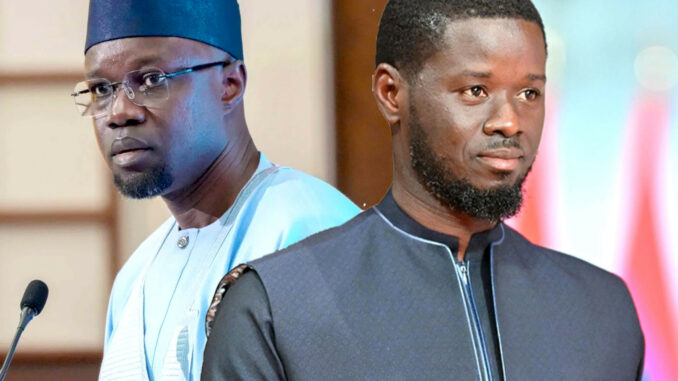
This week in Senegal marks the beginning of a pivotal political phase, where President Bassirou Diomaye Faye and Prime Minister Ousmane Sonko find themselves navigating distinct yet intersecting agendas under intense public scrutiny.
As of May 21, President Faye has embarked on a ten-day national consultation tour, engaging with political parties, civil society organizations, religious leaders, and traditional authorities. This initiative replaces the previous annual dialogue day and is positioned as a bold step toward fostering inclusivity and collective decision-making.
The move is widely seen as an effort to strengthen President Faye’s reputation as a unifying leader, particularly amid criticism from opposition voices who argue that key electoral and institutional reforms have been implemented with insufficient stakeholder input.
Meanwhile, Prime Minister Sonko is set to address lawmakers during a parliamentary session focused on urgent national issues. While scheduled as part of routine parliamentary proceedings, the timing of his address has sparked discussions about the dynamics between the two top leaders of Senegal’s executive branch.
Political analyst Maurice Soundieck Dione suggests that both leaders are now vying for political and media visibility, potentially leading to overlapping narratives. Analyst Assane Samb emphasizes that improved coordination could have prevented the perception of competing messages emanating from the highest levels of government.
Since assuming office, the relationship between President Faye and Prime Minister Sonko has repeatedly sparked debates about the true distribution of power within Senegal’s leadership structure.
You may also like
Le carnet de Malian relance l’enquête sur la migration clandestine au Sénégal
Mamadi Doumbouya de retour à Conakry après une visite d’État en Côte d’Ivoire
Elversberg vs Bayern Munich: kick-off time, tv channel and team news
Gabon : l’association Force ouvre un espace de propositions pour la rentrée
Dakar 2026 : Diomaye Faye confie la flamme olympique à la jeunesse sénégalaise