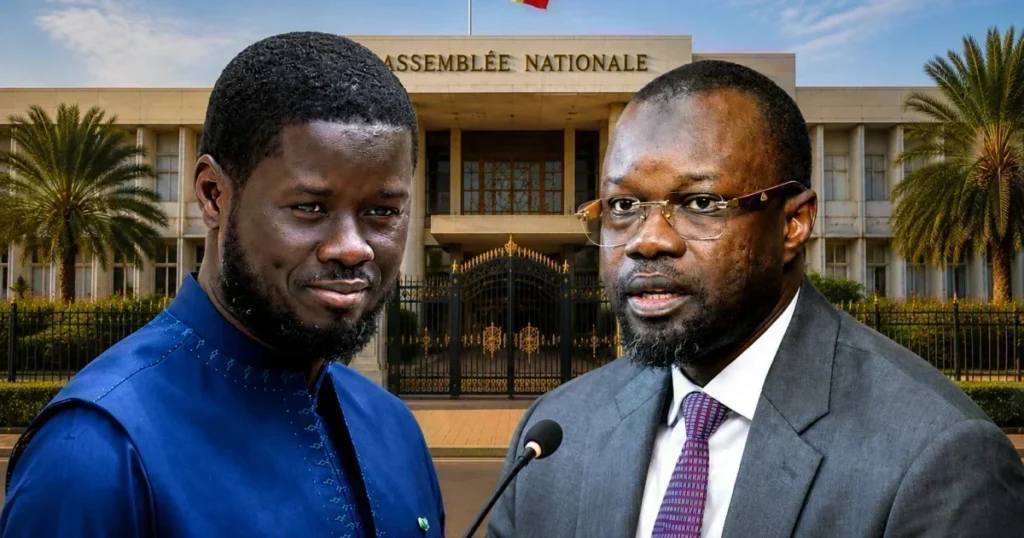
Senegal’s political tension escalates as Ousmane Sonko blocks presidential amendments
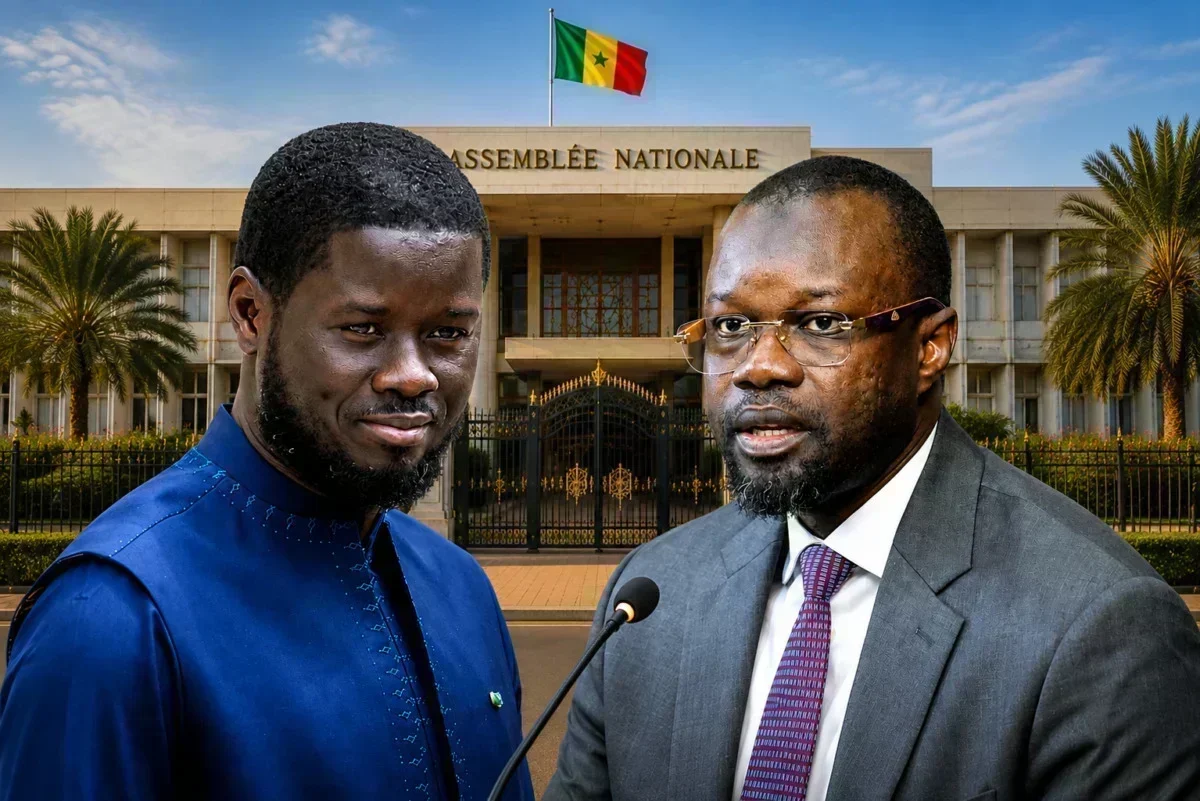
Tensions between Senegal’s executive and legislative branches have reached a boiling point as lawmaking processes become battlegrounds for procedural disputes and political power plays.
The balance of power at Senegal’s National Assembly remains precarious as another legislative showdown unfolded yesterday. Following the recent standoff over asset declarations, the executive and legislative branches clashed fiercely over amendments to a bill regulating special credits. The first sign of President Bassirou Diomaye Faye’s confrontational approach emerged when Justice Minister Moussa Sarr appeared at the technical commission instead of the expected Finance Minister Cheikh Diba. The government introduced six amendments, all of which were promptly rejected by Pastef party deputies. Will the government invoke Article 82 again next week during the plenary session?
Technical commission discussions yesterday were presided over by Finance Committee Chair Cherif Ahmed Dicko. Justice Minister Moussa Sarr opened his remarks by questioning the bill’s clarity and coherence, then proceeded to introduce six amendments. Pastef deputies requested and were granted a suspension to review the proposed changes. After prolonged deliberations, they returned to the chamber, only to reject every single amendment put forward by the government.
Government’s last-minute ministerial switch raises eyebrows
Yesterday’s technical commission was tasked with examining a bill on special credits regulation proposed by Guy Marius Sagna, Mame Diarra Bèye and Alphonse Mané Sambou. Given the financial nature of the proposal, the Finance and Budget Control Committee—led by Cherif Ahmed Dicko—was the competent body. By protocol, Finance Minister Cheikh Diba should have represented the government. Instead, President Faye issued an interim decree on August 7 to send Justice Minister Moussa Sarr to the Assembly. The move sent a clear signal to political observers.
Commission proceedings began around 3 PM under Chairman Dicko’s leadership. Justice Minister Sarr immediately raised concerns about the bill’s drafting, citing numerous ambiguities. He then proposed six amendments. Pastef deputies, upon reviewing the changes, requested a temporary adjournment to deliberate among themselves, which was granted. After extensive discussions, they returned with their decision—unanimous rejection of all six amendments.
All presidential amendments rejected in technical commission
Unlike previous sessions where the government had managed to secure approval for some amendments, Pastef deputies this time firmly rejected every proposal from Justice Minister Sarr. Only one amendment survived—the one introduced by Alphonse Mané Sambou. His proposal, through Article 8, originally stated that special credits would be subject to parliamentary oversight under conditions defined by the organic law governing the National Assembly’s internal regulations. Sambou modified it to specify that oversight would be exercised exclusively by the Finance and Budget Control Committee, with managers required to maintain detailed accounting records and supporting documentation.
The government’s six proposed amendments were all struck down. The first targeted Article 1, which originally pertained only to the President’s credits. The Justice Minister sought to expand its scope to include credits for the National Assembly President and Prime Minister, proposing: “This law defines special credits allocated to the Presidency of the Republic, the National Assembly, and the Prime Minister’s office, and outlines their scope.” This amendment was rejected outright.
The executive branch also clashed with Pastef deputies over Article 5, which in the original proposal excluded social, political, and routine institutional operating expenses from special credits. The government pushed for a broader definition that would allow credits to cover social cohesion, African solidarity values, and national stability preservation—particularly in humanitarian crises or social distress situations.
Fundamental disagreements over special credits definition
The bill proposed by opposition deputies defines special credits as funds “exclusively designated for national defense, internal and external security, and intelligence activities.” The government countered with a sweeping expansion, aiming to include social order preservation, African solidarity values, and national interests during crises or emergencies. This stark contrast in definitions became another major point of contention.
The final point of disagreement centered on oversight mechanisms. While the government proposed that special credits oversight would follow existing laws and regulations, Pastef deputies maintained that oversight should be conducted by the Finance and Budget Control Committee—either through parliamentary control (as originally proposed) or through the committee specifically (as amended by Sambou).
The technical commission ultimately adopted the Pastef deputies’ bill by majority vote. The final test will come next week in the plenary session, where the government is expected to reintroduce its rejected amendments. If history repeats itself, Justice Minister Sarr will likely invoke Article 82 with a blocked vote. However, National Assembly President Ousmane Sonko has previously stated his opposition to blocked votes except in cases of government bills—setting the stage for another potential referral to the Constitutional Council.
You may also like
Lyon’s goalless stalemate with Chelsea: the real-world fallout for fans, clubs and the women’s game
Eastern DRC peace mediation: what the latest Tshisekedi letter to Gnassingbé means for civilians and local businesses
Mali: JNIM ambush on Russian Africa Corps convoy near Niono — what it means for civilians and local trade
Mali’s poverty crisis: how hunger and hardship are reshaping daily life for millions
Guinea-Bissau’s December election: what Embaló’s return means for daily life, stability and the economy