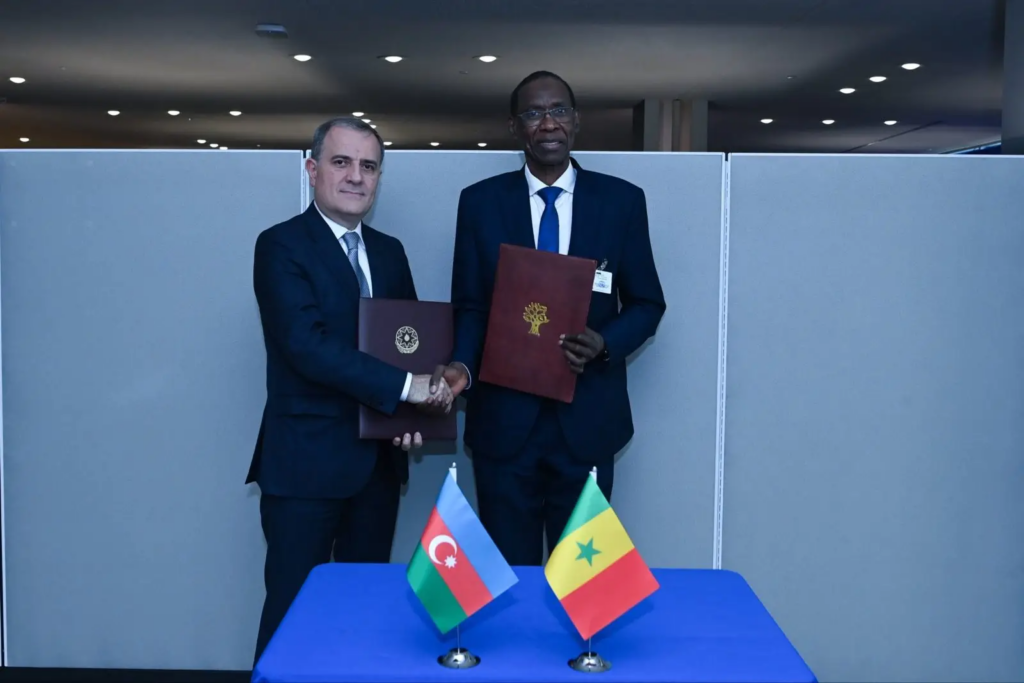
Senegal and Azerbaijan have opened a new chapter in their bilateral relationship with the signing of a memorandum of understanding that establishes regular political consultations between the two countries. The agreement was finalized in New York during the high-level week of the 81st session of the United Nations General Assembly, according to an announcement made Friday evening by the Ministry of African Integration, Foreign Affairs and Senegalese Abroad.
What the memorandum changes for day-to-day cooperation
For ordinary citizens and businesses, the creation of a structured political dialogue framework is more than a diplomatic formality. By institutionalizing exchanges between the two administrations, the agreement opens the door to discussions that could touch on economic opportunities, technical cooperation and multilateral coordination. In practical terms, a permanent channel of communication means that Senegalese and Azerbaijani officials will not have to wait for occasional high-level meetings to address issues of mutual interest—they will have a standing mechanism to review the state of their cooperation and plan its development.
The memorandum does not yet specify which sectors will be covered by the consultations. Such agreements typically serve as a foundation for later talks that can range from trade and investment to cultural and technical exchanges. For Senegal, this could translate into new avenues for exporting goods and services, attracting investment, or sharing expertise in areas where Azerbaijan has developed know-how. For citizens, the long-term effects may include job creation, improved business ties and a stronger voice in international forums.
No timeline yet, but expectations are high
The ministry did not disclose the exact schedule for implementing the mechanism or how often the political consultations will take place. Those details are expected to emerge in upcoming official communications from both governments. The absence of a fixed calendar does not diminish the significance of the signing, but it leaves room for speculation about how quickly the framework will become operational.
What is clear is that the agreement fits into a broader pattern of Senegalese diplomacy that has been actively courting partnerships with countries in Asia and Eastern Europe. By expanding its network beyond traditional allies, Dakar is positioning itself to diversify its international relations and reduce dependence on a narrow set of partners. The memorandum with Baku is another step in that direction.
Why the UN General Assembly is a launchpad for bilateral deals
The high-level week of the UN General Assembly has long been a prime venue for bilateral diplomacy. Heads of state, government leaders and foreign ministers gather in New York, creating opportunities for side meetings that might otherwise require separate trips. Signing agreements on the margins of the assembly saves time and resources while adding a symbolic weight to the commitments made.
The ministry’s announcement did not identify the signatories or the exact format of the ceremony. Additional details about how the memorandum will be put into practice are expected in the coming days. For now, the signing stands as a signal that Senegal and Azerbaijan intend to turn a one-off encounter into a lasting partnership—one that could eventually yield tangible benefits for citizens and businesses in both countries.
As the two governments move toward implementation, observers will be watching for concrete outcomes: joint projects, increased trade flows, or coordinated positions in multilateral settings. The real test of the memorandum will be whether it delivers on the promise of deeper cooperation, not just on paper but in the everyday lives of those it is meant to serve.
You may also like
What Luxembourg’s 9.8 billion FCFA port training pledge means for Benin’s workers and businesses
Burkina Faso: shrinking civil service payroll exacts a heavy toll on households and local economies
Libya-Cameroon air link plan: how Yaoundé and Tripoli are reacting, and what could follow
Silmossin fallout: Burkina Faso’s security debate moves beyond slogans
Chad’s UN warning on Ennedi-East strikes: global reactions and what happens next