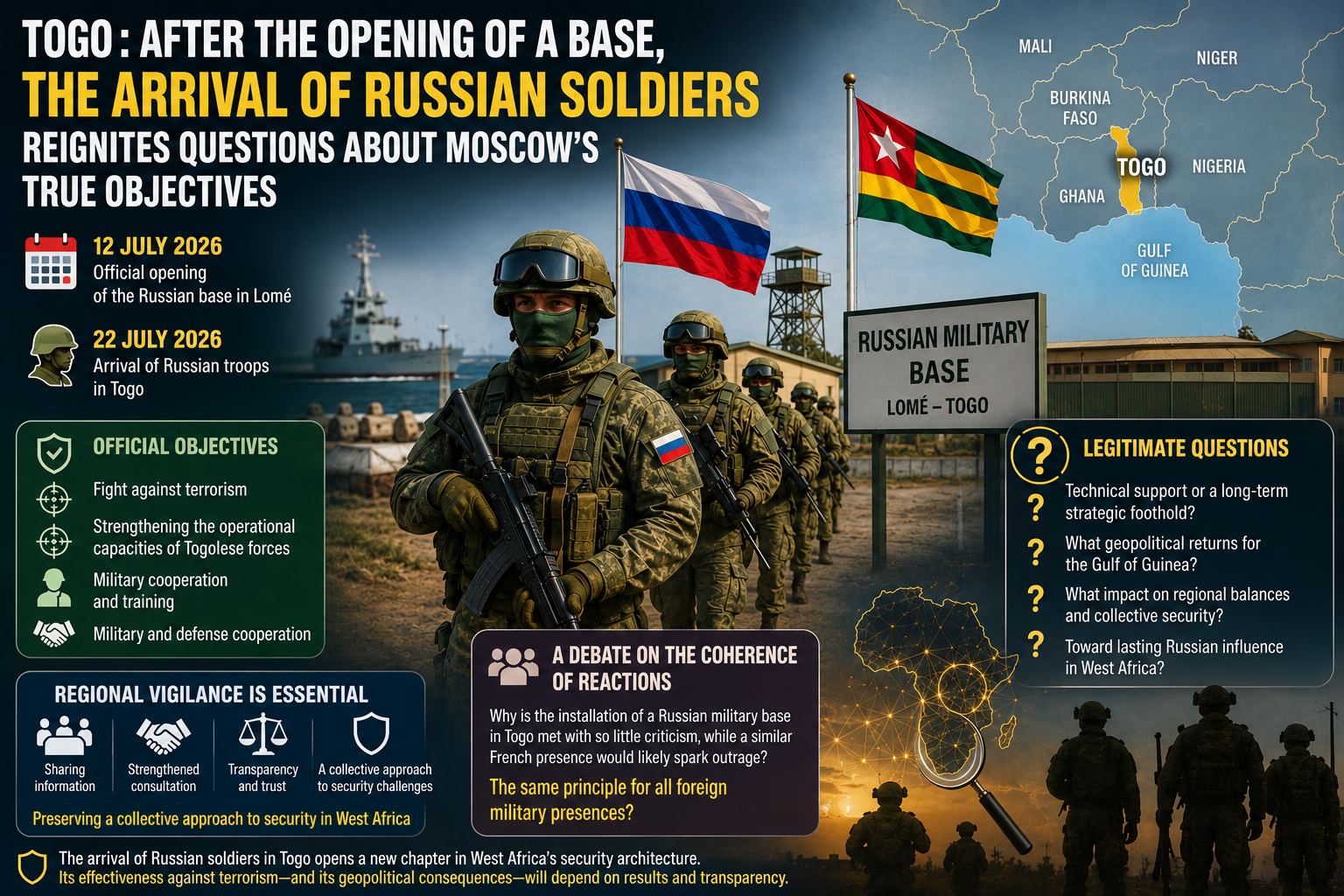
The deployment of Russian military personnel in Togo, announced on July 22, 2026—shortly after the opening of a Russian base on July 12—marks a significant shift in security cooperation between Lomé and Moscow. Officially framed as a contribution to counterterrorism efforts and the enhancement of Togo’s operational military capabilities, the move underscores the growing ties between the two nations in defense matters.
Yet this development has sparked intense debate among West African security analysts. While military cooperation remains a sovereign decision for the Togolese government, the establishment of a long-term foreign military presence in a region still grappling with persistent terrorist threats raises critical questions about regional power dynamics. Over the past several years, Russia has steadily expanded its footprint across Africa, forging defense agreements, training local forces, supplying military equipment, and in some cases, deploying its own troops. The arrival of Russian soldiers in Togo aligns with this broader trend of deepening security partnerships across the continent.
Beyond immediate security needs
Analysts are now questioning whether this military cooperation is solely aimed at addressing immediate security challenges in northern Togo or represents a strategic move by Russia to solidify its influence in the Gulf of Guinea. The implications of such a presence extend beyond direct military support—potentially reshaping intelligence-sharing networks, defense industry collaborations, and diplomatic alignment in West Africa.
Double standards in foreign military presence
The situation has also reignited discussions about the inconsistency in reactions to foreign military deployments. Observers have noted that while a comparable French military base in Togo would likely have provoked strong reactions—particularly from members of the Alliance of Sahel States (AES) and their allies—public criticism of the Russian presence has been notably subdued. This discrepancy has led some analysts to question whether assessments of foreign military presence are based on objective security concerns or influenced by geopolitical affiliations.
For these experts, the disparity in responses raises important questions about coherence. If the presence of foreign troops is viewed as a threat to national sovereignty or regional stability, such concerns should apply uniformly, regardless of the foreign partner. Conversely, if certain military presences are deemed acceptable while others are not, the criteria for these distinctions must be clearly articulated to foster a transparent public debate grounded in verifiable evidence rather than geopolitical assumptions.
Regional implications and the need for vigilance
Neighboring states are closely monitoring the situation, recognizing that while Togo retains the sovereign right to select its defense partners, the broader impact of this cooperation on regional security architecture, collective defense mechanisms, and diplomatic balances cannot be ignored. With terrorist threats transcending borders and external powers vying for influence, the need for transparency and coordinated regional responses has never been greater.
Enhanced information-sharing and structured dialogue among West African nations could help mitigate misunderstandings and foster a unified approach to shared security challenges. The deployment of Russian troops in Togo thus signals a new chapter in the region’s security landscape, one whose long-term implications—both in terms of counterterrorism effectiveness and geopolitical realignment—will only become clear through tangible outcomes and evolving diplomatic relations between Lomé, Moscow, and neighboring governments.