A day that demands answers
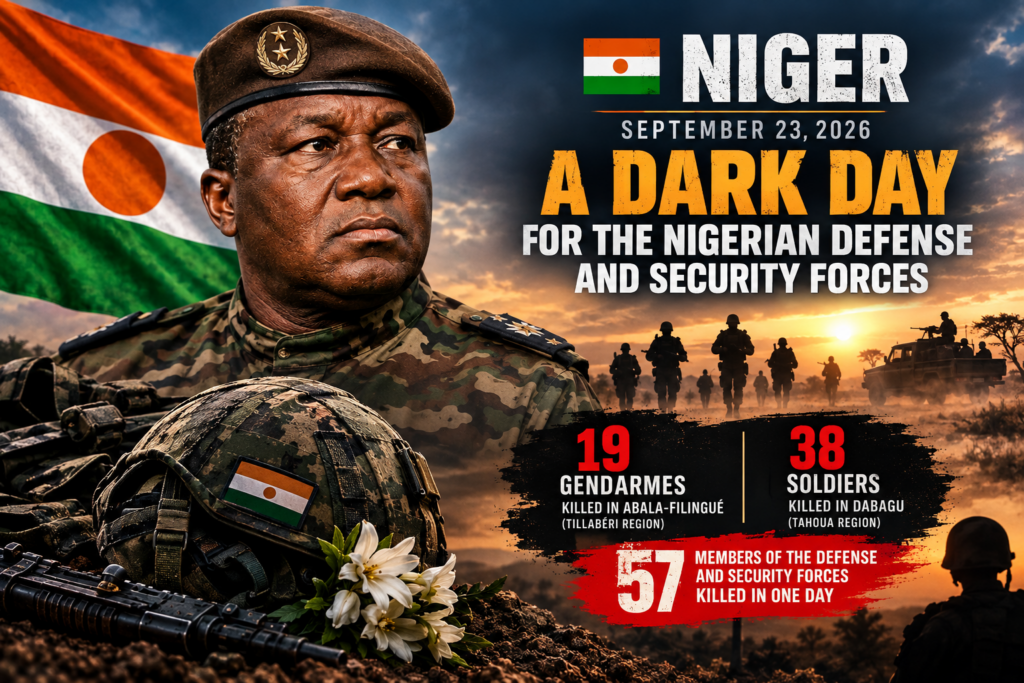
The events of September 23, 2026, have left an indelible mark on Niger’s recent security record. Within a matter of hours, the country’s defense and security forces suffered severe losses in two separate assaults, once again exposing the intense pressure that armed groups continue to exert across multiple fronts.
Heavy toll across two regions
In the Abala-Filingué area of the Tillabéri region, nineteen gendarmes were reportedly killed. On the same day, at least thirty-eight soldiers of the Nigerien Armed Forces are said to have lost their lives in an attack on a military position at Dabagu, in the Konni department of the Tahoua region. Several service members were also reported missing following the second assault. These figures have yet to be officially confirmed by Nigerien authorities.
Taken together, the two incidents bring the provisional toll to fifty-seven members of the Defense and Security Forces killed in a single day, based on available information stark figure that raises urgent questions about the ability of the security apparatus put in place under the regime of General Abdourahamane Tiani to shield its own personnel from mobile, organized, and heavily armed groups.
Official silence and a widening information gap
At Abala, the Nigerien Ministry of Defense acknowledged that FDS elements engaged in an operation to intercept a stolen cattle convoy had encountered a large column of armed men on motorcycles on the morning of September 23. The ministry conceded that several human and material losses were sustained among Nigerien ranks, without providing an official numerical toll.
It is precisely this discrepancy between official statements and information emerging from local and security sources that warrants close scrutiny. How many soldiers and gendarmes actually lost their lives? How many were wounded or remain unaccounted for? What equipment was lost? And above all, why do units deployed in such exposed areas continue to suffer losses of this magnitude despite repeated claims by the Tiani regime of strengthened military capabilities?
Beyond courage: the operational equation
The problem cannot be reduced to the bravery of individual soldiers. Niger’s defense and security forces are confronting adversaries capable of rapid movement by motorcycle, of concentrating fighters against isolated positions, and of withdrawing before reinforcements arrive. Under such conditions, intelligence, mobility, aerial surveillance, communications, and the equipment of forward units become decisive factors.
Yet the events of September 23 also raise a broader political and strategic question: are the resources announced over several years to bolster national security actually delivering the expected results on the ground? Since the CNSP assumed power in July 2023, security has been presented as one of the Tiani regime’s foremost priorities. The losses recorded on September 23 therefore directly challenge the effectiveness of that strategy.
Niger asserts that it has reinforced its military capabilities and intends to progressively regain control of its territory. However, repeated attacks against the defense and security forces demonstrate that certain areas remain extremely vulnerable. The Tillabéri region, in particular, continues to face intense activity by armed groups.
A human toll that extends far beyond the battlefield
The toll from this single day is therefore heavy: fifty-seven members of Nigerien forces killed according to provisional figures reported by multiple sources a number that could rise in addition to the wounded and those whose fate remains undetermined. At this stage, the Nigerien Ministry of Defense has not publicly confirmed the overall figure.
Beyond communiqués and statistics, it is fifty-seven families that may have been plunged into mourning.
A turning point that compels reflection
September 23 is not merely another date on Niger’s calendar of attacks. It is a signal that demands scrutiny of the effectiveness of the intelligence apparatus, the protection of forward positions, the equipping of engaged units, and the overall strategy for combating armed groups.
It also compels an examination of the political responsibility of the ruling authorities. The Tiani regime cannot simply highlight the military resources mobilized and the operations announced: it must also account for the results achieved on the ground, particularly when dozens of defense and security personnel are killed in a single day.
For when dozens of soldiers and gendarmes fall in one day, the question is no longer solely how many enemies were neutralized. It is also necessary to understand why so many defenders of the territory continue to pay the highest price, and why after more than three years of CNSP rule certain areas remain so vulnerable.
By Daniel Mbami — Politics and Security
You may also like
Debt and education after New York: the debate Côte d’Ivoire has now triggered
Sky Dragon 30 backlash: Burkina Faso’s air-defence bet faces growing scrutiny and an uncertain road ahead
Abala-Filingué: Niger’s GARSI loses 15 troops, and a nation debates what comes next
Ghana’s Salomay Awiti case: fallout, public debate and the road ahead
Cameroon’s phone import duty reform: the backlash, the debate and what happens next