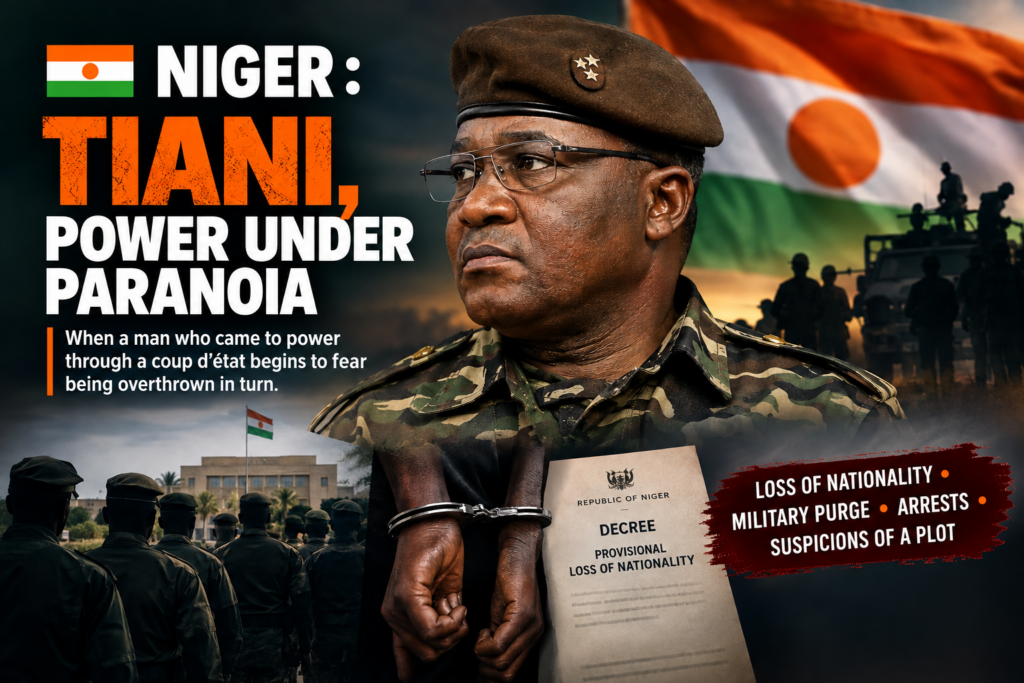
When a leader who seized power by force begins to fear being overthrown in turn, the political landscape shifts in ways that touch every citizen. In Niger, the decree signed on September 17 against five nationals, including former Prime Minister Ouhoumoudou Mahamadou, has ignited a fierce debate about the boundaries of state security and the cost of loyalty.
The move comes amid a climate of intense political and military tension. After surviving an attempted coup on August 29, General Abdourahamane Tiani appears to have made mistrust a guiding principle of governance.
There are coincidences that tell a story all on their own.
On July 26, 2023, General Tiani rose to power after toppling Mohamed Bazoum. Three years later, on August 29, 2026, the man who had taken power by arms found himself facing a reversal attempt. This time, the gunfire did not come from outside. It came from within. The presidential palace was targeted. Air Base 101 was attacked. The public television station was besieged. For several hours, the balance of power remained uncertain within the military apparatus itself. Soldiers hesitated to take sides as mutineers sought to rally other officers.
For a man who came to power through a coup, the signal is brutal: the very scenario he helped set in motion can now turn against him.
The August 29 turning point
The attempted putsch did not topple Tiani, but it profoundly altered the equation of power. The junta reportedly had to rely on several hundred Russian Africa Corps soldiers to retake Air Base 101. At least 200 military personnel have been arrested since the events of August 29, mainly from special forces units.
Then the chain of command began to shift. On September 11, the chief of staff of the armed forces, General Moussa Salaou Barmou, was dismissed. A few days later, four ministers were replaced. The regime is described as closing ranks after the coup attempt.
Officially, the rationale is reorganization, addressing dysfunctions, and securing the chain of command. But in politics, timing matters. And the timing tells a story: after being threatened, the power structure is rearranging itself around those it deems most reliable.
Then comes the decree
On September 17, another thunderbolt struck. General Tiani signed a decree provisionally stripping five people of their Nigerien nationality. Among them: Ouhoumoudou Mahamadou, former Prime Minister under Mohamed Bazoum.
The decree cites “intelligence with foreign powers,” the dissemination of data likely to disturb public order, alleged participation in an enterprise to demoralize the army and the nation, and threats to state security. It must be emphasized: these are accusations and prosecutions mentioned in the decree, not a final judicial conviction. But politically, the symbolism is heavy.
Ouhoumoudou Mahamadou is not just any opponent. He belongs to the former state apparatus. He served as Prime Minister under Mohamed Bazoum, the president Tiani overthrew. And that is precisely where the case takes on another dimension.
Bazoum is no longer in power, but his shadow lingers
Three years after the coup, former President Mohamed Bazoum remains a central figure in Niger’s political confrontation. His regime has vanished. His institutions have been dismantled. But the men who served him continue to appear in the security and judicial files of the new power.
With this new decree, five Nigeriens are now provisionally deprived of their nationality under a mechanism established in 2024. According to the Nigerien Press Agency, the total number has now reached 25.
A question then arises: at what point does the defense of the state cease to be merely a security operation and become a political cleanup operation? The question deserves to be asked without presuming the guilt or innocence of those targeted.
A power that sees enemies everywhere?
This is where the case becomes more troubling. Since August 29, the Nigerien authorities have had to manage a threat that no longer comes only from armed groups or external adversaries. The threat can now, according to reported events, come from within the military apparatus itself.
And when the loyalty of soldiers becomes a central question, the temptation can be strong to seek out those responsible, relays, accomplices, or sponsors. The risk is then that suspicion becomes a method of government.
A military officer replaced. A minister sidelined. Soldiers arrested. Former officials of the Bazoum regime targeted. And now, citizens provisionally stripped of their nationality. Taken separately, each act has its official justification. Put together, they paint a picture of a power that, after being directly threatened, seeks to regain control of all circles that might represent a vulnerability.
Tiani, the president who trusts no one?
This may be the most embarrassing question for the regime. How can one govern sustainably when a power born of a coup discovers that another coup can be applied to it? General Tiani now knows this mechanism from the inside. He knows that a military power can seem firmly installed until the day a few officers decide to cross a line.
August 29 demonstrated it. What was supposed to be impossible became possible. What was supposed to be unthinkable happened around the presidential palace. And when a power discovers it can be overthrown by the same methods that brought it to the top, fear of the next plot can quickly become a political obsession.
“Niger is me”?
This is precisely where critics of the regime see a worrying drift. By deciding who is loyal, who is suspect, who should be arrested, who should be sidelined, and now who can provisionally keep their nationality, Tiani gives his detractors the impression of a leader who behaves as if he alone holds the keys to the Republic.
As if Niger must be divided between those who support the power and those who must be excluded from it. As if serving under Bazoum now constitutes a permanent political fault. As if any dissenting voice must necessarily hide a plot.
General Tiani is obviously not Niger. But the concentration of decisions around his person fuels a fundamental question: how far can a regime go when, to protect itself, it ends up seeing threats behind every face?
The paradox of a power born from a putsch
Herein lies the irony of this story. Tiani rose to the top after a coup. Today, he leads a regime that has itself just escaped a coup attempt. And between these two dates, Niger seems to have tipped into a cycle where each crisis produces new purges, each suspicion calls for a new sanction, and each attempt at contestation reinforces the concentration of power.
The September 17 decree is therefore not just a matter of nationality. It is a new episode in a broader battle: that of a power seeking to eliminate zones of uncertainty around itself.
One question remains, perhaps the most important: by fighting real or supposed plots, is Tiani building a system where any contestation automatically becomes a plot? If so, the problem would no longer be just knowing who wants to overthrow Tiani. It would also be worth asking why a power that claims to be firmly installed now seems so afraid of those around it. And above all, how far will this logic go? For when a regime starts considering its own citizens as potential threats, the line between protecting the state and protecting the power becomes dangerously thin.
You may also like
Benin–Spain cultural alliance: what the reaction tells us about what comes next
Niger’s 1.8 billion FCFA security fund: the fallout nobody is talking about
Mali’s press reform: the real test begins after the applause
Niger and Libya’s Fezzan puzzle: fallout from Tiani’s Haftar gambit
Benin–Cuba economic reset: the debate, the doubts and what happens next