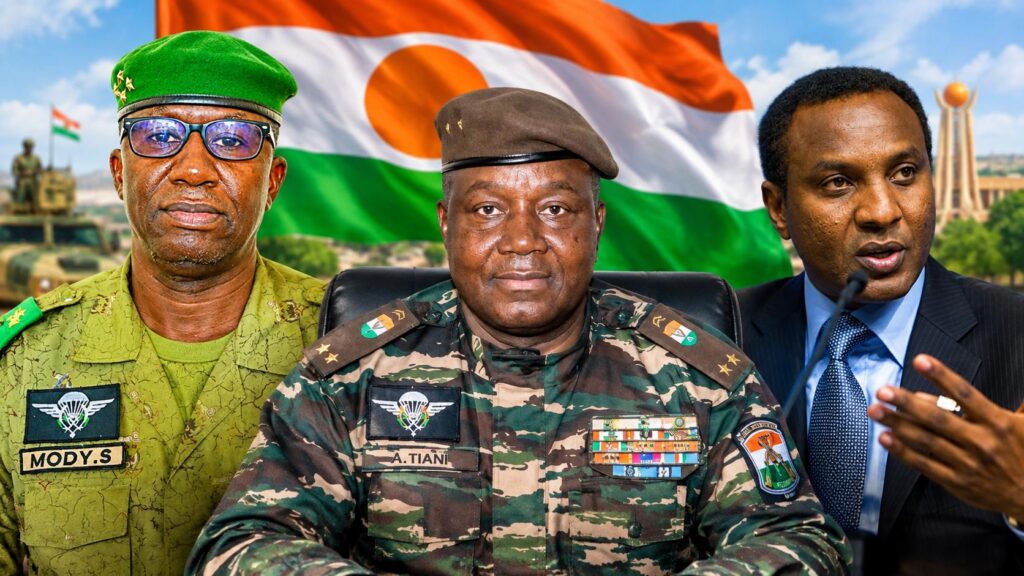
The fight over Niger’s Commandement des Forces de Protection et de Développement (CFPD) has moved well beyond a quiet institutional dispute. It has spilled into public debate, reshaped alliances at the top of the state, and left a trail of political fallout that is still unfolding. At the centre of it all: a military structure, three powerful figures — General Salifou Mody, CNSP head Abdourahamane Tiani, and former Finance Minister and Prime Minister Lamine Zeine — and a monthly envelope of 1.8 billion FCFA.
What the CFPD was meant to do — and what it became
Officially, the CFPD exists to protect Niger’s strategic infrastructure. In practice, it has become a battleground over three things: who commands the men, who decides the missions, and who controls the money.
On 9 May 2024, General Abdourahamane Tiani signed decree No. 2024-309/P/CNSP/MDN, creating the Commandement des Forces de Protection et de Développement. The stated goal was to secure mining and oil installations, corridors and pipelines. The Ministry of Defence confirmed the new structure, and the recruitment of 10,000 young people in 2024 added muscle to Niger’s armed forces. On paper, it was a security project. In reality, it became something far more political.
The numbers behind the showdown
Article 28 of the decree sets a Prime Unique d’Astreinte (PUA) of at least 12,000 FCFA per man per day, with a financial contribution required from the companies benefiting from the security cover. For a force of 5,000 men, the arithmetic is stark:
- Per day: 5,000 men × 12,000 FCFA = 60 million FCFA
- Per month (30 days): 1.8 billion FCFA
- Per year: 21.9 billion FCFA
These figures are not theoretical. They are backed by contracts with companies, actual payments and deployed troops. That is exactly why the CFPD sits at the heart of the power struggle inside the regime.
Defence versus Finance: the standoff that changed everything
General Salifou Mody pushed hard for the CFPD to be implemented. General Tiani signed the decree under direct pressure from his Defence Minister. But after the signature, the CNSP head ordered Finance Minister Lamine Zeine to freeze the CFPD’s financial provisions. The structure was created — but stripped of the means to operate. Mody found himself facing a direct political blockade of his own project.
Lamine Zeine became the central point of friction. His ministry deliberately blocked the budgetary translation of the military mechanism. By January 2026, Zeine was both Prime Minister and Minister of Economy and Finance, while Mody served as Minister of State for Defence. Mody secured the removal of the Finance portfolio from Zeine, then forced his exit from the Prime Ministership. The CFPD conflict had destroyed trust between the pillars of power.
Mody takes the reins — and sets his own terms
The reshuffle at the top ran through Zeine’s departure. General Mody took charge of the government and imposed one condition: he would hold both the Prime Minister’s post and the Defence Ministry. In doing so, he concentrated political, military and administrative levers in his own hands.
Damolleydi: the second front
With the CFPD blocked, the regime launched the general mobilisation drive known as “Damolleydi” to rally volunteers and existing structures. General Mody was put in charge of the committee running it, sidelining General Mohamed Toumba, the Interior Minister. Yet Mody deliberately slowed Damolleydi’s rollout. The initiative lost visibility, overtaken by autonomous local structures.
Three levers of control
The whole affair locks the state apparatus around three axes:
- Command: control over personnel assigned to strategic sites.
- Missions: deciding which infrastructure gets protected and what the priorities are.
- Money: control over contributing companies and the financial flows they generate.
Article 28 of the decree governs this financial mechanism — 1.8 billion FCFA every month.
What comes next
That 1.8 billion figure is the direct financial stake of the system. It confirms the CFPD’s political dimension, sitting at the crossroads of strategic resources, corporate contributors and the chain of command. Beyond the rivalry between Tiani, Mody and Zeine, whoever wins this confrontation holds exclusive control over Niger’s men, missions and resources. Behind the personal quarrels, what is really being locked down is total mastery of the state apparatus.
The public debate now turns on a simple question: can a security fund designed to protect Niger’s most valuable assets survive being treated as a prize of internal power politics? The answer will shape not just who runs the government, but how — and whether the CFPD can ever fulfil the mission it was created for.
You may also like
Benin–Spain cultural alliance: what the reaction tells us about what comes next
Niger: Tiani’s widening purge sparks debate over citizenship and loyalty
Mali’s press reform: the real test begins after the applause
Niger and Libya’s Fezzan puzzle: fallout from Tiani’s Haftar gambit
Niger’s defense dilemma: can anyone still trace the men, contracts and money behind the CFPD and Domol Leydi?