coastal town in agadir region becomes frontline in counter-terrorism battle
The first light of dawn had not yet graced the horizon over Aourir, a quiet coastal village north of Agadir, when heavily armored vehicles rolled through its empty streets on a still-sleepy Monday morning. The mission was precise: dismantle an active terror cell linked to the so-called Islamic State (ISIL) before it could strike. Intelligence from the Directorate-General for Territorial Surveillance (DGST) had pinpointed a radicalized individual in the area, and the elite Rapid Response Force moved in with surgical efficiency. Within moments, the suspect was subdued and the immediate threat neutralized.
As residents of Aourir awoke to an unfamiliar sight—an intense security lockdown around their homes—the reality of what had been prevented began to sink in. The DGST’s judicial arm, the Central Bureau of Judicial Investigations (BCIJ), conducted a thorough search of the suspect’s residence. What they uncovered was far more alarming than ideological extremism: combat gear, bladed weapons, and tactical materials ready for deployment. The operation had come just in time.
a hidden bomb factory exposed in industrial outskirts
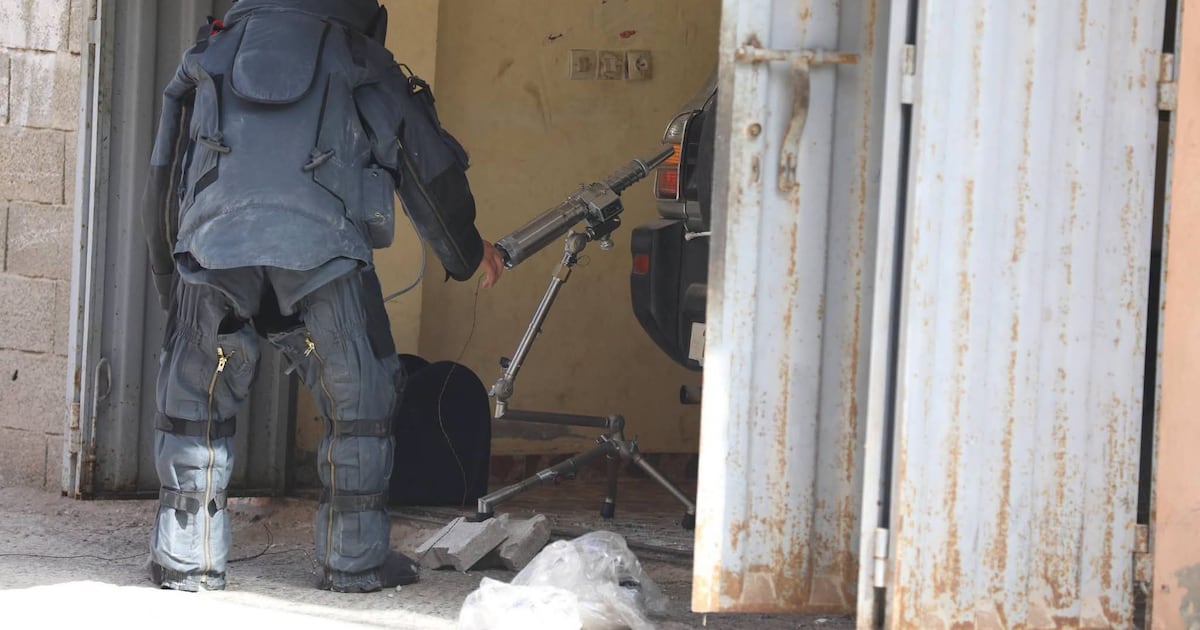
Just south of Agadir, in the industrial zone of Inezgane, a second raid revealed the true scale of the threat. Behind the closed doors of a warehouse in the Traast El Jorf district lay a clandestine bomb-making facility. At its center stood a modified 4×4 vehicle, its fuel system secretly altered to run on butane gas—a deliberate choice to maximize explosive force and thermal impact in a potential suicide attack or vehicle-borne assault on critical national infrastructure.
The BCIJ immediately triggered emergency protocols: evacuation of nearby residents, deployment of bomb disposal units from the National Security Directorate (DGSN), and the use of advanced robots and sensors to inspect the vehicle’s interior without endangering personnel. Once the area was secured, investigators uncovered a chilling inventory: pressurized gas canisters, pressure cookers rigged with thousands of shrapnel nails, electrical wiring, detonators, welding equipment, and substantial quantities of solid and liquid chemical compounds.
a synchronized strike across seven cities
While the operational hub of the cell was located in the Souss region, its network extended deep into Moroccan territory. To prevent any premature alert from the raid in Aourir, the DGST’s Special Forces executed simultaneous strikes in seven cities: Agadir, Taroudant, Casablanca, El Hajeb, Tétouan, Fquih Ben Salah, and Safi. Ten extremists were arrested, including a 17-year-old—a stark reminder of the cynical radicalization of youth—and a former convict previously sentenced under anti-terrorism laws, raising concerns about recidivism among released detainees.
Searches across multiple residences, supported by explosive detection K9 units, uncovered a trove of incriminating evidence: military uniforms, handwritten manuals detailing bomb assembly techniques, and digital files containing two critical videos. One showed the suspects pledging allegiance to the ISIL ‘caliph,’ while another contained explicit threats of large-scale sabotage targeting vital national sites.
Sahel connection: foreign directives fuel domestic terror
Preliminary investigations have traced the cell’s orders and logistical support directly to ISIL operatives in the Sahel region. The directive was unequivocal: avoid joining insurgent groups in sub-Saharan Africa. Instead, the cell was instructed to remain in Morocco and carry out attacks from within, using local operatives to target critical infrastructure and sow chaos nationwide.
The cell’s leader had structured the group like a military unit, with tight compartmentalization to minimize leaks. A reconnaissance team identified and monitored potential targets, a logistical unit discreetly procured chemical components, welding tools, and vehicles, while a technical team in Inezgane modified the 4×4 and assembled explosives. It was a meticulously planned operation—one that was dismantled just days before execution.
Nine adult suspects have been remanded in custody, while the minor has been placed under specialized judicial supervision under the anti-terrorism prosecutor’s office. Meanwhile, BCIJ forensic and intelligence teams are working to decrypt seized phones and hard drives, mapping encrypted communication lines with the Sahel to ensure no dormant threats remain undetected.
The calm has returned to Aourir and Inezgane, but the fight against terrorism continues. This operation underscores the evolving nature of the threat in North Africa and the critical role of Morocco’s intelligence and security agencies in preempting attacks before they materialize.