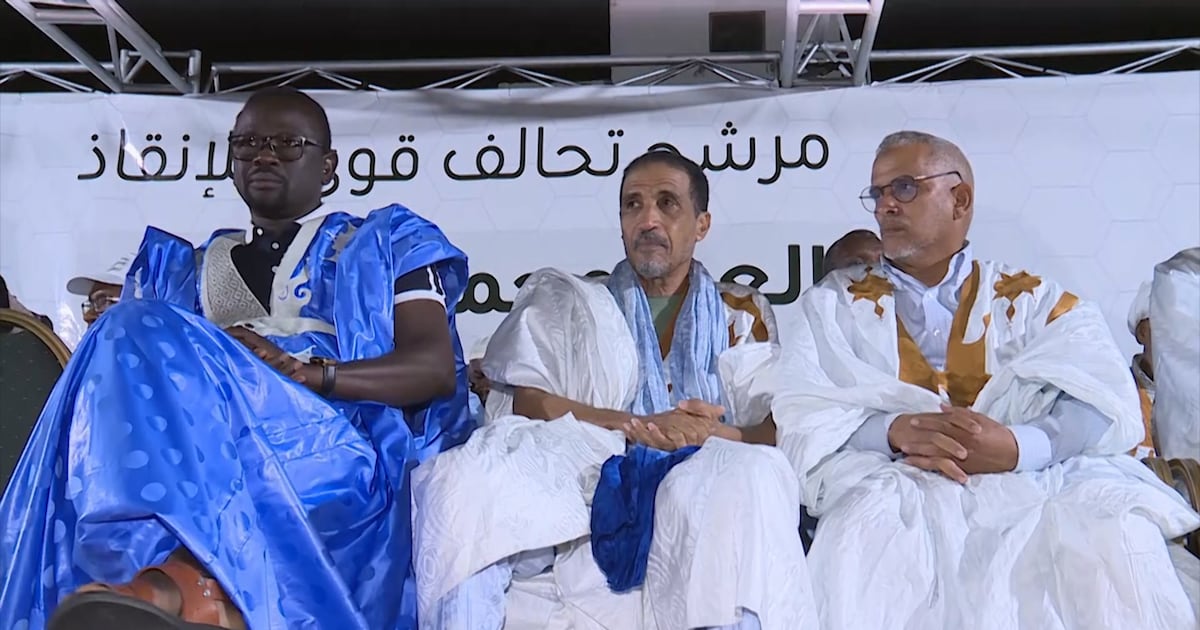
Nouakchott — Professor Mohamed Maouloud has taken the helm of Mauritania’s largest opposition coalition amid a complex national landscape. His challenge begins with a historic mobilization: thousands gathered in the capital for a massive rally that underscored the public’s demand for change and accountability.
Mauritania’s critical crossroads: a nation waiting for solutions
Mauritania stands at a pivotal moment, grappling with interlocking crises that threaten stability and unity. The stalled national dialogue—a process meant to unite political actors around shared solutions—has reached a breaking point. Meanwhile, identity-based rhetoric is gaining dangerous traction, inflaming social tensions and deepening divisions. In the eastern regions bordering Mali, insecurity has escalated, forcing thousands of refugees across the border and forcing Mauritanian herders to abandon centuries-old transhumance routes. At the same time, soaring living costs are pushing families to the brink, with basic goods becoming increasingly unaffordable.
The newly elected leader of the Opposition Coalition for Democratic Change (PCOD) has sounded the alarm. In a candid assessment, he warns that Mauritania is facing not one, but multiple emergencies: “Our nation is in urgent need of healing. The dialogue process must resume—it is the only path to consensus. But it has been deliberately obstructed by the ruling majority, who seek to impose an agenda that excludes the concerns of all Mauritanians.”
First priority: breaking the political deadlock
Breaking the impasse in national dialogue tops Maouloud’s agenda. He has issued a direct call to President Mohamed Cheikh El Ghazouani, urging him to intervene and prevent attempts to introduce constitutional changes—specifically, a potential third presidential term—that were never part of the agreed roadmap. The president’s silence on these attempts has fueled public distrust and raised suspicions about hidden political agendas.
“The dialogue is not a favor—it is a constitutional obligation,” Maouloud emphasized. “Without it, no progress can be made on security, economic recovery, or national cohesion. We need a space where all voices are heard—not one where a single faction dictates the future.”
Security and survival: the human cost of instability
The eastern border regions are under severe strain. The spillover from violence in northern Mali has displaced communities, while the closure of the frontier has trapped Mauritanian herders between desperate need and blocked opportunity. Livestock owners, who once relied on seasonal migration to sustain their livelihoods, now face ruin as grazing routes vanish and markets shrink. Families in Nouakchott and beyond cope with rising food prices, a consequence of global inflation and local policy failures.
Maouloud warns that identity-based rhetoric, amplified on social media, is further polarizing a society already fractured by economic hardship. “We cannot allow fear to dictate our future,” he stated. “Mauritania is home to diverse cultures and histories. Our strength lies in unity—not in division.”
The road ahead: leadership at a defining moment
For Maouloud, the stakes could not be higher. As the leader of an opposition coalition that has emerged as a unifying force in civil society, he carries the hopes of thousands who marched in Nouakchott. His ability to restore dialogue, protect livelihoods, and defend national cohesion will define his legacy—and the future of Mauritania.