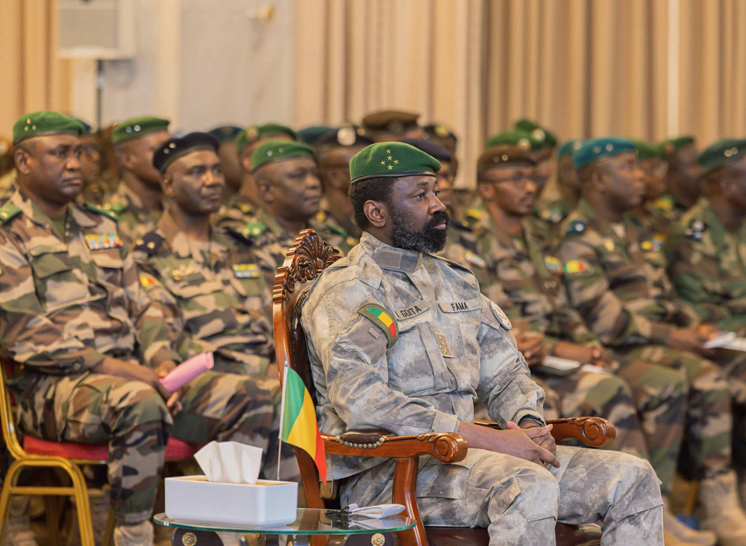
Twenty-two years after the initial National Defense law, Mali is rolling out an expanded security architecture that now encompasses internal security, cybersecurity, and comprehensive crisis management. The new framework, approved by the National Transitional Council, redefines strategic decision-making, operational command, and the roles of regional stakeholders.
The 125 voting members of the Council adopted the legislation in July 2026, setting the stage for its eventual replacement of the 2004 law (Law No. 04-051 of November 23). Speaking to council members, General Daoud Aly Mohammedine, Minister of Security and Civil Protection, emphasized that two decades of implementation and shifting security dynamics made this overhaul essential. He also highlighted the collaborative approach taken during preparatory discussions, ensuring diverse security actors contributed to shaping the reform.
Streamlining responsibilities for modern threats
The 2004 framework, while originally military-focused, already addressed internal security, civil defense, and the involvement of local authorities, civil society, and communities. Under the revised structure, military leadership in operations remains central, particularly during territorial defense scenarios where the Chief of Staff of the Armed Forces assumes authority over select security forces.
The reform doesn’t introduce new responsibilities but instead consolidates and clarifies them to align with today’s threats. Internal security and cyberdefense are now explicitly embedded within national security priorities. The National Security Council and the National Defense Committee replace their predecessors to enhance coordination under the President’s leadership. Operational command is unified under the Chief of Staff of the Armed Forces for territorial defense, enabling swifter responses to attacks, major crises, or cross-border threats—though it does not place police, gendarmerie, national guard, or civil protection under permanent military control.
A key evolution since 2022 is the militarization of the National Police and Civil Protection. This change facilitates their integration into broader security operations while preserving their core public safety and rescue missions.
General Mohammedine outlined three critical priorities during his address: strengthening territorial administration, engaging traditional leaders in counterterrorism efforts, and continuing force recruitment and equipment upgrades. These goals align with the expanded mandate of the Ministry of Territorial Administration and Decentralization, now tasked with civil defense coordination, oversight of decentralized services, local government involvement, and community mobilization. The strategy aims to ensure early warnings flow from municipalities without turning civilians into auxiliary security personnel.
Cybersecurity takes center stage in Mali’s defense strategy
Cybersecurity has become a cornerstone of the new framework. In June, the government enacted laws establishing the National Agency for Information Systems Security (ANSSI), as outlined in the 2026–2030 National Cybersecurity Strategy. The ANSSI is charged with coordinating responses to cyberattacks and safeguarding critical infrastructure and services. While cyberdefense falls under the state’s strategic protection umbrella, cyberspace security extends to public administrations, networks, and electronic communications.
The reform’s success hinges not on terminology but on execution. Key factors will include implementation texts, intelligence sharing, local government resources, cyber expertise, integration monitoring, and clearly defined responsibilities. The chain of command now prioritizes rapid decision-making, seamless field coordination, and institutional trust among security forces, government bodies, and the public.
Community reintegration strengthens security collaboration
On August 4, 254 former combatants from various armed groups completed training at Soufouroulaye and officially joined the Armed Forces as part of the Disarmament, Demobilization, and Reintegration Initiative (DDR-I). The program aims to integrate 2,000 ex-combatants while supporting the socioeconomic reintegration of another 1,000. Though not legally tied to the new law, this initiative has fostered inter-agency collaboration among defense, security, reconciliation, and local authorities.