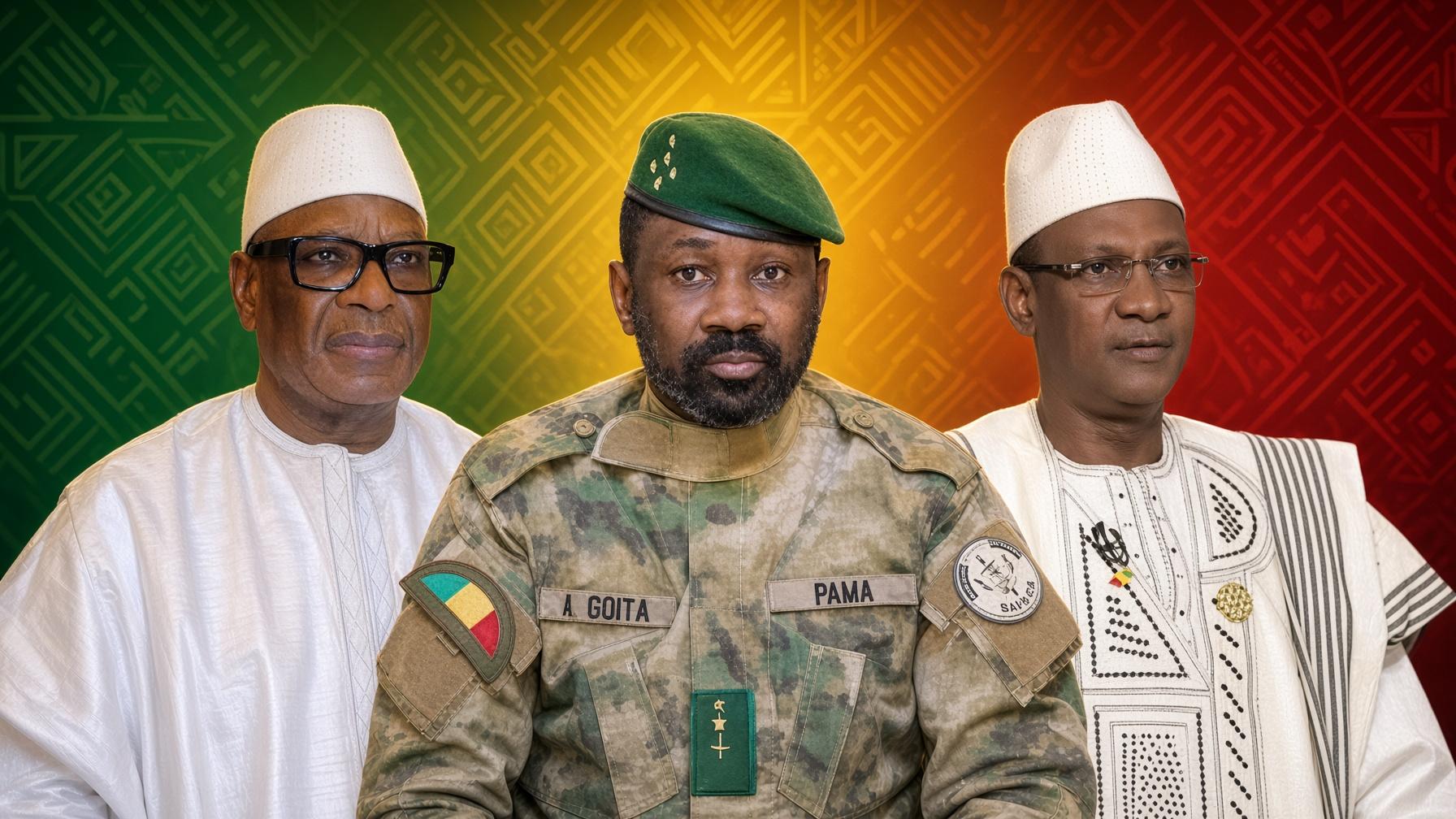
For generations, Mali’s political stage was dominated by figures from ADEMA, RPM, and URD—parties that shaped the nation’s trajectory through television studios and parliamentary corridors. Yet under the iron grip of General Assimi Goïta’s military regime, their once-unassailable influence has crumbled, not in a single stroke, but through a calculated, years-long dismantling of democratic institutions.
The old political order is confronted with a stark reality: retreat into irrelevance, flee into forced exile, or face incarceration on vague, politically motivated charges. This isn’t a coincidence—it’s a deliberate purge, meticulously executed. The junta hasn’t merely removed rivals; it has dismantled the very foundation of Mali’s post-1991 democratic experiment.
Three ways Mali’s political dinosaurs are being erased
The military regime has implemented a systematic strategy to neutralize former powerbrokers. The approach follows a clear, oppressive blueprint that leaves no room for comebacks or second chances:
The weapon of the court: when justice becomes a political tool
Prisons have replaced legislative chambers for many of Mali’s disgraced elites. High-profile detentions—often justified by nebulous claims of « national security threats » or « financial impropriety »—serve two strategic purposes. First, they neutralize active opposition. Second, they serve as a stark warning to any who might challenge the new order. The plight of former Prime Minister Choguel Maïga underscores this reality: even those who once aligned with the junta’s ideology now languish in pretrial detention, proving that loyalty offers no safety net.
The exodus of influence: when silence speaks louder than power
For those spared imprisonment, exile has become the only path to survival. Scores of ministers, party leaders, and civil society figures have relocated to cities such as Dakar, Abidjan, or Paris. Though some attempt to maintain resistance networks from abroad, their influence within Mali has evaporated. State-controlled media and hyper-patriotic rhetoric have drowned out dissent, transforming exiles into spectral figures across their homeland. Without access to national broadcasting platforms or political forums, their once-formidable influence has dissolved across borders.
The silence of the few who stayed: survival in a climate of fear
For the handful of politicians who remain in Bamako, survival hinges on absolute silence. Political parties have been banned. Civil society organizations face dismantling proceedings. Even the mildest criticism is branded « treason » or « collaboration with hostile entities. » The message is unmistakable: resist, and you vanish. The result? A paralyzed political class, reduced to spectators in a theater where they once held center stage.
From public frustration to institutional paralysis
The junta’s campaign wasn’t born from sheer military force alone. It thrived on widespread public disillusionment with the old political class. After three decades of multiparty democracy plagued by corruption, favoritism, and an inability to curb jihadist violence, Malians were primed for radical change. By framing the political elite as the root cause of the nation’s decline, Colonel Goïta’s regime positioned itself as the sole savior—justifying the suspension of elections, the dissolution of parties, and the creation of transitional structures tailored to its own interests.
What started as a populist narrative has solidified into an enduring institutional lockdown. No elections are on the horizon. No return to constitutional governance is envisioned. The transition, designed in the junta’s image, has become a one-way road—erasing the old political guard rather than reforming it.
The dangerous emptiness of a nation without political dialogue
The eradication of Mali’s political elite has left a perilous void. Gone are the forums for debate, negotiation, and compromise. Gone are the mechanisms for peaceful power transitions. In their stead stands a government trapped in its own self-referential bubble—a regime that values short-term control over long-term stability.
While the junta may enjoy temporary calm, it has sacrificed the essential ingredients for lasting governance: pluralism, credible opposition, and institutional checks and balances. By eliminating the old elite—through imprisonment, exile, or self-censorship—Bamako may have stifled visible dissent. Yet in doing so, it has also buried the seeds of democratic renewal. Without structured opposition or a functional political class, Mali’s future risks being written in isolation, by decree, and for the benefit of a single leader’s vision.