unrest shakes Gabon’s masonic leadership
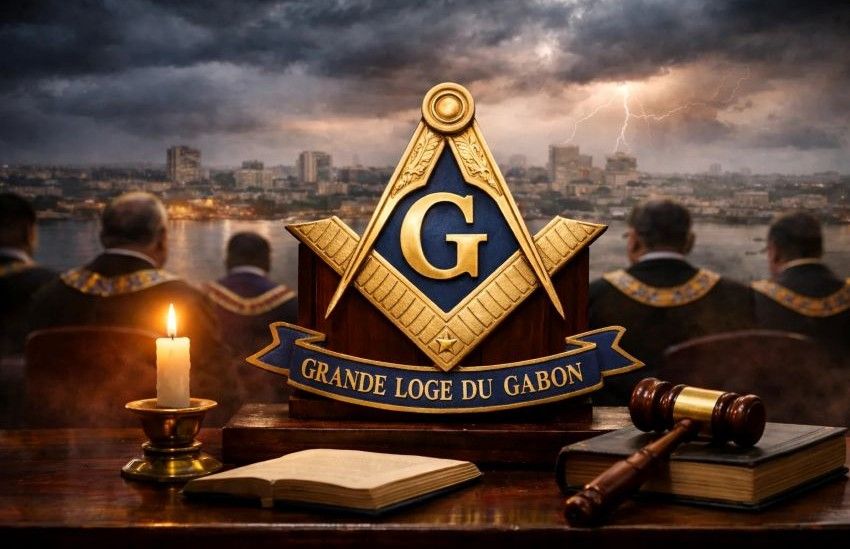
Libreville, June 19, 2026 – For decades, the Grand Lodge of Gabon (GLG) has thrived on discretion, influence, and an image of resilience amid political turbulence. Yet today, that carefully constructed facade is showing cracks.
The most influential masonic body in the country now faces an unprecedented open crisis. Succession battles, authority disputes, financial allegations, and clan rivalries are no longer confined within its walls. What we are witnessing is not just internal strife—it is a fundamental shift in a system long anchored by a dominant figure, now struggling to redefine its foundations.
Testimonies from within the GLG describe an atmosphere of mounting tension. Once a symbol of brotherhood, moral elevation, and harmony, the institution is now grappling with divisions that extend far beyond its temples.
the end of a long-standing order
The roots of this crisis trace back to recent power dynamics in Gabon. For years, political and masonic authority were intertwined, often held by the same individual. When the head of state also served as Grand Master, personal ambitions existed but were kept in check by an unassailable hierarchy.
That balance shattered after August 30, 2023. While many anticipated that the new president, Brice Clotaire Oligui Nguema, would take over the GLG’s leadership, he chose not to pursue the role. Instead, Jacques-Denis Tsanga was installed as Grand Master in February 2024.
This break from tradition sent shockwaves through the institution. Some viewed it as a deliberate move toward depoliticization. Others saw it as opening a period of uncertainty—one in which the absence of a unifying figure unleashed long-suppressed rivalries.
a succession revealing deep fractures
Three years into Jacques-Denis Tsanga’s tenure, criticism has intensified. Supporters credit him with restructuring provincial lodges, improving asset management, and expanding the GLG’s international reach. Detractors, however, accuse him of centralizing power, operating opaquely, and mishandling sensitive matters.
Hard numbers highlight the growing discontent. Attendance at lodge meetings has plummeted. Of roughly 600 registered members, only about 200 still participate regularly. A wave of expulsions, suspensions, and voluntary departures has fueled a climate of distrust unlike any before.
With the upcoming general assembly looming, the stakes are higher than ever. Multiple candidates—veteran leaders, high-ranking officials, and rising voices—are positioning themselves for the top role. The contest is no longer symbolic; it is existential for the organization’s future.
searching for a new center of gravity
Beyond Gabon’s masonic circles, this crisis reflects broader shifts in the country’s centers of influence. For years, the GLG benefited from its ties to the highest levels of government, which provided internal stability. Now, as the institution asserts its autonomy, long-hidden fractures are surfacing.
The irony is striking. Those who once criticized the fusion of political and masonic power now see how that alliance once kept internal divisions in check. Conversely, the GLG’s growing independence has exposed vulnerabilities that were once concealed by centralized authority.
This is no longer just about electing the next Grand Master. It is about whether the institution can forge a recognized authority in an increasingly fragmented environment. When the center of gravity weakens, ambitions no longer orbit around power—they collide to seize it.
The current turmoil is a defining test for the Grand Lodge of Gabon. If it can transform this period of tension into a renewal opportunity, it may emerge stronger. But if internal divisions deepen, today’s disputes could lead to lasting fragmentation.
For an organization that long wielded secrecy as its greatest asset, the spectacle unfolding within its ranks carries symbolic weight. It reveals a timeless truth: even in the oldest and most influential institutions, the core challenge remains the same—how to preserve unity when authority is no longer absolute.
You may also like
After Dioura: how the AES security gamble became the Sahel’s biggest open question
Olympe Bhêly-Quenum at 100: how the literary world is reacting and what lies ahead
Mali reacts to Goïta’s independence day address: what the war-and-dialogue pledge means now
Rosenior fallout: Strasbourg fans, Ligue 1 panel and the road ahead
Atonfack Guemo’s vigilance appeal sparks nationwide debate: what Cameroonians are saying now