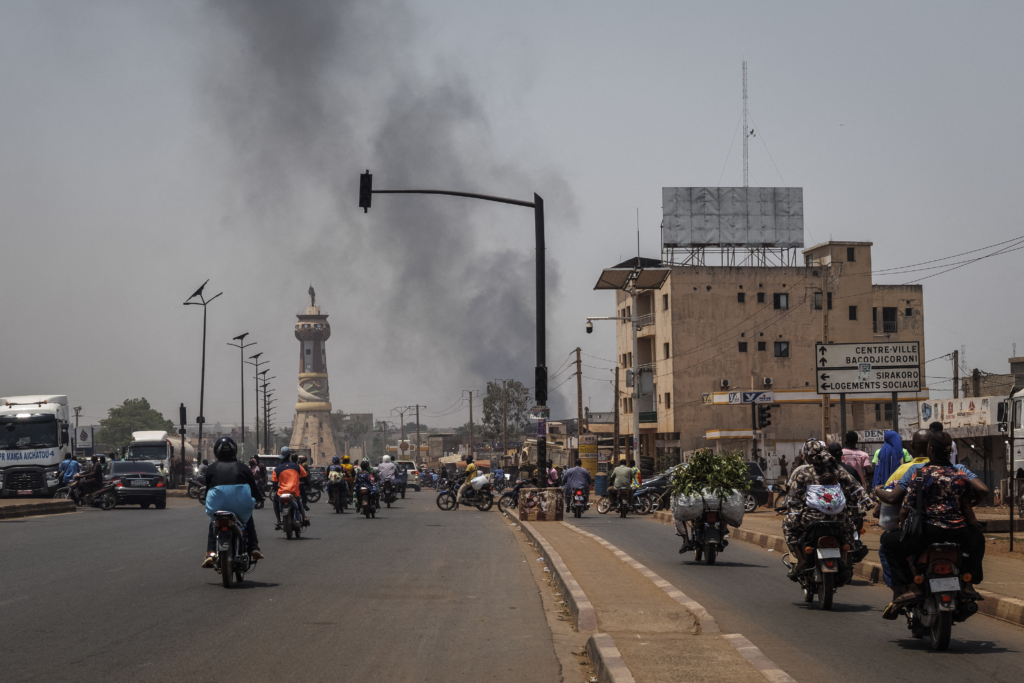
Since 28 April, the Mali capital of Bamako has been under a crippling blockade imposed by the Group for Support of Islam and Muslims (GSIM), an armed faction linked to Al-Qaïda. The restriction has cut off three of the six main access routes, severing vital supply lines and triggering severe disruptions to daily life for residents. Civilian freedom of movement, food security, health services, and overall safety are now under unprecedented threat, raising urgent concerns about compliance with international humanitarian law.
On 6 May, the blockade escalated when GSIM fighters ambushed a civilian truck convoy transporting fruits and other goods between Bamako and Bougouni. Officials confirmed that none of the vehicles carried military personnel or equipment, nor were they under military escort at the time of the attack. This targeting of purely civilian logistics directly contravenes the Geneva Conventions, which mandate strict separation between combatants and non-combatants during armed conflict.
Marceau Sivieude, Regional Director of Amnesty International for West and Central Africa, warned that such measures violate core protections owed to civilians. “Any attack on civilian vehicles engaged in lawful commerce is illegal under international humanitarian law. Parties to conflict must distinguish at all times between civilians and fighters. Deliberate assaults on civilians or civilian assets—including vehicles and critical infrastructure—are strictly prohibited.”
Blockades must never be used to strip civilians of their economic and social rights. The GSIM must uphold international law and ensure uninterrupted access to essential supplies like food, water, and medical care for all residents of Bamako.
Marceau Sivieude, Regional Director, Amnesty International
Illegal blockade violates rules of war
The blockade was first announced on 28 April by a GSIM spokesperson in an online video. Unlike the September 2025 blockade—which had targeted only fuel tankers entering Bamako—the current restrictions appear indiscriminate, impacting all commercial traffic. By 15 May, reports confirmed that at least three of the six major corridors connecting Bamako to regional ports were compromised, leading to sharp price increases for staple goods and fuel shortages.
“Blockades cannot be weaponized to deny civilians their fundamental rights,” Sivieude stated. “The GSIM must respect international humanitarian law and guarantee that Bamako’s residents continue to receive adequate food, clean water, and medical supplies.”
The United Nations High Commissioner for Human Rights (UNHCHR) reiterated this warning on 5 May, calling for an immediate end to hostilities and urging all parties to prioritize civilian protection and respect for humanitarian norms.
On 6 May, the GSIM announced a partial easing of restrictions, claiming that medical patients would be allowed entry into Bamako. However, independent verification of this pledge remains pending.
Deadly ambush on fuel tankers exposes war crimes
In late January 2026, a survivor recounted a harrowing attack on a military-escorted convoy of fuel tankers traveling between Diboli and Kayes. The assault, carried out by over 200 armed assailants on motorcycles, resulted in multiple fatalities and severe human rights abuses.
According to the driver, who spoke on condition of anonymity: “We were ambushed 20 kilometers from Diboli. The attackers opened fire without warning, targeting both the convoy and fleeing civilians. Three military vehicles arrived in response, but the soldiers were killed, and their trucks were set ablaze.”
The driver and his team were captured and forced to dig graves for fallen attackers before being executed. At least 12 drivers and apprentices were killed in this brutal attack, which constitutes a clear violation of international humanitarian law and may amount to war crimes.
Amnesty International has called for an immediate halt to all attacks targeting civilians and demands that Malian authorities conduct thorough investigations into these atrocities. Justice, accountability, and reparations must be secured for survivors and victims’ families.
Context: coordinated assaults intensify insecurity
On 25 April, GSIM and the Front for the Liberation of Azawad launched simultaneous attacks in Bamako, Kati, Mopti, Sévaré, Gao, and Kidal. Military camps and homes of political and military figures were targeted, with Defense Minister Sadio Camara among those killed in an improvised explosive device attack on his residence in Kati.
On 6 May, GSIM fighters launched further raids on Kori Kori and Gomassagou in central Mali, resulting in dozens of civilian deaths and widespread destruction. Local sources reported at least 40 fatalities and multiple disappearances, underscoring the escalating humanitarian crisis.