The United Nations Security Council witnessed another diplomatic showdown on Friday, October 30, 2026, as deepening divisions over Western Sahara reached a critical juncture. Both a US-backed resolution and Russia’s counterproposal failed to secure the necessary support, leaving the fate of the MINURSO peacekeeping mission hanging in the balance and casting doubt over the future of the territory itself.
Two rival visions clash over Western Sahara’s political future
The Security Council convened to renew the mandate of the United Nations Mission for the Referendum in Western Sahara (MINURSO), whose term was set to expire on October 31, 2026. What followed, however, was not a consensus-driven endorsement but a clash of fundamentally opposing visions for the territory’s political trajectory.
Washington pushes for a paradigm shift in the conflict resolution process
The American draft resolution sought to fundamentally alter the framework of the decades-old dispute. It proposed extending MINURSO’s mandate until October 31, 2027, but with a significant shift in mission scope. The plan prioritized Morocco’s autonomy initiative under Moroccan sovereignty as the exclusive basis for future negotiations. It also called for dropping the referendum reference from the mission’s name, effectively rechristening it as the United Nations Mission in Western Sahara (MINUSO).
Beyond branding changes, the US proposal envisaged a gradual transformation of MINURSO’s role. The draft suggested systematically phasing out the peacekeeping component and replacing it with a political mission—reflecting a broader strategic vision to move from a peacekeeping model toward a purely political facilitation mechanism.
Moscow pushes back, defending historical UN parameters
Russia vehemently opposed the US proposal, arguing it undermined the long-standing political framework established by the UN to resolve the conflict. Moscow emphasized that the American plan risked prejudging the outcome by privileging a single political option—Morocco’s autonomy initiative—at the expense of the principle of self-determination enshrined in the UN Charter.
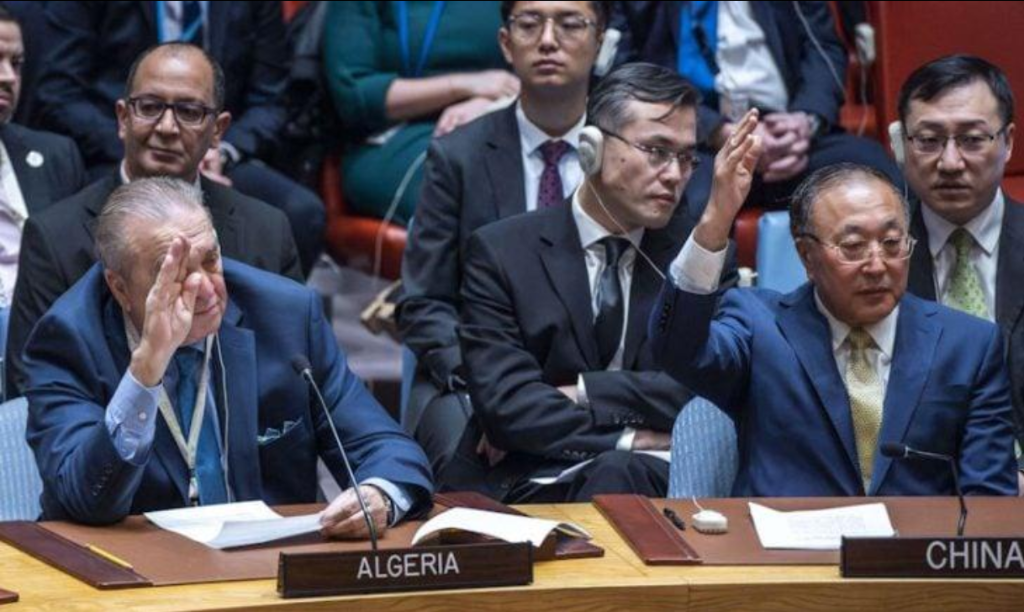
The Russian delegation maintained that any resolution must preserve balance, neutrality, and adherence to international law, especially the right of the Sahrawi people to freely determine their future. When the vote was called, Russia exercised its veto power under Article 27 of the UN Charter, despite 11 council members voting in favor. China, Pakistan, and Somalia abstained.
Moscow’s fallback fails to break the deadlock
With the US-backed resolution blocked by Russia’s veto, Moscow attempted to salvage the situation by introducing a minimalist alternative. Its revised draft proposed a straightforward one-year extension of MINURSO’s mandate in its current form, without renaming the mission or altering its peacekeeping priorities.
Russia framed this initiative as a pragmatic move to prevent a sudden UN withdrawal and maintain stability on the ground. Yet the move backfired. The Russian-backed resolution garnered only three votes—its own, China’s, and Somalia’s—while the United States opposed it outright, and the remaining 11 members abstained.
The motion fell short of the required nine affirmative votes, failing not due to a US veto but because of insufficient support. This second consecutive defeat underscored the depth of the council’s paralysis and the inability of either Washington or Moscow to sway a majority.
Self-determination at the heart of the impasse
At the core of the dispute lies a fundamental question: the right of the Sahrawi people to exercise genuine self-determination. MINURSO was established in 1991 under a UN peace plan that included preparations for a referendum on self-determination. Yet this referendum never took place due to persistent disagreements over voter eligibility and the political process.
Two conflicting narratives shape the debate
- Morocco’s position: Promotes a plan for autonomy under Moroccan sovereignty as the sole viable path to a negotiated solution.
- Sahrawi aspirations: Insist on the right to a referendum offering independence among the possible outcomes, rooted in international law and UN resolutions.
For Sahrawi representatives, elevating Morocco’s autonomy plan to the exclusive negotiating framework would be tantamount to closing the door on independence and other legitimate political futures. They view the preservation of the referendum mandate as a non-negotiable pillar of any just resolution.
MINURSO’s future hangs in the balance
The Security Council adjourned with no resolution adopted and no mandate renewed. As October 31 approached, the expiration of MINURSO’s mandate left the mission’s continued presence in limbo, raising urgent questions about its operational future and the broader implications for regional stability.
A council paralyzed by permanent members’ divergences
The double failure—first, the US plan vetoed by Russia, then the Russian plan falling short of a majority—lay bare the council’s structural limitations. It exposed how competing national interests among permanent members can override collective diplomacy, effectively freezing international conflict-resolution efforts in their tracks.
For the Sahrawi people, the stakes extend far beyond procedural disputes between Washington and Moscow. The central issue remains the preservation of the international framework guaranteeing their right to self-determination—and the hope of a political solution that truly reflects their will.
What comes next for Western Sahara?
The October 30 session ended in a historic diplomatic impasse, marking another chapter in the frozen conflict. Neither the US nor Russia succeeded in imposing its vision. The council remains locked in a stalemate, and the Sahrawi people continue to wait—while the world watches an institution built for peace stumble under the weight of geopolitical divisions.