Gold, power, and the Moscow pact: What’s really driving Burkina Faso’s security deals?
The captain Ibrahim Traoré’s ascent to power in Burkina Faso has reshaped the country’s alliances, but one question looms large: how much of the nation’s gold wealth is being traded for security guarantees from Moscow? Behind Ouagadougou’s newfound partnership with Russia lies a complex web of economic interests, political survival, and mineral wealth that could redefine the region’s power dynamics.
At Bissa’s gold mine, a silent war plays out for control
At the heart of this strategic dilemma is the Bissa gold mine, operated by Nordgold, a Russian-owned company. What began as a commercial rivalry over security contracts has escalated into a shadow conflict involving competing Russian security firms. RSB-Group, a once-entangled player now excluded from the protection arrangements, has alleged that rival operators are exacerbating communal tensions near the mine—accusations that, if verified, reveal a deeper struggle for influence in Burkina Faso’s mining heartlands.
The dispute highlights a critical intersection where Burkina Faso’s mineral wealth, foreign security partnerships, and internal stability become inextricably linked. While the country grapples with insurgent threats, its gold reserves are emerging as a currency of power—not just for economic gain, but for political survival.
From military alliances to economic leverage: How Moscow strengthens its foothold
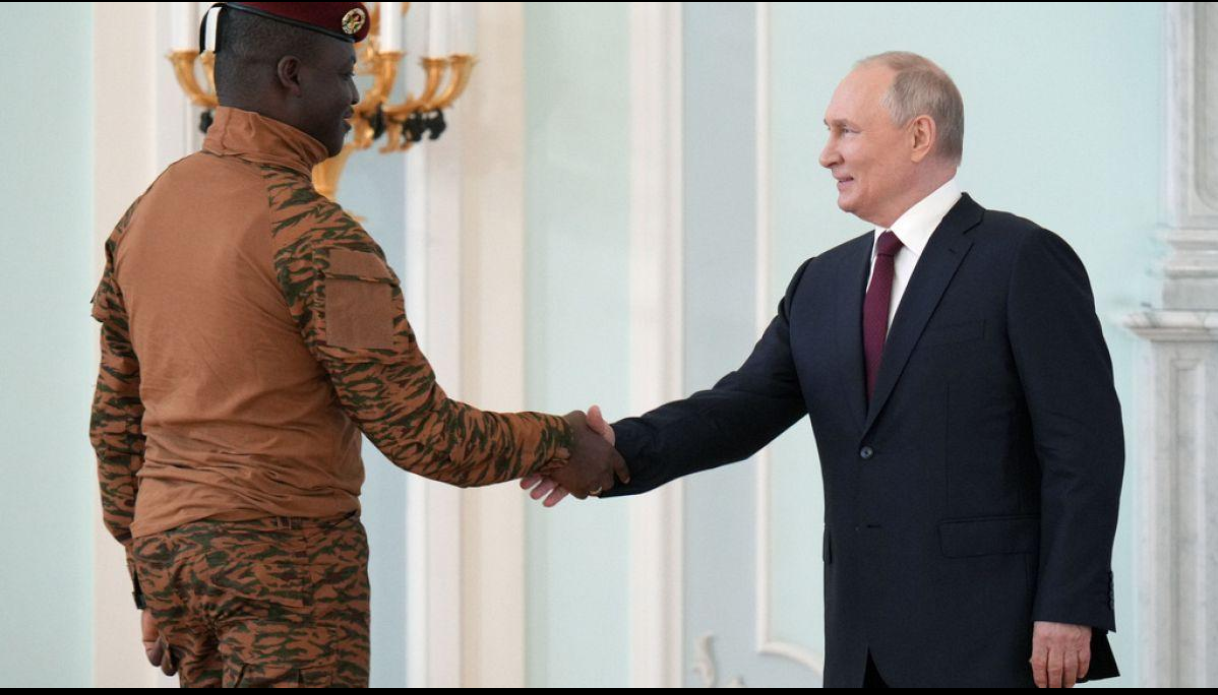
Since Traoré took office in 2022, Burkina Faso has deepened ties with Moscow, primarily framed as a defense against jihadist insurgencies. But the collaboration extends far beyond counterterrorism. Observers note the presence of Russian paramilitary units in Ouagadougou, deployed not only near conflict zones but also in proximity to state institutions. While officially tasked with training and advisory roles, their positioning raises questions about their broader role in safeguarding the regime itself.
Russia’s interest in Burkina Faso’s mining sector is equally pronounced. Nordgold, a key operator in the country’s gold industry, operates two major mines—Bissa and Bouly—giving Moscow a direct economic stake in the country’s stability. In early 2023, the Burkinabe government requisitioned 300 kilograms of gold from Bissa Gold under emergency powers, signaling a new era where mineral resources are mobilized to meet state exigencies. The rationale? Safeguarding a strategic asset essential for both national revenue and regime resilience.
Security or control? The dual role of Russian forces in Burkina Faso
The presence of Russian security contractors and advisors has sparked debate. Are their primary objectives combating terrorism, protecting Traoré’s leadership, or securing mining operations? While their exact mandate remains opaque, regional analysts argue that Moscow’s involvement likely serves multiple purposes—military support for Traoré, economic access for Russian firms, and a strategic foothold in West Africa’s Sahel.
A 2024 assessment by the West Point Combating Terrorism Center underscores this ambiguity. While security contracts may initially stem from corporate interests—such as shielding Nordgold’s investments—the broader geopolitical outcome appears to strengthen Traoré’s grip on power, even if no formal exchange of gold for protection has been publicly acknowledged.
The human cost: Who bears the burden of mining security?
For communities living near the Bissa mine, the arrival of armed Russian-backed security firms has not brought peace. Reports of heightened tensions—particularly around pastoralist Fulani villages—suggest that mining security operations may be escalating local grievances. Civilians caught in the crossfire face displacement, loss of livelihood, and increased vulnerability to attacks, raising urgent ethical questions about whose interests these security arrangements truly serve.
As Burkina Faso navigates this delicate balance between sovereignty, security, and resource wealth, one fact becomes clear: the fate of the nation’s gold no longer lies solely within its borders. It is being shaped by a partnership whose terms remain largely unwritten—and whose consequences extend far beyond the mine site.