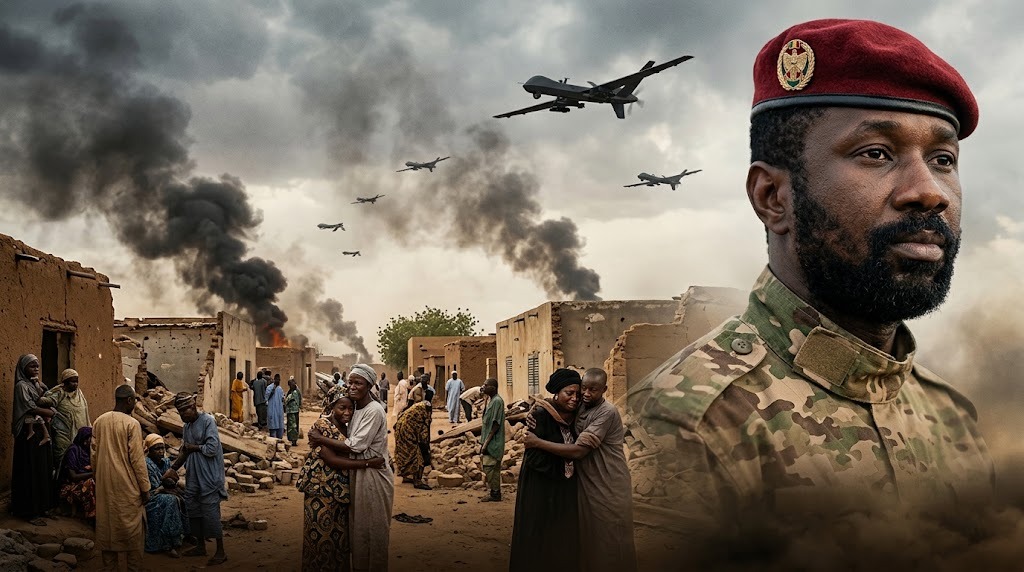
How many deaths does it take before someone is named as responsible? That is the uncomfortable question now hanging over Mali’s air campaign. Drones promoted as instruments of surgical warfare have instead left a trail of funerals across the north and centre of the country: over three years, monitoring data points to 731 civilians killed in 199 strikes. The stakes are no longer only military. They are legal, moral and deeply personal — because behind every figure is a village, a household and, in some cases, a child.
How Mali’s skies became a front line
In northern and central Mali, the distant drone of an engine overhead has become a sound people dread. Successive governments have poured resources into air power as a way of fighting armed groups without placing soldiers in immediate danger. Turkish Bayraktar TB2 and Akinci drones now fly alongside combat aircraft, operated by the Malian armed forces and their Russian partners from the Africa Corps.
On paper, this arsenal should allow strikes against clearly identified targets from a safe distance, with far greater accuracy than before. On the ground, the picture that emerges from months of field reconstruction is markedly different — and considerably more troubling.
Twelve strikes, rebuilt piece by piece — and 146 civilians dead
To get past official accounts, investigators examined close to 60 strikes and independently reconstructed 12 of them. The method was painstaking: satellite imagery, video footage, photographs, fragments of munitions, testimony from survivors and geolocation data were cross-checked against one another until a sequence of events could be established. In those twelve cases alone, 146 civilians were identified among the dead.
Zoom out and the scale grows. Data covering the period from September 2023 to September 2026 records 199 strikes that mainly hit civilians, and 731 civilian deaths over three years. These figures do not mean that every victim has been individually named, nor that legal responsibility has been formally established for each attack. What they do provide is a measure of how heavy the human cost of this air campaign has become.
The finding that is hardest to read: children in the frame
Among the episodes studied, witness accounts and material evidence raise a question that goes to the heart of how these operations are conducted: what did the operators know before the order to fire was given?
One phrase recorded during the investigation captures the accusation in its rawest form: “They saw the children, and they fired anyway.”
If such conduct were confirmed in the cases concerned, it would raise serious issues under the core principles of international humanitarian law — above all the duty to distinguish between combatants and civilians, and the obligation to take every feasible precaution to spare non-combatants.
The question does not stop at the person sitting in front of a screen. It runs through the entire chain that produces a strike: intelligence gathering, target identification, authorisation, the choice of munition and the final order to fire.
A chain of command with too many links and too few answers
This is where accountability becomes genuinely difficult. Mali’s aerial war involves several parties at once: Malian forces, Russian personnel attached to the Africa Corps, and, for the Turkish drones, the actors involved in acquiring and operating them.
Because those roles overlap, establishing who is answerable for a given strike is extraordinarily complex. The unanswered questions pile up:
- Who identifies the target in the first place?
- Who confirms that it is genuinely military in nature?
- Who authorises the strike?
- Who monitors the operation at the moment of firing?
- And, above all, who answers for the victims when a strike hits a civilian population?
These questions carry particular weight in a conflict where authorities routinely describe their air operations as actions directed against armed groups.
Why precision weapons do not protect the people below
The arrival of drones was widely presented as the dawn of cleaner, more exact warfare. An operator can watch a zone from afar, follow a target and pick the moment to strike without exposing troops to enemy fire.
But technology does not eliminate human error, and it cannot guarantee that the intelligence feeding a decision is correct. In a region where armed groups move among civilian populations, where villages sit far from any road and where information is often fragmentary, being certain that someone is a fighter can be almost impossible.
That is the contradiction the investigation lays bare: weapons of remarkable sophistication deployed in places where the people living under them are entirely unprotected. From the ground, a drone in the sky does not distinguish a fighter from a herder, a trader or a child.
A war that leaves its mark on entire villages
The available numbers describe a clear shift in how the war is being fought. Strikes that cause civilian casualties have risen sharply compared with earlier years, in a country where violence against non-combatants remains a defining feature of the wider Sahel crisis. Armed groups bear their own heavy responsibility for attacks on civilians, and they too are building up drone and explosive capabilities.
For Malian families, though, none of these distinctions change the outcome. When a strike lands on a village, what disappears is a life. The debate over which technology was used, or which actor pressed the button, offers little comfort to those left behind.
The real question raised by these revelations is therefore not simply whether drones are militarily effective. It is what limits should govern their use.
The distance between a button and a burial does not erase responsibility
As Sahelian armies continue to acquire ever more advanced air power, the issue of accountability can no longer be deferred. A weapon capable of striking from several kilometres away does not relieve the person using it of the duty to verify the target.
In Mali, the hundreds of civilian deaths documented over three years serve as a blunt reminder. In any technological war, the gap between the person who presses a button and the person who dies can be enormous. Responsibility, however, does not shrink with distance.
You may also like
Is Mali swapping Moscow’s firepower for Washington’s intelligence?
Nigeria’s presidential election: what is really at stake in the police promise of a neutral vote?
Mali’s prison crossroads: can the crackdown on crime coexist with humane detention?
At what cost does Burkina Faso pursue sovereignty if Tougan’s farmers cannot earn a living?
Will Niger’s youth answer the FPL’s call, and what is really at stake?