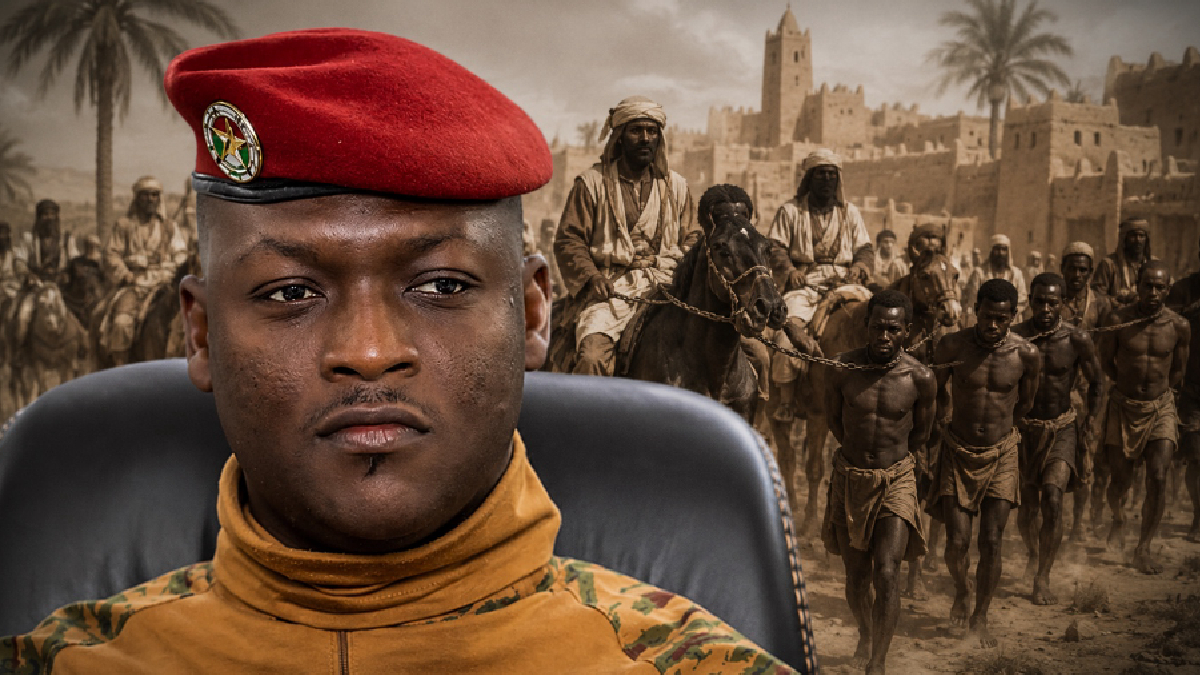
In a move that reverberates across the Sahel, Captain Ibrahim Traoré of Burkina Faso has publicly addressed the sensitive subject of Arab slavery and its connections to contemporary radical Islam. This isn’t merely a provocation; it’s a direct challenge to the blind spot in African historical narratives, a truth that Gulf powers and some Western intellectuals often prefer to ignore. This political declaration unveils deep-seated historical tensions within the continent.
The weight of centuries of silence
Africa carries certain truths as invisible burdens, and Captain Ibrahim Traoré’s recent pronouncements in Ouagadougou exemplify this. Before an assembly of dignitaries, Burkina Faso’s transitional leader dared to do what his predecessors, both civilian and military, consistently avoided: explicitly linking the Arab-Muslim slave trade to the jihadist violence currently ravaging the Sahel region.
For thirteen centuries, millions of Black Africans were forcibly taken from areas like Lake Chad, enduring arduous journeys to slave markets in Cairo, Tripoli, and Zanzibar. While historical records acknowledge this immense tragedy, official narratives have largely suppressed it. The reasons for this silence are complex: unlike the transatlantic trade, the oriental slave trade doesn’t easily fit into mobilizing narratives favored by Western chancelleries. Furthermore, it uncomfortably highlights that political Islam, often portrayed as an anti-colonial liberation ideology, historically served as a vehicle for racial exploitation.
Historiography confronted by politics
Historian Olivier Pétré-Grenouilleau’s seminal works previously laid the groundwork for this uncomfortable truth. Accounts from Ibn Battuta, archives from Sahelian sultanates, and Timbuktu manuscripts provide extensive evidence of this systematically organized trade. Yet, no truth commissions have ever convened in Agadez or Timbuktu. No national museums in Sahelian capitals, including those in Mali or Niger, extensively detail this period. Post-colonial elites, indoctrinated with the narrative of unity against former colonizers, chose oblivion over confrontation.
This deliberate oversight inadvertently granted jihadist groups a monopoly over historical interpretation. By framing their struggle as a rebellion against a neo-colonial order, these groups skillfully obscured their own ideological lineage to a conquering force that, since the Almoravids, justified violence through claims of spiritual superiority. Traoré, acting more as a soldier than an intellectual, has shattered this carefully constructed narrative.
A double-edged historical strategy
Tactically, the captain’s statement demonstrates remarkable shrewdness. By nationalizing the fight against terrorism, he strips it of its transnational character, restoring its historical and racial dimensions. The enemy is no longer an imported faction but an inheritor of a foreign domination enterprise over Black African lands. Through this, he aims to rally rural communities, who are often the primary victims of jihadism and frequently feel neglected by urban elites influenced by Qatari or Saudi funding.
However, this strategy is fraught with peril. By invoking the specter of Arab slavery, Traoré risks his nation’s diplomatic isolation. On one hand, he alienates traditional Gulf allies whose Quranic schools have influenced the Sahel’s religious landscape for four decades. On the other, he displeases a segment of the West African intelligentsia who perceive this discussion as an attempt to divide the Black front against the former white colonizer. The comparative history of slave trades is a minefield, and the captain navigates it with the light steps of a soldier rather than the caution of a diplomat.
The silences of Western repentance
What makes this declaration particularly unsettling for Western chancelleries is its exposure of contradictions in Western memorial policies. UNESCO, NGOs, and social science faculties have diligently learned their lesson: repentance is offered for the transatlantic slave trade, never for the oriental one. Selective memory is a prevalent practice, where diversity is celebrated while any critique of radical Islam is stifled under accusations of “Islamophobia.”
Ibrahim Traoré, for his part, seeks neither money nor apologies from France. He simply urges his people to confront their own history, however inconvenient it may be for Gulf allies. This fierce historical independence, brutal as it may seem, is perhaps what most disturbs Parisian circles. It serves as a potent reminder that Africa is now capable of conducting its own historical inquiry, free from the distorting lens of former colonial powers.
A lesson for the Old World
What can we glean from this Sahelian intervention? Firstly, competing historical narratives will not be resolved by subsidies or UN resolutions; they will clash on the terrain of foundational myths. Secondly, political Islam, far from being merely a Middle Eastern import, draws its roots from a centuries-old history of conquest and subjugation that Africans themselves have too long preferred to ignore.
Traoré has chosen his path. The question remains whether his people, exhausted by a decade of asymmetric warfare, will possess the resilience to support this historical re-evaluation, risking the reopening of wounds believed to have been healed by forgetting. Historians might argue he simplified a complex tragedy. Politicians might say he lacked nuance. Yet, the captain reminds us with military bluntness: in Africa, as elsewhere, peoples who do not shape their own history are condemned to endure it.
While some debate repentance and intersectionality, a hardened Sahelian military leader forcefully reminds them of history’s true order. Truth liberates, they say, but in the Sahel, it is a lion that must be tamed. Ibrahim Traoré has just opened its cage. We hope he has the fortitude to bear this immense burden, for the guardians of political correctness will not forgive him.