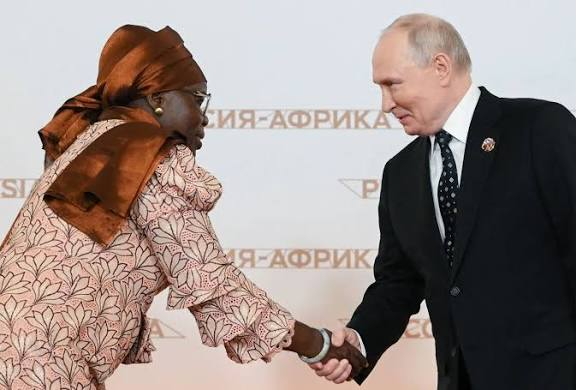
The third edition of the Russia-Africa Summit, held in Moscow on October 28–29, 2026, marked a turning point for Benin. Vice President Mariam Chabi Talata did not attend as a passive observer but as a visionary architect poised to reshape her nation’s economic destiny. Her mission was clear: convert decades of diplomatic ties into a forward-looking partnership that fuels growth, innovation, and equitable prosperity across Benin and its citizens.
Invited to the Kremlin’s high-stakes dialogue, Chabi Talata engaged with global leaders in a setting where history intersected with ambition. This summit was not a routine gathering; it was a dynamic arena where alliances were forged, outdated narratives reimagined, and new economic frontiers began to emerge—particularly between Africa and Russia. For Benin, the stakes were unmistakable: to position itself not merely as a participant, but as a leader in forging a modern economic partnership.
From Cold War ties to a springboard for 21st-century growth
The diplomatic relationship between Benin and Russia predates the collapse of the Soviet Union. Officially established on January 9, 1962—merely one day after Benin (then known as the Republic of Dahomey) gained independence—this partnership flourished during the 1970s and 1980s under the People’s Republic of Benin. That period witnessed substantial exchanges: thousands of Beninese students and professionals pursued education in Soviet institutions, while doctors, engineers, and military personnel built enduring professional networks that endured beyond geopolitical transitions.
Today, Benin is not looking back in nostalgia but forward with purpose. At the Moscow Summit, Chabi Talata was not merely revisiting the past; she was stepping into a strategic conference room of tomorrow. The objective? To transform these historic bonds into a partnership tailored to Benin’s contemporary needs: high-impact technology sharing, robust infrastructure development, and sustainable industrial growth.
Shifting from outdated pacts to empowered partnerships
The Russia-Africa Summit series began with events in Sochi (2019) and Saint Petersburg (2023). However, the 2026 gathering marked a significant evolution. The 2023–2026 implementation roadmap was reassessed, and preparations for the 2027–2029 strategic framework were already underway. Instead of arriving to receive promises, Benin arrived to set them—on its own terms.
Chabi Talata championed a fundamental shift: moving away from transactional partnerships that extract value without reciprocity toward investment models that deliver measurable benefits to local communities. Gone are the days of one-sided resource deals or debt-laden agreements without tangible returns. Benin’s stance was unequivocal: it seeks collaboration rooted in respect, mutual benefit, and lasting impact.
Benin’s strategic role on the global stage
Vice President Chabi Talata’s engagement extended well beyond ceremonial appearances. She actively participated in the Economic and Humanitarian Forum, contributed to plenary discussions with continental leaders, and held direct talks with Russian officials. Her presence was not symbolic; it was a calculated strategic move. She articulated Benin’s demand for a new kind of economic diplomacy—one grounded not in dependence, but in empowerment and shared sovereignty.
As the summit concluded with a renewed joint declaration and a reinvigorated action plan, a pivotal question emerged: Could Benin emerge not only as a participant, but as a trailblazer in redefining Africa-Russia economic relations? The answer rests in the commitments formalized in Moscow—and in the urgency with which Cotonou mobilizes to turn those commitments into tangible progress.
Benin’s top economic priorities announced in Moscow
- Boosting domestic value creation: Embedding technology transfer, workforce upskilling, and local manufacturing into trade and investment agreements to ensure lasting local benefits.
- Building infrastructure corridors: Strengthening links between Benin’s ports and key logistics centers and Eurasian supply chains through Russian partnerships in port modernization, rail expansion, and digital infrastructure.
- Transforming agriculture and industry: Harnessing Russian expertise in food security and agricultural innovation to elevate Benin’s rural sector and reduce reliance on food imports.
- Empowering youth through education: Reviving the legacy of African students trained in the Soviet era—this time with a focus on STEM education, vocational training, and entrepreneurship aligned with Benin’s digital economy roadmap.
Can Moscow become a catalyst for Benin’s economic renaissance?
The answer may hinge on whether this summit signifies the dawn of a new chapter or simply another routine diplomatic engagement. For Benin, the stakes are palpable. The world is watching. Russia is listening. And the citizens of Benin are hopeful.
The Moscow Summit was not an accident of timing; it was a carefully planned opportunity. And in that opportunity, Benin found its voice—not just as a bystander, but as a proactive architect of its own future.