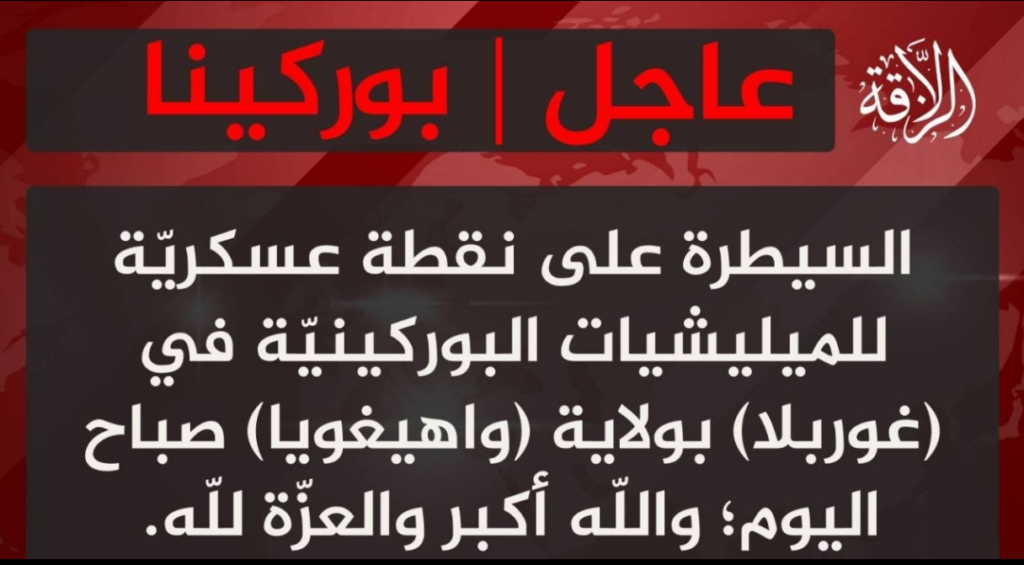
On Wednesday, April 15, 2026, the Northern region of Burkina Faso experienced another wave of violence. The Group for the Support of Islam and Muslims (GSIM), an affiliate of Al-Qaeda, announced via its propaganda channels that it had successfully taken over a security installation in Gorbla, situated on the outskirts of Ouahigouya.
A dawn offensive
According to reports shared by the jihadist organization, the assault was launched in the early hours of Wednesday morning. The target, a key military position defended by the Volunteers for the Defense of the Homeland (VDP)—civilian militias working alongside the regular army—was reportedly overrun after a period of intense combat.
The GSIM asserts that its fighters seized a substantial quantity of hardware, including weapons, ammunition, and several transport vehicles. While an independent body has yet to confirm the human toll of the engagement, the group claims that the local defense forces sustained numerous casualties.
A critical security buffer under threat
Located in the Yatenga province, the town of Gorbla represents a vital point for the protection of Ouahigouya, one of the primary urban centers in northern Burkina Faso.
- Strategic importance: This locality functions as a buffer zone intended to block the movement of armed groups toward the central parts of the country.
- Security environment: Despite the frequent interventions of the Defense and Security Forces (FDS), the Northern region remains plagued by instability and constantly shifting front lines.
Response from the authorities
At this stage, the General Staff of the Burkinabè Armed Forces has not issued a formal report regarding the incident. Local witnesses describe a fragile calm prevailing this afternoon, though rumors of a potential counter-offensive are circulating. The civilian population is expressing growing concern as the security situation tightens around the main transport routes leading to Ouahigouya.
The security landscape in Burkina Faso remains highly fluid, and claims made by insurgent groups are often part of a broader communication strategy. Caution is advised regarding casualty figures and territorial gains in the absence of official military verification.
You may also like
Senegal’s December 2 deadline: how a possible assembly dissolution could hit wallets and stability
Senegal’s 2026 budget revision: how the deficit surge hits households, businesses and the Pastef majority
Benin’s €544,042 UNAIDS funding: the tangible consequences for patients, communities and the economy
Senegal-Azerbaijan pact in New York: what it means for jobs, trade and cooperation
What Luxembourg’s 9.8 billion FCFA port training pledge means for Benin’s workers and businesses