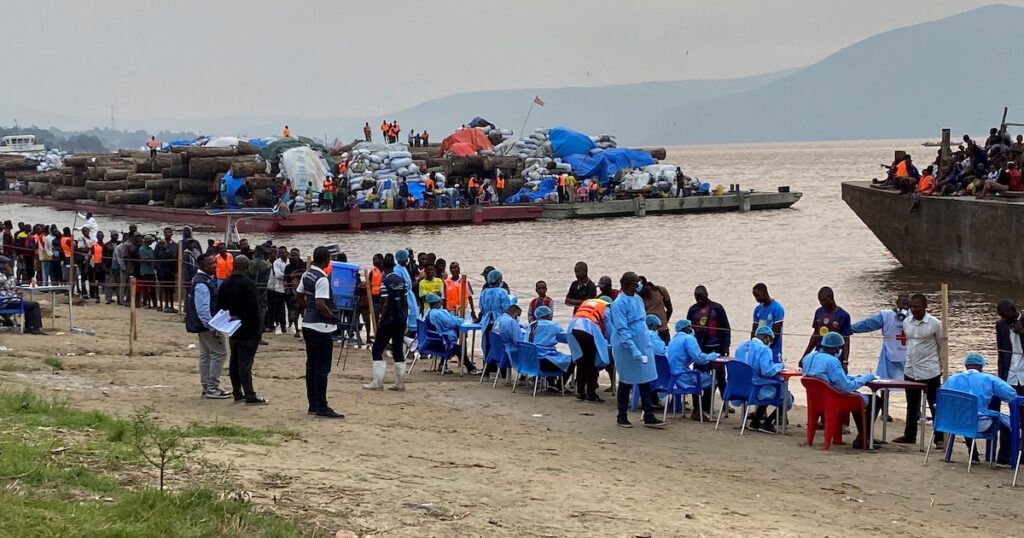
Health experts warn that the Ebola epidemic in the eastern Democratic Republic of Congo shows no signs of slowing. The grim assessment comes as the World Health Organization’s director-general visited the region, where the outbreak has now become the second-largest in history. Just two and a half months after the first confirmed case on May 15, the Bundibugyo strain has already claimed 1,850 lives out of nearly 4,000 reported cases, with a staggering fatality rate exceeding 40 percent.
This strain has proven far deadlier than in past outbreaks, according to the Africa Centres for Disease Control and Prevention (Africa CDC). During the last major Ebola crisis in the DRC, which lasted from 2018 to 2020, it took over ten months to reach a similar death toll. “We are not in a position to say that we have full control of this outbreak,” admitted Jean Kaseya, director-general of Africa CDC, at the end of July.
Violence and instability hamper containment efforts
The rapid spread of the virus is driven by multiple factors, chief among them the region’s chronic instability. The Ituri Province, the outbreak’s epicenter, has been plagued by relentless attacks from the Allied Democratic Forces (ADF), an armed group originating from Uganda. Meanwhile, North Kivu Province—also affected—remains largely beyond the government’s control after being seized by the M23 rebel group, widely believed to be backed by neighboring Rwanda, following intense clashes with Congolese forces.
Years of conflict have displaced millions, forcing people into overcrowded camps with dire hygiene conditions. The lack of early detection and insufficient surveillance systems further delayed the response, allowing the virus to spread unchecked. According to Médecins Sans Frontières (MSF), in Bunia, the outbreak’s hotspot, 90 percent of admitted patients had not been identified as contacts, while only 59 percent of contacts were traced across Ituri Province. Africa CDC estimates that for every confirmed urban case, around 40 contacts should be monitored—a target that remains far out of reach, with only 13 percent of the required 134,400 individuals currently under surveillance.
Complicating matters further, nearly one-fifth of tracked individuals receive inconsistent follow-ups due to staff shortages or ongoing violence. Shockingly, 60 percent of fatalities occurred in communities rather than healthcare facilities, highlighting the collapse of containment measures.
Experimental treatments and vaccines offer limited hope
Despite the grim outlook, researchers are racing to develop solutions. Oxford University launched the first clinical trial of a vaccine targeting the Bundibugyo strain this month, with the first volunteer receiving the dose. The trial aims to enroll 50 adults to assess the vaccine’s safety. Additionally, the Coalition for Epidemic Preparedness Innovations (CEPI) is funding the rapid development and testing of another vaccine by Singapore’s Hilleman Laboratories in the DRC.
For now, only the Ebola Zaïre strain vaccine is available, but Africa CDC announced plans to administer it widely in affected areas. While not a perfect match, early data suggests it may reduce symptoms and prevent deaths even against the Bundibugyo variant. More than 40 patients are also participating in a trial combining experimental treatments.
Jean Kaseya has proposed scaling up the use of remdesivir, an antiviral drug, based on its success in neighboring Uganda, where officials credited the drug with lowering the fatality rate to 10 percent during a recent outbreak. “The difference in Uganda’s response was the immediate deployment of remdesivir for all patients and contacts,” Kaseya noted. If current trends persist, this outbreak could surpass the devastating 2014–2016 West Africa epidemic, which killed over 11,000 people.
International aid arrives too late to curb the crisis
The delayed global response has exacerbated the situation. Early in 2025, the U.S. administration suspended decades of health and medical aid through USAID, leaving the DRC vulnerable. It wasn’t until August 5 that the U.S. State Department announced a $242 million aid package, bringing total American funding for the Ebola response to $512 million. This infusion finally provides the necessary resources for the WHO and CDC’s six-month response plan, estimated at $518 million. However, critics argue that the amount falls short of previous U.S. contributions to humanitarian and health crises. Despite this, the U.S. remains the largest donor, outpacing the European Union’s support.
You may also like
Senegal-Azerbaijan pact in New York: what it means for jobs, trade and cooperation
What Luxembourg’s 9.8 billion FCFA port training pledge means for Benin’s workers and businesses
Burkina Faso: shrinking civil service payroll exacts a heavy toll on households and local economies
Libya-Cameroon air link plan: how Yaoundé and Tripoli are reacting, and what could follow
Silmossin fallout: Burkina Faso’s security debate moves beyond slogans