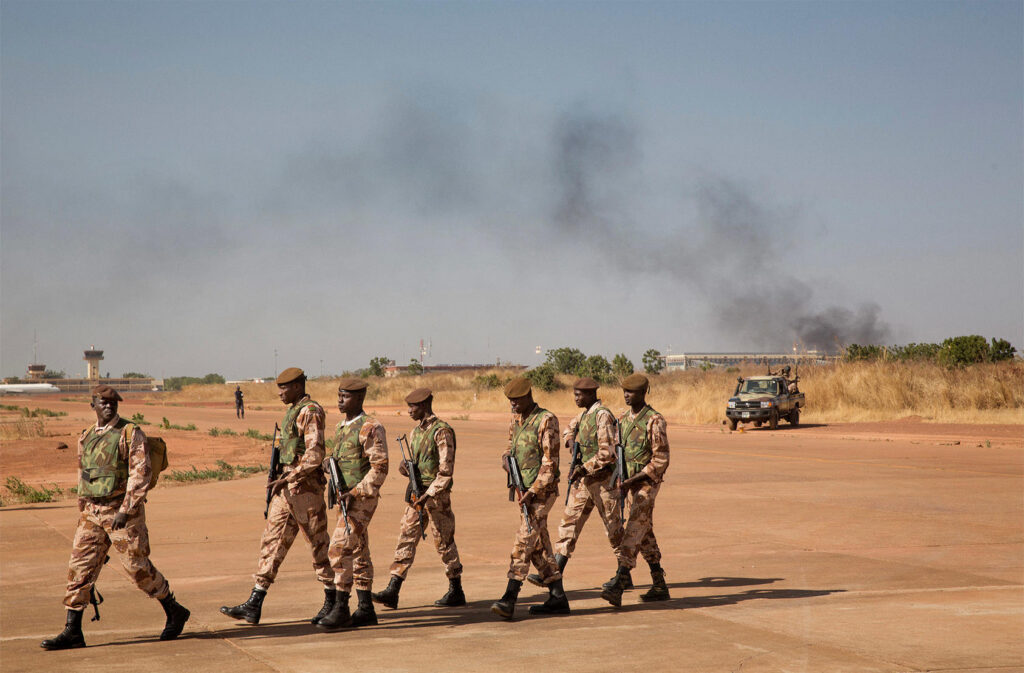
Following years of deep-seated instability and multiple political upheavals, Mali has entered a volatile new phase of armed conflict. On Saturday, April 25, a massive and synchronized offensive was launched by Touareg rebels from the Front de libération de l’Azawad (FLA) and jihadist militants from the Groupe de soutien à l’islam et aux musulmans (JNIM), an Al-Qaïda affiliate. The operation targeted seven key urban centers across the country, including the capital Bamako and its neighboring garrison town of Kati, as well as Konna, Mopti, Sévaré, Gao, and Kidal.
The strategic northern stronghold of Kidal has reportedly fallen entirely under the control of the insurgents. The attackers utilized a sophisticated array of tactics, including suicide vehicle-borne IEDs, kamikaze drones, and coordinated direct assaults on military installations. According to reports, the JNIM and FLA—the latter being the successor to the Coordination des mouvements de l’Azawad (CMA)—targeted high-profile sites such as the presidential residence, the Ministry of Defense, and the Modibo Keita International Airport.
Government response and high-level casualties
The transitional government described the strikes as “complex,” confirming at least 16 injuries among military personnel and civilians. In response to the deteriorating security environment, authorities imposed a 72-hour curfew in Bamako and suspended operations at the international airport. Oumar Diarra, the Chief of General Staff, characterized the attacks as a coordinated destabilization effort involving both domestic and foreign elements. While the military claims to have neutralized over 200 militants, Diarra admitted to a “redeployment” from Kidal toward Anefis, framing the retreat as a tactical maneuver to protect local populations.
The offensive has dealt a severe blow to the junta’s leadership. Sadio Camara, the Minister of Defense and a pivotal figure in the 2020 and 2021 coups, was killed following a suicide attack on his residence in Kati. The blast also claimed the lives of his family members and several civilians. Furthermore, Modibo Koné, the head of national security, was wounded by gunfire, while the transition leader, Assimi Goïta, was reportedly evacuated to a secure location.
The role of Russian and international actors
The Africa Corps, a Russian paramilitary unit under the Ministry of Defense that succeeded the Wagner Group, confirmed its withdrawal from Kidal alongside Malian forces. Despite the retreat, Russian sources claimed to have repelled multiple mass assaults and prevented a total collapse of the state. They alleged that the insurgent offensive, involving up to 12,000 fighters, received clandestine support from European and Ukrainian intelligence services.
This conflict highlights a significant tactical alliance between Touareg separatists and Al-Qaïda-linked groups. While their long-term goals differ—with the FLA seeking autonomy for Azawad and JNIM aiming for an Islamic state—they have united against the Bamako junta and its Russian partners. Analysts point to the battle of Tinzaouaten in July 2024 as the catalyst for this cooperation, where Ukrainian involvement was also suspected. Kyiv has officially denied providing direct support to terrorist organizations, despite suggestions that it is attempting to open a second front against Russian interests in Africa.
You may also like
Can Napoli halt the Arsenal machine in their Champions League opener?
Arsenal vs Chelsea: Premier League derby time and TV channel
Juventus vs AC Milan preview: Serie A clash at the Allianz Stadium
Linz ASK – Celtic Glasgow, Ligue des champions, match en direct le 25/08/2026
security crisis in Burkina Faso: assessing the impact of jinim attacks and state response