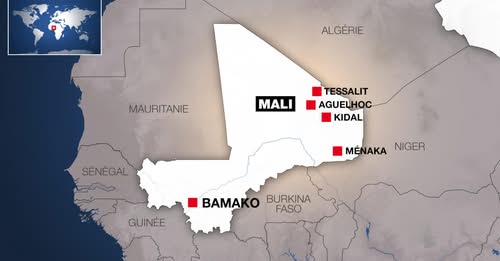
The security landscape in northern Mali has deteriorated rapidly, casting a pall over the region. Within days, the strategic balance has shifted dramatically. Following the symbolic fall of Kidal, armed groups are advancing with unprecedented speed, while the Group for the Support of Islam and Muslims (JNIM) has launched an unprecedented political gambit by urging the overthrow of the transitional government.
Military setbacks reminiscent of a dark past
A crisis reminiscent of the 2012 conflict is unfolding. On May 1, 2026, fighters from the JNIM and separatists from the Front for the Liberation of Azawad (FLA) seized critical military bases in Tessalit and Aguelhoc. The withdrawal of the Malian Armed Forces (FAMa) and their Russian partners, Africa Corps, facilitated the attackers’ entry without resistance.
A verified image has come to symbolize the humiliation: Seidane Ag Hitta, a prominent JNIM leader, is seen proudly holding the keys to the Tessalit base. This gesture carries profound significance, coming five years after the departure of the French Barkhane force. Since April 25, the towns of Ber, Tessit, Hombori, and Gourma Rharous have fallen, leaving residents of Gao and Timbuktu in a state of anxious anticipation.
Bamako’s response and Moscow’s unwavering support
Despite this crushing defeat, the Koulouba Palace remains resolute. General Assimi Goïta has issued a call for a « national awakening, » declaring that no « intimidation » will divert Mali from its path.
The military effort is now focused on two key fronts:
- Aerial and Ground Operations: The Malian army is conducting precision strikes on Kidal, targeting the governorate and logistical depots. While the FLA rebels dispute casualty figures, Bamako claims to have neutralized multiple « terrorists. »
- Logistics: As a jihadist blockade tightens around roadways leading to the capital, a massive convoy of 800 fuel tankers broke through this Friday, escorted by air support and ground troops.
From Moscow, the Kremlin, through spokesperson Dmitri Peskov, has reaffirmed its full backing for the transitional authorities, dismissing concerns about a potential Russian disengagement following losses in Kidal.
JNIM’s political maneuver: sovereignty or Sharia?
The most striking aspect of this crisis is its semantic shift. In a statement released on April 30, the JNIM abandoned its usual bellicose rhetoric in favor of a political discourse echoing that of its adversaries.
The group is now calling on « the nation’s vital forces, » political parties, and even religious leaders to form a « united front » to establish a « peaceful transition » and end the « dictatorship of the junta. » By invoking terms such as « sovereignty » and « dignity, » the JNIM seeks to sway segments of the public weary of conflict, while reasserting its ultimate goal: the imposition of Sharia law.
« In the face of the worst, we must seek the least of evils, » confides a former opposition minister, highlighting the dilemma now gripping Mali’s political class: should they engage in dialogue with yesterday’s enemy to stem the bleeding?
A regime under internal strain
Tensions are escalating even within the state apparatus. The prosecutor of the Bamako Tribunal has announced the arrest of several Malian soldiers, suspected of complicity in last weekend’s attacks.
Between the rebels’ territorial gains, the JNIM’s ambiguous political overtures, and the economic strain of the blockade, the transitional government is navigating its most profound crisis yet. The battle for Mali is no longer confined to the sands of the North—it is also being waged on the terrain of political legitimacy in Bamako.
You may also like
Burkina Faso: shrinking civil service payroll exacts a heavy toll on households and local economies
Simporé’s TV admission: Burkina Faso reacts as the security narrative crumbles
Gabon’s ghost payroll purge: public reaction, union pushback and what happens next
After Burkina Faso’s imam crackdown: the fallout, the anger, and the road ahead
Benin’s disability card rollout: reactions, scrutiny and what happens next