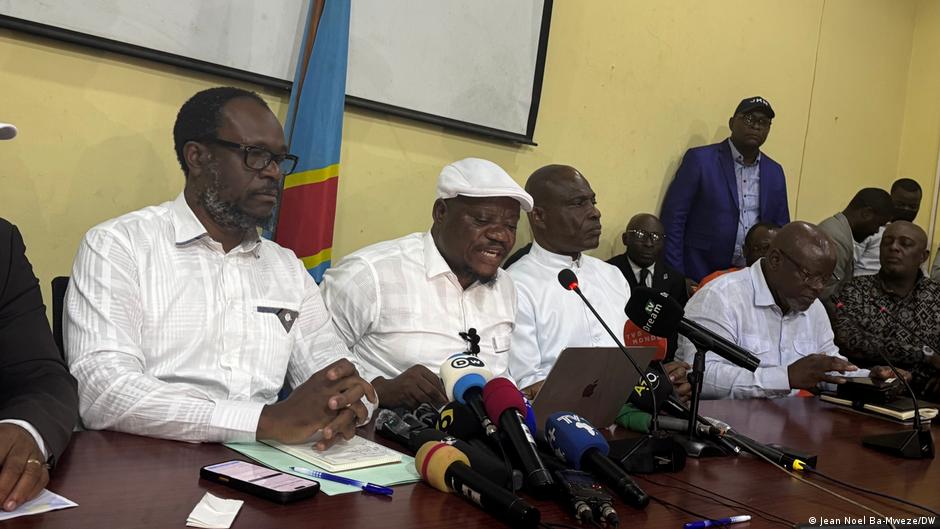
Congo politics: tshisekedi’s tactical retreat amid opposition ultimatum
In the Democratic Republic of the Congo, President Félix Tshisekedi has sent the referendum law back to Parliament for a second reading, despite a recent constitutional court ruling validating it with certain conditions. This move comes as the ultimatum issued by the opposition coalition Article 64 expires this Saturday.
The C64, alongside over 60 civil society organizations, demands that the president abandon his constitutional reform project by August 15 and reject the referendum law. They also call for the launch of an inclusive national dialogue. However, with the deadline just hours away, no date has been set for such talks.
Tshisekedi’s strategic retreat under pressure
While many assumed the referendum law was already in effect due to the lack of presidential promulgation within 15 days (as per Article 140 of the Congolese Constitution), Tshisekedi has opted to return the text to Parliament. The goal? A new deliberation based on the constitutional court’s observations.
According to Professor Bob Kabamba of the University of Liège, this decision represents a tactical retreat for Tshisekedi. However, it does not signal his abandonment of efforts to extend his rule beyond 2028, the end of his second term.
“It’s important to recognize the considerable pressure from both the opposition and regional actors. These combined forces, along with consultations, pushed Tshisekedi to backtrack by requesting a second reading of the law. It’s a retreat, but one that won’t stop him from pursuing alternative strategies to stay in power after 2028,” Kabamba explains.
The C64 vows renewed action after August 15
The C64 coalition has welcomed Tshisekedi’s decision to return the law to Parliament but remains unyielding in its demands. As the August 15 deadline looms, the coalition is preparing a series of unspecified measures to intensify pressure on the president.
“At midnight on August 15, we will confirm that nothing has been done. We will then announce major surgical operations led by our C64 laboratory to make this regime—which has stolen our freedom and is attempting to steal our national sovereignty—listen to reason,” declares Franklin Tshiamala, Secretary-General of the Leadership for Governance and Development (LGD), the political arm of former Prime Minister Augustin Matata Ponyo.
Standoff escalates as both sides dig in
From the government’s perspective, the referendum process is framed as a legitimate political and institutional initiative. The ultimatum from the C64 is dismissed as an illegitimate demand that cannot dictate the president’s agenda.
“The C64’s ultimatum is theirs alone—perhaps intended to please their backers. But the Republic continues to function normally,” asserts Adolphe Amisi Makutano, a member of the Union for Democracy and Social Progress (UDPS), the party of President Félix Tshisekedi.
The standoff remains unresolved, and August 15 may mark the beginning of a new chapter in Congo’s political landscape.
You may also like
Ivory Coast’s refusal of US deportee deal: what it means for West Africa’s economy and sovereignty
Senegal’s 2026 budget: what a Sonko blockade would mean for households and businesses
Nourane Foster’s PCRN resignation: what it means for Cameroon’s voters and 2027 race
Senegal’s electoral reform debate: what the fallout from Khalidou dit Mbaye Sokoma’s plan means for the country’s next steps
Senegal: how Sonko’s playful jab at Sadio Mané over 2029 is reshaping the political conversation