Ouagadougou’s controversial strategy: leveraging displaced miners for Moscow’s war effort
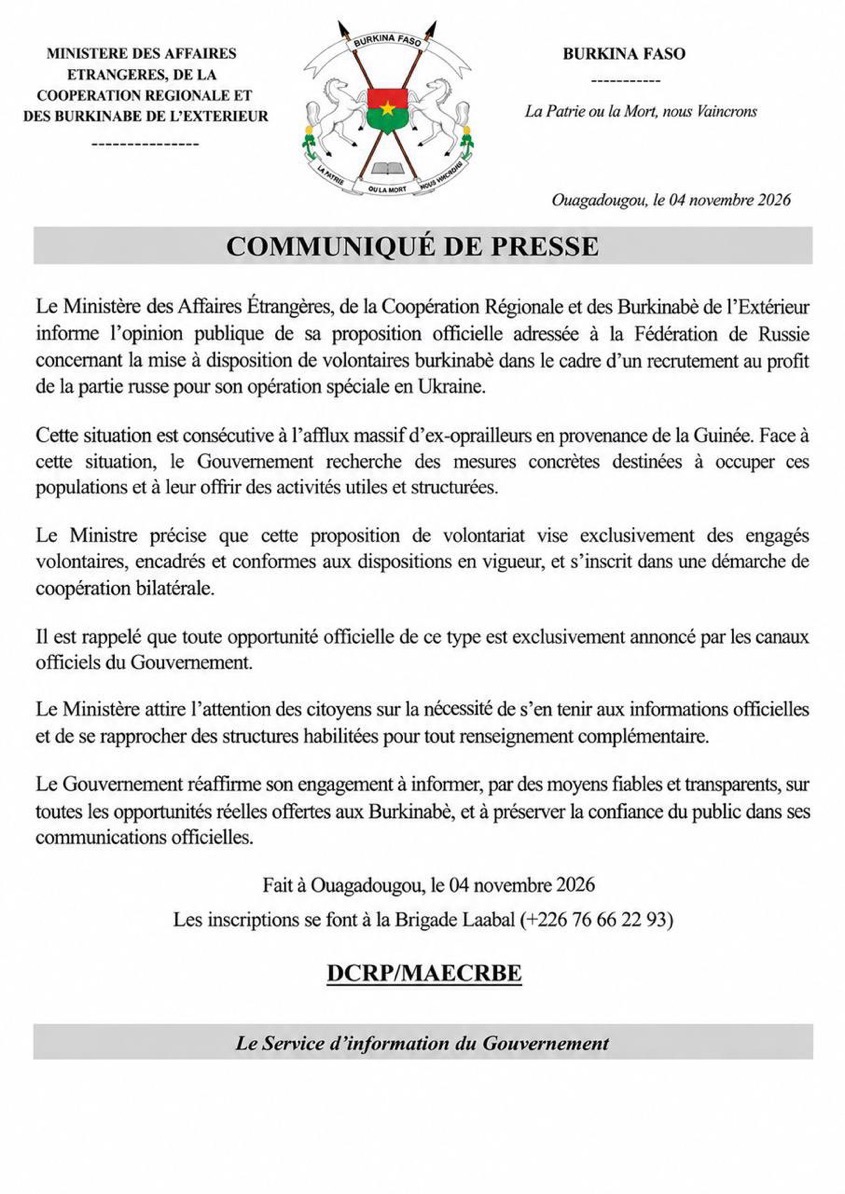
As Burkina Faso deepens ties with Moscow, a troubling development emerges: reports suggest that Ouagadougou may be facilitating the transfer of expelled Burkinabè gold miners to Russia for possible deployment in Ukraine. This alleged initiative raises critical questions about the true intentions behind these movements and the fate of some of the country’s most vulnerable citizens.
The proposal, if confirmed, would mark a dramatic shift from humanitarian assistance to a potential military recruitment drive. But is this a strategic move to address the immediate needs of displaced workers or an exploitative gamble that could send impoverished miners into a deadly foreign conflict?
At the heart of this controversy lies a paradox: a government touting sovereignty and strategic autonomy may be using its citizens as bargaining chips in a geopolitical equation far beyond their control.
From expulsion to recruitment: the precarious journey of Burkinabè miners
These miners were initially expelled from Guinea after being involved in unauthorized gold mining activities. Their return to Burkina Faso was presented as a humanitarian imperative yet the current process suggests a far more complex agenda. Reports indicate that certain groups of these returnees have been systematically gathered in Ouagadougou under the pretext of assistance, only to be redirected toward an uncertain and potentially dangerous future.
This trajectory from expulsion to alleged military enlistment illustrates how vulnerability can be weaponized. Economic desperation, combined with the loss of livelihood, makes individuals susceptible to offers that promise financial stability or even citizenship in exchange for military service.
The process unfolding in Ouagadougou raises immediate concerns: are these individuals fully informed of the risks they face? Has their consent been freely given, or is it the result of coercion or misleading promises? The answers to these questions will determine whether Burkina Faso is fulfilling its duty of care or abdicating it in favor of geopolitical convenience.
What do we know about the relocation process?
While official statements remain vague, credible accounts describe a coordinated effort to relocate expelled miners to Ouagadougou. The stated goal is humanitarian support, but the absence of transparency fuels skepticism. If these movements are merely evacuation procedures, why the need for secrecy? Why the urgency to regroup individuals who have already endured one forced displacement?
Key uncertainties persist: Who authorized the transportation? Was any compensation offered? And most importantly where are these people being taken, and for what purpose?
No official response has clarified the destination or the end use of these groups.
No public list of participants or their consent forms has been released.
The government’s silence on potential military implications only deepens public distrust.
Russia’s war needs and Ouagadougou’s expanding role
Russia’s sustained military engagement in Ukraine has created an insatiable demand for manpower. Open-source intelligence and battlefield reports consistently highlight severe personnel shortages, forcing Moscow to seek alternatives to traditional conscription. This context makes Burkina Faso’s potential role particularly significant.
Since seizing power, Burkina Faso’s transitional authorities have positioned Russia as a key security partner, replacing long-standing Western alliances with a new axis toward Moscow. Public appearances by Russian paramilitary instructors and joint training exercises have reinforced this partnership. But when cooperation extends to human resource transfers, the ethical and legal implications become impossible to ignore.
A partnership built on shared security interests must not become a pipeline for cannon fodder. If Burkina Faso is knowingly facilitating the transfer of citizens to a war zone under unclear conditions, it risks violating international humanitarian law particularly the principle of non-refoulement and obligations to protect citizens from harm.
Sovereignty versus exploitation: the moral cost of geopolitical strategy
Burkina Faso’s leadership has framed its pivot to Moscow as an assertion of national sovereignty a rejection of external interference and a quest for self-determination. Yet true sovereignty is not measured solely by political alignment; it is demonstrated through responsible governance, especially toward those most in need.
The situation of these miners exposes a dangerous contradiction: a government claiming to defend its people’s interests may be placing them in harm’s way for the benefit of a foreign power. If vulnerable citizens are systematically relocated under the guise of humanitarian aid only to be funneled into combat, the concept of sovereignty is undermined at its core.
A nation’s strength is not enhanced by sending its poorest to die in someone else’s war. If Ouagadougou is indeed orchestrating this flow of people toward Russia’s war effort, it is not asserting independence it is outsourcing its moral responsibility.
What safeguards are in place and are they enough?
« A sovereign state must protect its citizens, not use them as currency in strategic games. »
The absence of verifiable safeguards is alarming. No public framework has been presented regarding:
Informed consent procedures for enlistment
Clear contracts outlining service duration and compensation
Legal protections against coercion or fraud
Emergency repatriation clauses in case of injury or death
The risks are not theoretical: mercenary recruitment often targets individuals in dire economic straits. Without robust oversight, the line between voluntary service and coercion vanishes. Burkina Faso’s authorities must clarify their role are they facilitators, protectors, or enablers of human trafficking disguised as military cooperation?
A humanitarian crisis in disguise?
Behind the geopolitical maneuvering lies a human tragedy. These miners many of whom left Burkina Faso to escape poverty were expelled from Guinea, stripped of their livelihoods, and now face yet another displacement. If their ultimate destination is a Ukrainian battlefield, their story becomes one of exploitation rather than liberation.
The international community has repeatedly condemned the use of foreign fighters in Ukraine. Yet when such recruitment is outsourced through proxies like Burkina Faso, plausible deniability becomes a powerful shield. The ethical dimension cannot be overlooked: how can a government justify facilitating such a high-stakes gamble with human life?
Until Ouagadougou provides unequivocal answers, the world must question the narrative of cooperation and question whether this strategy serves the people or merely the interests of a distant warlord.
Where do we go from here?
The coming weeks will reveal whether this is a temporary logistical operation or the beginning of a systematic program. Civil society, regional partners, and the African Union must demand clarity. Transparency is not optional it is a moral and legal obligation.
Burkina Faso holds the power to reverse course. It can choose to reunite displaced miners with their families, offer real economic opportunities, and reject any role in fueling a foreign war. Or it can double down on opacity, allowing its citizens to be swept into a conflict they neither chose nor understand.
The choice will define not only its foreign policy, but its very claim to sovereignty.
By Daniel Mbami — Journalist