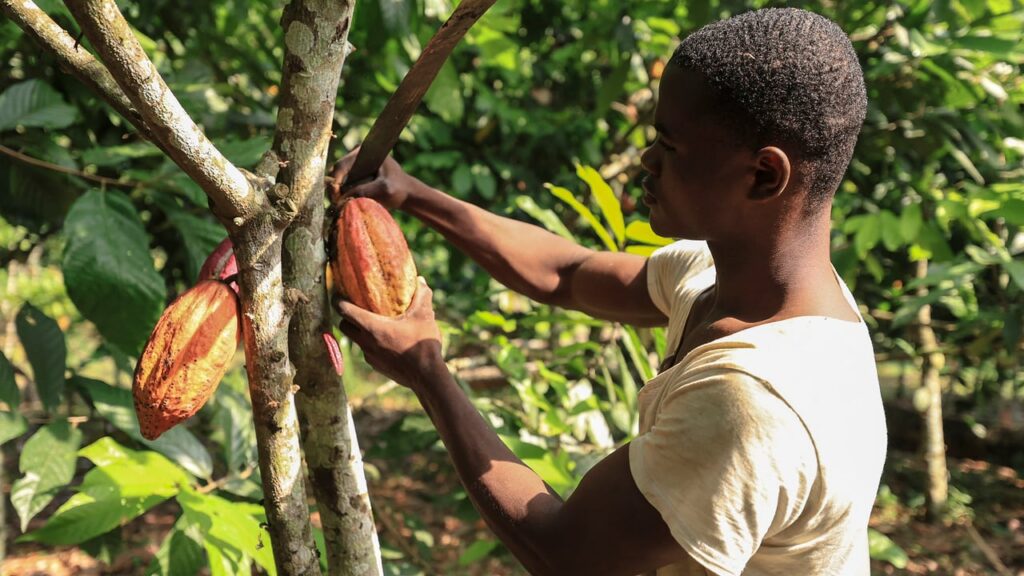
In the heart of Central Africa, Cameroon’s cocoa producers are navigating a turbulent landscape marked by fluctuating market prices, climate uncertainties, and logistical hurdles. Family-run plantations, the backbone of the nation’s cocoa sector, face an uphill battle to secure sustainable livelihoods while maintaining the quality that once earned Cameroon a reputation for premium beans.
Recent harvests have exposed the fragility of these small-scale operations. Farmers in regions like Ebebda and Mbankomo report declining yields despite increased inputs. The persistent issue of black pod disease, exacerbated by erratic rainfall patterns, continues to devastate crops, leaving many growers grappling with losses that threaten their very survival.
Market volatility and fair trade struggles
The global cocoa market’s instability casts a long shadow over Cameroon’s producers. International price fluctuations, driven by speculative trading and shifting demand in Europe and Asia, leave local farmers with little control over their earnings. While certified fair-trade cooperatives offer a glimmer of hope, only a fraction of growers can access these premium markets, often due to stringent certification requirements and limited infrastructure.
Many independent farmers feel sidelined, forced to sell their beans at below-market rates to middlemen who exploit the lack of transparency in pricing. The result is a cycle of indebtedness, where proceeds from one harvest barely cover the costs of the next planting season.
Government initiatives and ongoing challenges
Recognizing the sector’s critical role in rural employment and export revenue, the Cameroonian government has rolled out support programs aimed at revitalizing cocoa production. Initiatives include subsidized fertilizers, disease-resistant seedling distribution, and training workshops on modern farming techniques. Yet, critics argue that these efforts are fragmented and insufficient, failing to address systemic issues like poor road networks and unreliable electricity in farming communities.
Transportation remains a major bottleneck. The journey from remote plantations to processing hubs in Douala or Yaoundé is fraught with delays and additional costs, cutting into already slim profit margins. Without significant investment in infrastructure, even the most dedicated farmers struggle to compete on the global stage.
Hope on the horizon: innovation and resilience
Despite the adversity, pockets of innovation are emerging. Some cooperatives are experimenting with organic farming methods, tapping into niche markets willing to pay premium prices for sustainably sourced cocoa. Others are diversifying income streams by integrating beekeeping or shade-grown coffee alongside their cocoa trees, creating a buffer against market downturns.
Young entrepreneurs are also stepping in, leveraging digital platforms to connect directly with buyers and bypass traditional intermediaries. These grassroots initiatives, though small-scale, signal a shift toward greater autonomy for Cameroon’s cocoa producers. Yet, for the changes to be truly transformative, systemic support—from fair pricing policies to robust infrastructure—must align with these individual efforts.
The path forward for Cameroon’s cocoa farmers is undeniably challenging, but their determination to adapt and innovate offers a beacon of resilience in an ever-changing industry.
You may also like
After the #PSE debate, Cameroon’s youth push for digital accountability
Chad tackles gender-based violence with victim support mapping
Soaring cost of living in Niger: sociologist advocates market price tracking
Cotonou’s food safety revolution for port workers and vendors
Sudanese cultural influences reshape N’Djamena weddings