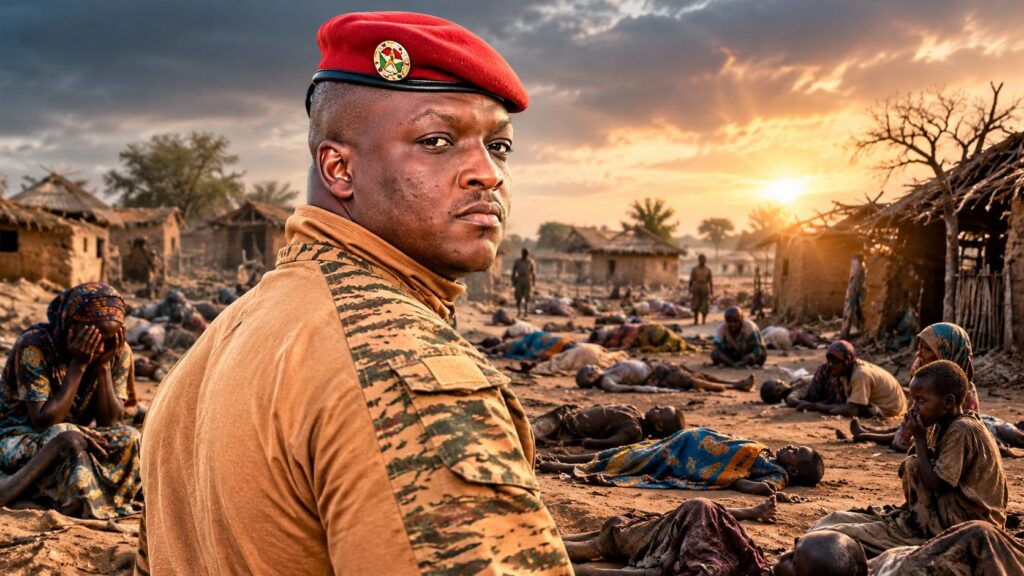
A village emptied as armed groups advance on the capital’s doorstep
Barely 77 kilometres north-east of Ouagadougou, the village of Boussouma has become the focal point of a humanitarian and security crisis that is now fuelling intense public debate across Burkina Faso. Once a thriving crossroads of trade and a symbol of community cohesion, the locality has witnessed a forced rural exodus, with residents fleeing the steady advance and entrenchment of armed terrorist groups.
The unravelling of traditional anchors: a green light for attackers
The security collapse stems directly from the recent overhaul of the administrative and traditional framework imposed by the authorities. By dismantling local customary authorities and disrupting the historic administrative network — through the application of legislation on the status of customary chieftaincy (law No. 002-2026/ALT) and adjustments within the Royal Court of Boussouma — the central government broke the social shield and informal security anchor that had kept the area cohesive.
This institutional vacuum and the resulting loss of reference points were seen on the ground as a de facto starting signal for armed groups. Exploiting the weakening of traditional structures that provided community relay and local intelligence, the attackers quickly moved in to assert control.
The noose tightens around the capital
The gradual installation of armed groups and the near-total displacement of Boussouma’s population mark a critical stage in the country’s security decline. Seeing a village positioned less than 80 kilometres from the capital deserted under terrorist pressure demonstrates the scale of the state’s territorial retreat.
Displaced families, a nation debating
As displaced people pour into neighbouring localities or attempt to reach the outskirts of Ouagadougou in utter destitution, Boussouma’s abandonment sharply raises the question of whether ongoing institutional reforms are appropriate — measures perceived by local populations as disconnected from the vital emergencies on the ground.
Reactions and the road ahead
The fall of Boussouma has triggered a wave of reactions, from civil society groups to local leaders, who question the wisdom of reforms that appear to have undermined the very structures protecting communities. Many now ask what comes next: will the state rethink its approach to customary governance, or will more villages follow the same path?
For the displaced families, the immediate outlook remains uncertain, with humanitarian needs mounting and no clear timeline for return. The debate over Boussouma is no longer just about one village — it has become a referendum on the state’s ability to hold its ground.
You may also like
After 25,000 tonnes of Russian wheat, Burkina Faso faces a food sovereignty reckoning
Madaouela fallout: how Niger’s uranium gamble with Atomic Eagle is being received
Chadian rebels in Lomé: the fallout, the debate, and what happens next for Togo
Moussa Kaka’s disappearance in Niamey: the fallout, the debate, and what happens next
358 russian fighters killed in three years: the fallout reshaping Mali’s security debate