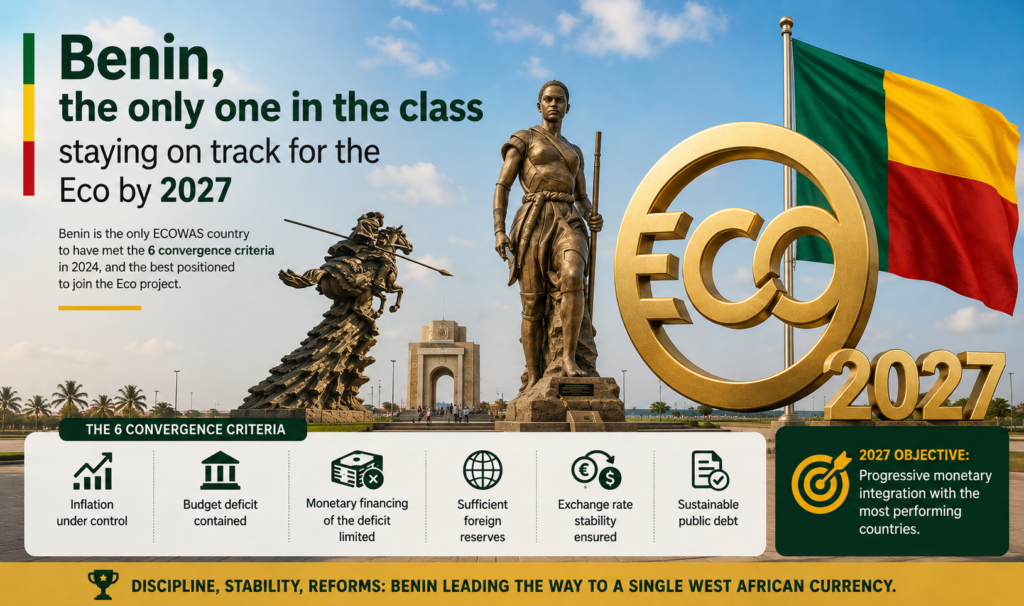
The Economic Community of West African States (ECOWAS) remains committed to introducing the Eco as a single currency by 2027, though regional economic disparities suggest not all member states will progress at the same pace. In this evolving landscape, the Republic of Bénin has emerged as a frontrunner, positioning itself as one of the most likely candidates for an early adoption of the monetary union.
Macroeconomic Readiness Sets Bénin Apart
While the concept of a unified West African currency has long been a cornerstone of ECOWAS integration efforts, the gap between political ambition and economic reality persists. Inflationary pressures, public deficits, debt levels, foreign reserves, exchange rate stability, and divergent national economic policies continue to pose significant challenges.
Under these circumstances, a staggered implementation of the Eco appears increasingly plausible, allowing the most prepared countries to adopt the currency first while others continue working toward convergence criteria. Bénin’s progress in this regard is particularly noteworthy, having met all six macroeconomic convergence benchmarks set by ECOWAS in 2024 a distinction shared by no other member state.
Six Pillars of Economic Discipline
The convergence criteria serve as the technical foundation for the Eco, designed to prevent disparities in national economic policies from undermining the stability of a shared currency. These indicators include:
Controlled Inflation: Ensuring price stability to protect purchasing power and monetary credibility.
Budgetary Restraint: Limiting fiscal deficits to comply with regional fiscal rules.
Monetary Financing Limits: Preventing excessive money creation to fund public spending.
Adequate Foreign Reserves: Maintaining sufficient reserves to cover several months of imports.
Exchange Rate Stability: Preserving a stable nominal exchange rate as a prerequisite for monetary integration.
Sustainable Debt Levels: Keeping public debt at manageable levels to avoid fiscal strain.
Meeting these benchmarks simultaneously signals robust economic governance, reinforcing the credibility of Bénin’s monetary and fiscal policies in the eyes of regional partners.
Years of Reform Pave the Way for Progress
Bénin’s achievement reflects a deliberate strategy of economic stabilization and growth. Over recent years, the government has prioritized revenue mobilization, public financial management reforms, and strategic infrastructure investments—all while navigating the complexities of balancing fiscal discipline with development needs.
This approach has required careful trade-offs: sustaining budgetary discipline without compromising essential public services, social programs, or critical infrastructure projects. The challenge now lies in converting this year’s compliance into a sustained trend, proving that Bénin’s economic performance is not merely an anomaly but a durable foundation for future integration.
A Gradual Transition Gains Momentum
The inherent economic heterogeneity among ECOWAS member states complicates a uniform transition to the Eco. Variations in debt burdens, fiscal space, inflation rates, and exposure to regional crises including security threats and trade disruptions demand a flexible, phased approach.
Rather than mandating simultaneous adoption, a progressive model would allow countries that meet the criteria to proceed while others continue their convergence efforts. Bénin’s consistent compliance places it in a prime position to join the initial cohort of Eco-adopting nations, potentially enhancing its economic influence within the regional bloc.
Strategic Advantages of Early Adoption
Should Bénin integrate the Eco ahead of schedule, the benefits could extend beyond monetary mechanics. A shared currency fosters deeper policy coordination, strengthening trade ties, investment flows, and financial credibility. For Cotonou, this could translate into improved economic attractiveness, greater investor confidence, and a stronger negotiating stance in regional economic forums.
However, the road to 2027 remains uncertain. The success of the Eco hinges not only on individual country performances but also on collective decisions regarding governance, monetary policy frameworks, and inter-state solidarity mechanisms. Political dynamics, including recent shifts in regional alliances, further complicate the integration landscape.
Sustaining Momentum Beyond 2024
Bénin’s current lead is a testament to its economic resilience, but maintaining this advantage will require continued vigilance. Key priorities include:
Preserving macroeconomic stability through disciplined fiscal policies.
Managing public debt to avoid unsustainable accumulation.
Controlling inflationary pressures to safeguard price stability.
Advancing structural reforms to strengthen long-term competitiveness.
Ensuring infrastructure and social investments do not compromise fiscal sustainability.
The ultimate test for Bénin will not be limited to outperforming peers in 2024. It will involve sustaining this trajectory as the Eco transitions from a theoretical framework to a tangible economic reality. By doing so, Cotonou could solidify its role as a leader in West Africa’s monetary integration journey, setting a benchmark for others to follow.
You may also like
Lyon’s goalless stalemate with Chelsea: the real-world fallout for fans, clubs and the women’s game
Eastern DRC peace mediation: what the latest Tshisekedi letter to Gnassingbé means for civilians and local businesses
Mali: JNIM ambush on Russian Africa Corps convoy near Niono — what it means for civilians and local trade
Mali’s poverty crisis: how hunger and hardship are reshaping daily life for millions
Jailing of lawyer Lirwana in Niger: the real-world toll on citizens, businesses and the economy