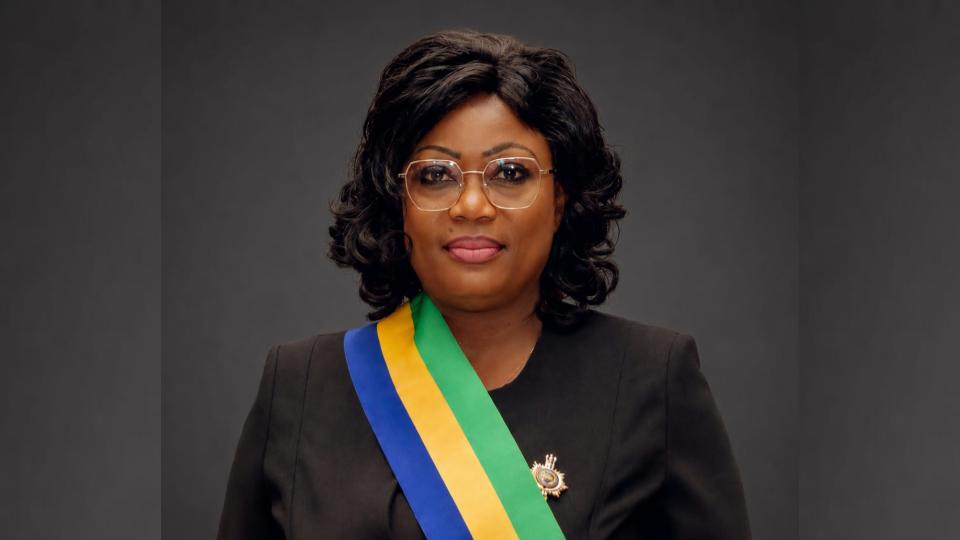
In the face of increasingly inflammatory remarks attributed to activist Landry Mbeng, widely known as Lanlaire, targeting Gabon’s President Brice Clotaire Oligui Nguema, his wife, and his mother, lawmaker Daisy Léance Akinikoussou has taken a firm stance. In a bold statement titled “It’s time to say: enough is enough,” the representative for the second constituency of the Plateaux region condemns what she describes as a dangerous escalation—one that has shifted from political critique to personal attacks against women and their families.
The question at the heart of this controversy is clear: does the freedom to criticize a leader extend to targeting their family? For Akinikoussou, the answer is unequivocally no. As Secretary-General of the National Network of Women Parliamentarians (RENAFED), she argues that there must be a strict boundary between rigorous political debate and attacks on the private lives of public figures’ loved ones.
Her remarks follow recent statements attributed to Mbeng, who has gained notoriety online under the alias Lanlaire. The lawmaker views the attacks on the President’s mother as a red line that should not be crossed.
Motherhood transcends political roles
“A mother remains a mother, regardless of the position held by her child,” Akinikoussou declares. In her view, the President’s mother cannot be fair game for political attacks simply because of her son’s role. She draws a sharp distinction: “One can challenge the President, reject his policies, and oppose his governance with unwavering force—but his mother is not a political actor merely because she is his mother.“
This, she insists, is not about defending President Oligui Nguema’s regime. It is about defending a principle—the right of every individual to dignity, free from attacks rooted solely in familial ties to a public figure.
Reaffirming the dignity of women in public discourse
As Secretary-General of RENAFED, Akinikoussou frames this debate around the broader issue of protecting women from symbolic violence and humiliation. She contends that demanding respect for one’s own dignity while contributing to the degradation of another is contradictory. “The fight for women’s rights cannot be selective,” she asserts. “It must extend to all women—even those whose views, alliances, or family connections we do not share.”
Her stance seeks to shift the conversation from partisan clashes to a more fundamental question: how do we prevent the normalization of insults and personal attacks in digital spaces?
Setting dangerous precedents
Akinikoussou warns that tolerating such rhetoric today could set a perilous precedent. The verbal violence directed at the leader’s family today could tomorrow target the loved ones of an opponent, journalist, activist, or ordinary citizen. “Today, it is the President’s mother. Tomorrow, it could be the mother of an opponent, a journalist, or any citizen,” she cautions.
Her plea is not to shield the head of state from criticism. On the contrary, she acknowledges the legitimacy of challenging his governance. What she demands is that debate remain focused on policies, actions, and decisions—not on the personal lives of those connected to power.
Restoring the boundaries of democratic debate
This intervention comes amid growing concern from civil society and public figures in Gabon about the erosion of online discourse standards. Beyond political divides, the issue now centers on the collectively accepted limits of public confrontation. Akinikoussou boils her position down to a simple truth: “One can be a determined political adversary without becoming an adversary of human dignity.”
In her view, democracy thrives when ideas are vigorously debated and leaders are held to account. But weaponizing mothers, wives, or relatives as tools to attack opponents erodes the very foundations of meaningful political discourse. Hence her uncompromising call: “Enough is enough.”
You may also like
Guinea-Bissau’s December election: what Embaló’s return means for daily life, stability and the economy
The $20 million bounty on Robert Brovdi: what it means for Ukraine’s citizens, businesses and war economy
What Tinubu’s four-week Europe trip costs Nigeria as independence day looms
Burkina Faso: how four years under Ibrahim Traoré reshaped the lives of millions
Cameroon’s Vision 4 shutdown: what the Martinez Zogo trial suspension means for viewers, journalists and business