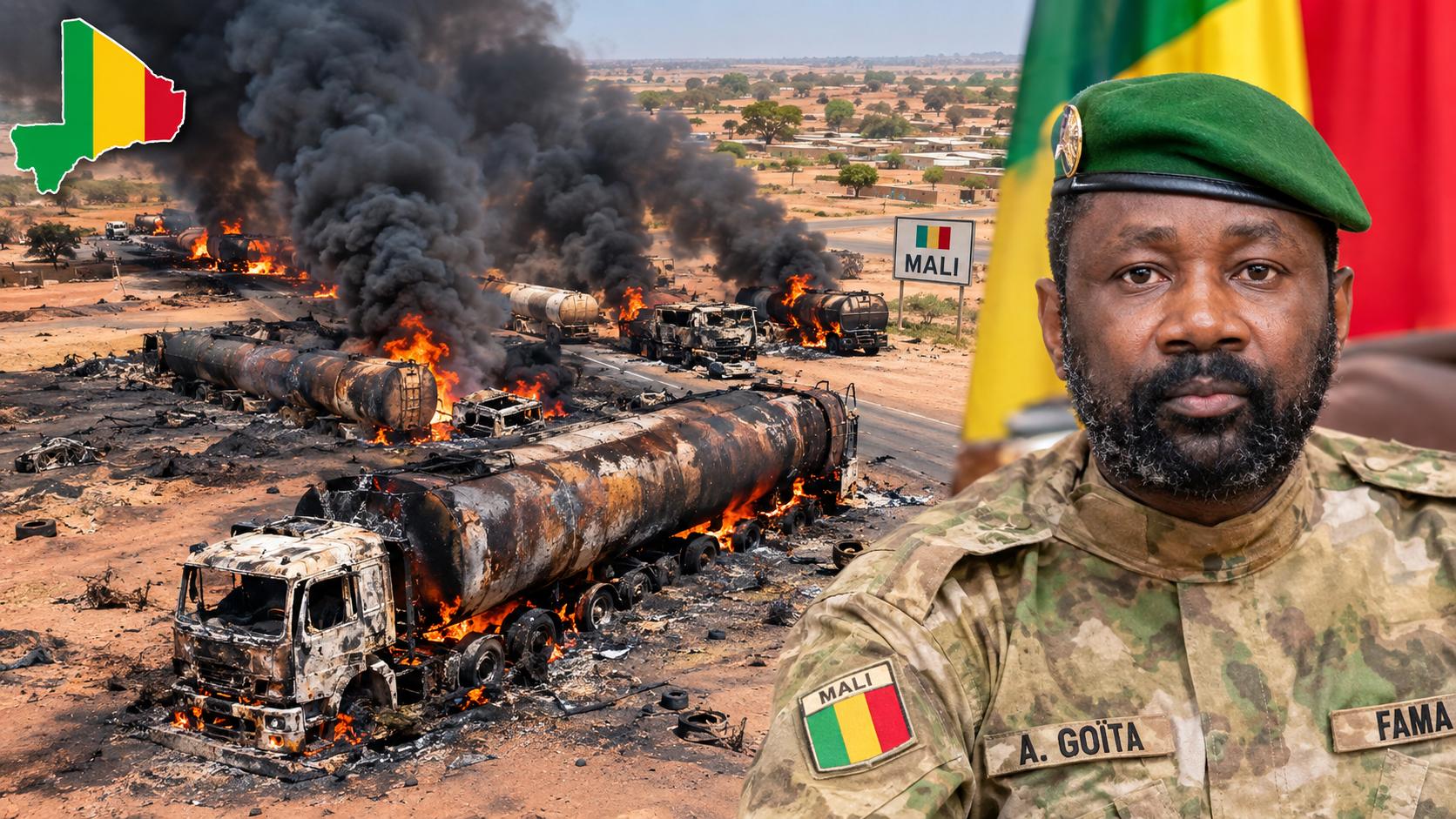
Since September 2025, the fuel convoy blockade imposed by JNIM has turned Mali’s supply routes into veritable front lines. In Bamako and towns across the interior, shortages have driven up transport costs, disrupted electricity, paralysed economic activity and hampered essential services. A year later, this economic strangulation tactic above all exposes a major weakness of the military government: its difficulty securing the nation’s vital arteries.
An economic weapon rather than a simple road blockade
On 7 September 2025, Abou Houzeïfa Bina Diarra appeared on video to announce a ban on fuel deliveries to Mali from several neighbouring countries, notably Sénégal, Côte d’Ivoire and Guinée. At the same time, the activities of Diarra Transport were targeted.
The initial incidents might have been passed off as isolated events. Malian authorities then spoke of accidents and weather-related traffic problems. But within days, the reality became hard to conceal.
On 14 September, JNIM, an Al-Qaïda affiliate, attacked a major convoy of tanker trucks on the Kayes–Bamako axis. Further attacks followed on the main commercial routes. An investigation by Bellingcat had already documented, by autumn 2025, more than 130 tankers destroyed in several verified strikes.
The choice of targets is far from trivial. Mali is landlocked and heavily dependent on road-borne fuel imports. The routes linking Bamako to Sénégal’s and Côte d’Ivoire’s ports and borders thus form a true national economic artery.
JNIM has not merely sought to burn trucks. It understood that by striking fuel, it could hit nearly every sector of the economy.
Fuel becomes the nerve of the crisis
In Bamako, the first consequences appeared at petrol stations. Endless queues, closed stations or rationing: the capital gradually faced an unusual scarcity.
By autumn 2025, the price of available fuel on some markets had spiked, while transport became more expensive. Reuters reported long queues in the capital and shortages also noted in Ségou, Mopti and San.
The mechanism is simple: when a tanker truck cannot move, dozens of other activities slow down. Taxis and intercity transport raise fares or cut rotations. Goods cost more to move. Merchants pass on surcharges. Households, for their part, see their purchasing power shrink.
Fuel thus becomes far more than a motoring expense: it becomes a component of the price of almost everything.
The situation also hit electricity. The energy sector’s reliance on fuel makes supply disruptions particularly sensitive. A Bellingcat analysis, citing satellite imagery, observed a decline in Bamako’s night-time lighting during the crisis.
From schools to hospitals, the whole society pays the bill
The economic effect was not confined to businesses.
Schools and universities were disrupted, and at times closed. With transport difficult, pupils, students and teachers could no longer move normally.
Healthcare also suffered. Médecins sans frontières reported that fuel shortages hampered patient travel, limited power supply to medical facilities, and made evacuations slower and costlier. At Bamako’s Hôpital du Point G, the organisation noted a 15% drop in consultations in its breast and cervical cancer treatment programme.
In interior towns, the situation is even more worrying. Bla, San or Mopti lack the capital’s absorption capacity. When supplies dwindle, consequences can quickly become systemic: generators idle, transport reduced, businesses slow and public services disrupted.
In other words, the blockade turns a military operation into a social crisis.
A strategic humiliation for the junta
For JNIM, this strategy has a huge advantage: it allows striking the government without having to take Bamako.
The group attacks what makes the capital function. It does not need to physically control each petrol station. It merely needs to make roads dangerous enough to deter transporters.
That is precisely what makes this campaign especially embarrassing for Assimi Goïta’s junta.
Since coming to power, the military regime has made sovereignty and territorial reconquest the core of its rhetoric. It cut ties with several Western partners, ended MINUSMA’s presence and strengthened its partnership with Russia. But the fuel crisis raises a far more concrete question: what is the use of this security strategy if the state cannot guarantee a tanker truck reaches its capital?
Army-escorted convoys have indeed managed to reach Bamako. Some arrivals were even celebrated as victories. Yet the very fact that the arrival of a hundred tankers can become a national event says much about the scale of the crisis.
Propaganda may present each arrived convoy as a show of force. Economically, it is also an admission of vulnerability: ordinary resupply has become a military operation.
On 25 April, the security crisis reaches the heart of power
The fuel crisis obviously does not alone explain the attacks of 25 April 2026. But their political impact was immense.
That day, coordinated attacks struck several localities and military positions, including Kati, Bamako, Mopti, Gao and Kidal. General Sadio Camara, the defence minister, was mortally wounded during the attack on his residence in Kati. His death was officially confirmed by the Malian government.
The event was a shock for a regime whose legitimacy rests largely on its ability to restore security.
A few months earlier, the authorities had to mobilise military escorts to protect fuel convoys. In April, the very heart of its security apparatus was directly hit.
The symbolism is hard to ignore: while the junta promised to retake territory, armed groups showed their capacity to disrupt trade routes, suffocate the economy and reach centres of power right up to Bamako’s outskirts.
A year on, the economy remains hostage to insecurity
The latest reported attack on fuel convoys, on 2 September 2026 between Fana and Ségou, reminds that the crisis is far from over. Tankers were reportedly set ablaze again and soldiers killed.
According to assessments published in 2026, more than 300 tankers have been destroyed since the campaign began.
These figures, however, require caution: access to the ground is limited, and information from the warring parties is difficult to verify independently. This opacity has itself become a problem.
Because behind the numbers lies a much simpler reality: an entire country cannot function normally when its main supply roads become war zones.
JNIM has managed to turn a geographic weakness — Mali’s landlocked status — into a strategic weapon. The junta, for its part, struggles to show it has a lasting answer to this threat.
Conclusion: when securing the economy becomes a battle
A year after the blockade began, fuel has become one of the best indicators of Mali’s crisis. Each tanker truck that reaches Bamako testifies both to the state’s capacity to react and to its inability to durably normalise the roads.
JNIM has grasped an essential point: it is not necessary to conquer a capital to weaken a regime. Sometimes it is enough to cut its supplies.
For the junta, the challenge thus goes far beyond counterterrorism. The task now is to restore circulation, protect economic infrastructure and rebuild the trust of transporters, businesses and populations.
And it is precisely on this ground that its sovereignty rhetoric faces its harshest test: a state is sovereign when it can protect its roads, feed its economy and guarantee essential services to its people. A year after the blockade began, Mali is still far from that.