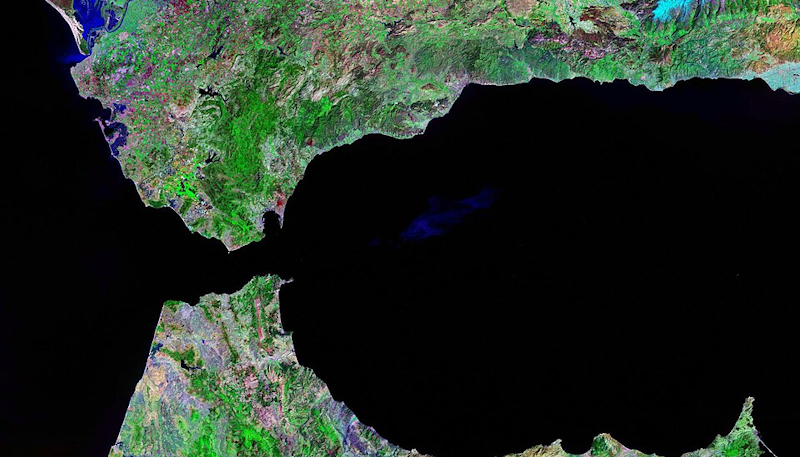
A new chapter is unfolding in the relationship between the United States and Morocco, with Ceuta and Western Sahara emerging as unexpected focal points. Diplomatic signals from Washington now suggest a shift in stance—one that could redefine alliances in the Western Mediterranean and test traditional partnerships.
Since late July, Washington has intensified its engagement with Rabat across multiple domains: territorial claims, economic ventures, regional security, and migration governance. The evolving dynamic follows a tumultuous period in Ceuta, where thousands of migrants surged into the Spanish enclave, straining relations between Morocco and Spain.
Within 24 hours, an estimated 50,000 individuals crossed into Ceuta, overwhelming Spanish authorities and prompting urgent calls for European support. While debate surrounds the origin of the influx—whether spontaneous or orchestrated—the crisis has undeniably amplified tensions between Rabat and Madrid.
Western Sahara: A cornerstone of Morocco’s diplomatic strategy
In December 2020, the U.S. formally acknowledged Morocco’s sovereignty over Western Sahara—a historic move linked to broader regional normalization efforts. The decision marked a turning point in a decades-long conflict pitting Rabat against the Polisario Front.
Now, Morocco is reinforcing its position by leveraging U.S. backing. High-profile initiatives, such as naming a major highway in Western Sahara after a former U.S. president, underscore Rabat’s intent to secure continued American support. Analysts view this as part of a broader campaign to align the Western Sahara issue with Washington’s geopolitical priorities.
« Morocco’s strategy hinges on maintaining U.S. endorsement of its autonomy plan, especially as international negotiations on Western Sahara intensify, » notes a regional observer. « The goal is to cement American backing until a resolution favorable to Rabat’s position is achieved. »
Economic interests fuel deeper ties
The momentum extends beyond politics. In late July, the U.S. ambassador to Morocco visited Laâyoune in Western Sahara to finalize a deal for an American-funded hydrogen and ammonia production unit. The project aligns with Washington’s push for investments that benefit U.S. enterprises while advancing Morocco’s economic development.
This convergence of interests—political support, economic opportunity, security collaboration, and shared regional objectives—forms the bedrock of the U.S.-Morocco partnership.
Pressure on the Polisario
Another development raises stakes for the Polisario Front. Two U.S. lawmakers introduced a proposal to evaluate classifying the movement as a foreign terrorist organization, citing alleged ties to Iran. While no concrete evidence supports these claims, the move reflects a broader U.S. strategy to counter perceived Iranian influence in North Africa and the Middle East.
« Morocco is capitalizing on Washington’s anti-Iran stance to reframe the Western Sahara conflict within the framework of U.S. priorities, » explains the observer. « By framing the issue in terms of regional security, Rabat aims to garner stronger U.S. backing. »
Ceuta and Melilla: A shifting U.S. stance
The most significant change lies in Washington’s evolving position on Ceuta and Melilla. Long considered Spanish territories, these enclaves are now the subject of statements suggesting a more ambiguous U.S. stance—one that some interpret as tacit support for Morocco’s territorial claims.
« Officials have signaled that Ceuta and Melilla are no longer viewed strictly as Spanish sovereign territory, » the observer notes. This shift could introduce new friction between the U.S. and Spain, particularly as Madrid has long relied on transatlantic alliances for regional security.
The Ceuta crisis: A strategic lever for Rabat
The surge of migrants into Ceuta occurred amid heightened tensions, raising questions about its origins. While some speculate it was a deliberate move by Morocco, others argue the influx was largely spontaneous before being exploited politically to pressure Madrid.
« The crisis served as a reminder to Spain that Morocco does not consider Ceuta and Melilla settled issues, » the observer remarks. « It was a calculated demonstration of leverage. »
Spain navigates a changing landscape
In response, Spanish Prime Minister Pedro Sánchez traveled to Algiers to strengthen energy ties with Algeria—a key Polisario ally. While this move may appear provocative to Rabat, analysts suggest it does not signal a fundamental shift in Spain’s support for Morocco’s autonomy plan for Western Sahara.
The Ceuta crisis, however, underscores a deeper territorial dispute between Spain and Morocco, one that transcends broader diplomatic alignments.
Uncertainty for Spain’s strategic framework
For Spain, the stakes are high. Traditionally, Madrid has relied on alliances with the U.S. and NATO to safeguard its interests. A U.S. departure from its long-standing position on Ceuta and Melilla could destabilize this framework, introducing uncertainty into Spain’s security calculus.
While an immediate crisis is unlikely, the current trajectory suggests that the sovereignty question over Ceuta and Melilla could resurface in future negotiations, reshaping regional dynamics in the Western Mediterranean.
A new geopolitical triangle
The evolving U.S.-Morocco relationship is reshaping power structures in North Africa. Rabat seeks to lock in U.S. support for its positions on Western Sahara and the Spanish enclaves, while Washington prioritizes strategic and economic interests. Meanwhile, Spain faces an increasingly unpredictable transatlantic partnership.
For Morocco, this moment presents an opportunity to consolidate gains. For Spain, it poses an unprecedented strategic challenge. Western Sahara and Ceuta—once separate issues—are now intertwined in a broader contest for influence in the Maghreb and the Western Mediterranean.
You may also like
South Africa’s gun violence crisis deepens as 27 killed in Johannesburg and Cape Town shootings
Burkina Faso: shrinking civil service payroll exacts a heavy toll on households and local economies
Simporé’s TV admission: Burkina Faso reacts as the security narrative crumbles
Gabon’s ghost payroll purge: public reaction, union pushback and what happens next
After Burkina Faso’s imam crackdown: the fallout, the anger, and the road ahead