
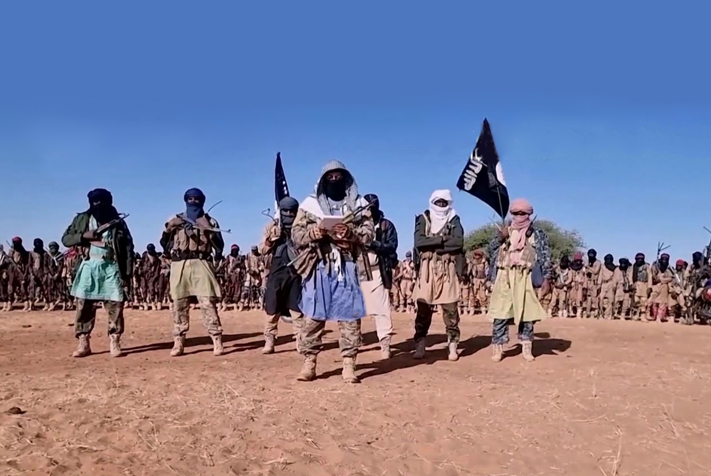
The Islamic State’s Sahel Province keeps a firm grip on northeastern Mali, even as rival factions dominate headlines
Despite growing attention on the Jama’at Nusrat al-Islam wal Muslimin (JNIM), the Islamic State’s Sahel Province (ISSP) continues to assert its presence in key areas of Mali. The Gao region—specifically the Ansongo district—and the Ménaka region remain hotspots where the ISSP maintains operational dominance. Localities such as Talataye, Tin-Hama, Tessit, and Labbezanga serve as critical nodes for the group, where it enforces territorial control and exerts constant pressure on nearby communities.
Leadership and Adaptation
The ISSP is currently led by Abu Al-Bara, who took charge after the 2021 death of Adnan Abu Al-Walid Sahraoui. While the exact command structure remains somewhat fluid, the group has shifted its tactics since 2020. Rather than relying on high-profile executions to instill fear, the ISSP has adopted a more calculated approach—focusing on localized governance and territorial influence. This strategy aims to embed itself within communities while minimizing the media attention that once exposed its brutality.
Military Pressure and Operational Tactics
Malian Armed Forces (FAMa) have intensified their efforts to dismantle the ISSP, most recently targeting a key operative in Bara, Ansongo district, during an overnight airstrike on May 14–15, 2026. The operation also resulted in the elimination of several affiliated fighters, underscoring Mali’s relentless pursuit of the group. Yet, the ISSP’s ability to regroup along border regions and sustain its logistical networks remains a persistent challenge for security forces.
The group continues to assert control over strategic routes linking Mali and Niger, particularly around Talataye, Tin-Hama, Tessit, Labbezanga, and Ménaka. By regulating the movement of people and goods, the ISSP reinforces its dominance over these critical corridors, while also influencing local armed factions to align with its objectives.
Rivalry with JNIM and Shifting Dynamics
The rivalry between the ISSP and JNIM has reshaped the Sahel’s security landscape. While JNIM has gained visibility through high-profile attacks—such as the coordinated assaults near Bamako on April 25, 2025—the ISSP has not vanished. Instead, the two groups operate under fundamentally different strategies. JNIM prioritizes spectacular, media-driven strikes, whereas the ISSP focuses on subtle territorial control, community pressure, and securing key transit points.
Transfuges from JNIM initially contributed to a relative lull in direct clashes, but this fragile truce has eroded since 2020. Recent military offensives by Malian forces have temporarily shifted the groups’ focus toward a common adversary, though no formal peace agreement has been reached.
Ongoing Threats and Regional Impact
Data from the Armed Conflict Location & Event Data Project (ACLED) confirms that in the first quarter of 2026, 86% of Islamic State activity worldwide occurred in Africa. The ISSP has escalated its use of armed drones, motorized attacks, and economic coercion to destabilize both urban and rural zones. Targets have included critical infrastructure along the Ménaka–Ansongo–Tessit axis and Labbezanga, where the group exploits local vulnerabilities to enforce its de facto rule.
A recent incident on February 7, 2026, demonstrated the ISSP’s reach when it ambushed a civilian convoy near Kobé, just 35 km from Gao. While international security cooperation has led to the neutralization of key figures—such as Abu-Bilal Al-Minuki, eliminated on May 16, 2026, in a joint operation involving the Nigerian military and U.S. forces in the Lake Chad Basin—the ISSP’s presence in northeastern Mali remains unbroken. Localities like the 3 T’s and Labbezanga continue to witness persistent territorial control and influence over armed groups, ensuring the group’s enduring threat.
The ISSP’s ability to thrive amid shifting security dynamics highlights its resilience. By leveraging media focus on rival factions, it has quietly consolidated its position, deepened its influence over populations, and maintained relentless pressure on Malian forces. Strengthening counterterrorism efforts along the Mali-Niger border will be crucial to curbing its expansion and restoring stability to the region.
You may also like
Mamadi Doumbouya de retour à Conakry après une visite d’État en Côte d’Ivoire
Elversberg vs Bayern Munich: kick-off time, tv channel and team news
Gabon : l’association Force ouvre un espace de propositions pour la rentrée
Dakar 2026 : Diomaye Faye confie la flamme olympique à la jeunesse sénégalaise
Mali: at least 80 soldiers killed in deadly assault on Dioura camp