
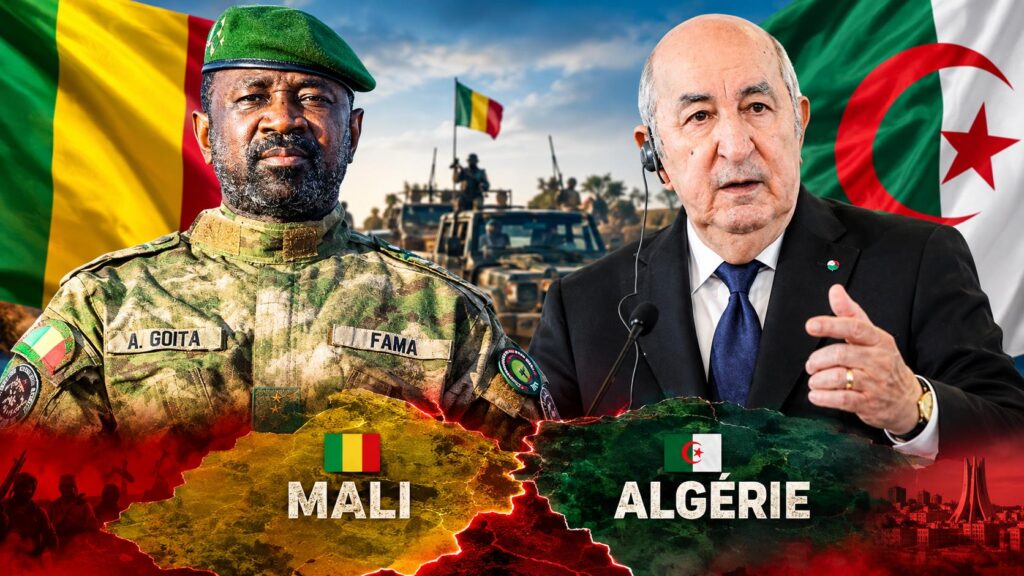
Algeria’s prime minister, Sifi Grine, spent Monday in Bamako, standing shoulder to shoulder with the man who runs Mali, army general Assimi Goïta. The visit was staged as a decisive step towards warmer ties between two Sahelian neighbours, yet the pageantry hides a far messier diplomatic picture. Behind the firm handshakes and the carefully worded statements, the memory of a bitter quarrel and the long shadow of the 2015 Algiers Accord still hang over a relationship that had sunk to its lowest point.
A photograph at Koulouba meant to steady a wobbling relationship
The setting was intended to look historic and reassuring: the reception rooms of the Koulouba palace, an Algerian prime minister on one side, Mali’s military ruler on the other. Sifi Grine and General Assimi Goïta sat down to discuss tighter bilateral links, security cooperation and a fresh push for economic exchanges across a Sahel region under heavy strain.
What the two delegations put on the table
- Closer political and diplomatic coordination between Bamako and Algiers
- Joint efforts on security and border surveillance
- Rel launching trade and economic exchanges in a tense regional climate
For Algerian diplomacy, the trip fits a clear ambition: regaining a foothold in its southern backyard. For Bamako, parading a diplomatic partner of real weight is a way out of growing international isolation. Even so, the picture of unity struggles to convince those who follow the file closely.
Two capitals, two very different calculations
Algiers wants influence and stability along its southern frontier. Bamako wants visible backing and a counterweight to partners it has pushed away. Neither objective is the same as friendship, and neither side pretends otherwise.
The heavy baggage left by Bamako’s accusations
This sudden brotherly warmth follows months of an unusually sharp diplomatic crisis. Not long ago, the military authorities in Bamako were piling harsh criticism on Algiers, turning sovereignist rhetoric into a signature style and openly accusing their northern neighbour of meddling in Mali’s internal affairs.
The grievances that were hammered home
- Algeria’s reception of Malian opposition figures and influential religious leaders
- Suspected backing for autonomy-seeking rebel groups in the north
- Claims that hostile acts were being carried out behind a peacemaking facade
By pointing at Algiers, the junta was also looking for an outside scapegoat, a convenient way to explain a stalled security campaign and a deteriorating situation on the ground.
A marriage of convenience dictated by geopolitics
The rapprochement celebrated this Monday looks far more like a forced union of interests than a sincere, lasting alliance. Bamako has cut ties abruptly with its traditional Western partners and is tangled up in uncertain regional arrangements, so it is hunting for new diplomatic supporters wherever it can find them.
Algiers, for its part, cannot live with a permanent pocket of instability on its southern border, a space that breeds terrorist networks and cross-border trafficking. The meeting between Sifi Grine and Assimi Goïta therefore comes down to hard pragmatism: keep up appearances, avoid the point of no return, and leave the deep mutual resentment that has eaten away at trust between the two governments untouched.
Why the 2015 Algiers Accord still hands Algeria the stronger hand
In this quiet tug of war, Algeria keeps an undeniable strategic advantage. Long seen as the security lock and the indispensable mediator of the Sahel, it set the pace of peacemaking in the region for years, most notably through the Algiers Accord signed in 2015.
When the junta unilaterally disowned that agreement in early 2024, it believed it was asserting its authority and sweeping away any outside supervision. Events proved otherwise. Dropping the Algerian negotiating framework brought neither peace to northern Mali nor an end to the security threat. By travelling to Bamako today to press its own terms and reopen the dialogue, the Algerian government is demonstrating its political centrality: Bamako may try to ignore Algerian diplomacy, but it always ends up having to reckon with it.
The limits of diplomacy conducted in uniform
This ceremonial visit buys General Assimi Goïta a welcome media breathing space, yet it settles none of the underlying problems. Mali’s junta keeps building its authority on security rhetoric while indefinitely postponing a return to a democratic constitutional order.
Without a real commitment to domestic political stability and without a sincere regard for regional balances, the pledges made during this encounter risk amounting to nothing more than public relations. Behind the diplomats’ smiles and the stiff uniforms, the Bamako-Algiers relationship remains a minefield where each side waits for the other to take a false step.
You may also like
Sonidep’s 2026 loss: how Niger’s cheap fuel policy is draining the state oil company
Texforces-BF: a textile plant built on Burkina Faso’s retirement savings
Niger’s external liabilities reach 12,900 billion CFA francs as dependence deepens
Benin’s school canteens now feed 1.9 million children every school day
Burkina Faso: sovereignty on credit and the bill that comes later