
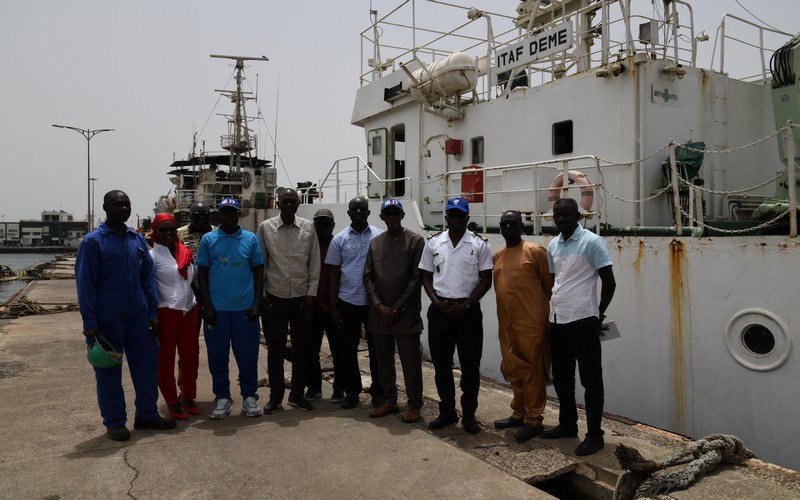
Senegal is demonstrating a strong commitment to revitalizing its fisheries and oceanographic research capabilities with the anticipated rehabilitation of the research vessel ITAF Dème. This strategic floating laboratory, a cornerstone of the national maritime scientific infrastructure, particularly for the Dakar-Thiaroye Oceanographic Research Center (CRODT) of the Senegalese Institute of Agricultural Research (ISRA), has been out of service since November 2022.
On May 14, 2026, Dr. Mamadou Abibou Diagne, Secretary General of the Ministry of Fisheries and Maritime Economy, undertook an official visit to the vessel at the Port Autonome de Dakar. The purpose of this visit was to assess the prospects for reactivating this crucial scientific asset.
The ITAF Dème: a strategic asset for fisheries and the blue economy
Through its essential work in evaluating fish stocks, monitoring marine ecosystems, collecting vital oceanographic and environmental data, and training technical and scientific teams, the ITAF Dème plays a central role in the sustainable management of Senegal’s marine resources.
Beyond its scientific endeavors, this vessel also holds significant national sovereignty implications. It empowers Senegal to generate its own maritime data, reducing dependence on foreign expertise, and solidifying its regional leadership in fisheries and oceanographic research across the West African sub-region.
However, its immobilization since November 2022 has severely hampered scientific activities at sea, including critical oceanographic campaigns and regular monitoring of fish stocks, causing considerable concern among experts.
Ministerial visit propels vessel’s operational revival
The mission led by the Secretary General of the Ministry of Fisheries and Maritime Economy included prominent figures such as Dr. Moustapha Guèye, Director General of ISRA; Youssoupha Bâ, Secretary General of the institution; and Dr. Ismaïla Ndour, Director of CRODT, accompanied by his technical team.
During this important meeting, Captain Seydina Hamza Amar, the vessel’s commander, presented a detailed technical assessment of the ship. His report, which authorities found reassuring, affirmed that the vessel remains technically salvageable and that its return to service is achievable through targeted rehabilitation efforts.
Captain Amar underscored that the vessel still possesses the necessary capabilities to resume its scientific missions at sea.
Government pledges renewed commitment to fisheries science
Following a thorough inspection of the vessel’s facilities and scientific equipment, Dr. Mamadou Abibou Diagne reiterated the government’s steadfast commitment to enhancing national maritime scientific research capacities.
He emphasized that, alongside the ongoing project to acquire a new research vessel, the government is determined to rehabilitate the ITAF Dème. The aim is to establish it as a foundational pillar for sustainable fisheries management and the advancement of Senegal’s blue economy.
The Secretary General also highlighted the strategic importance of the fishing sector to the national economy, explaining the significant attention this vessel commands from the highest levels of state authority.
CRODT highlights critical impact of vessel’s inactivity
Dr. Ismaïla Ndour, Director of CRODT, welcomed the official visit, interpreting it as a powerful signal of support for fisheries and oceanographic research.
He observed that the presence of ministerial authorities aboard the ITAF Dème underscores a heightened recognition of scientific research’s strategic role within public policies related to fishing and the maritime economy.
Dr. Ndour further elaborated on the substantial economic and scientific repercussions stemming from the prolonged immobilization of Senegal’s sole national fisheries research vessel.
He specifically noted that crucial stock assessment campaigns, indispensable for determining fish surpluses required for profitable national fishing agreements, are currently struggling to proceed. Moreover, Senegal’s regional leadership in fisheries and oceanographic research is significantly impacted by the halt of scientific expeditions previously conducted by the ITAF Dème across the sub-region.
Concluding his remarks, Dr. Ismaïla Ndour expressed optimism that the proactive momentum initiated by ministerial authorities opens encouraging prospects for progressively addressing the challenges confronting fisheries and oceanographic research, particularly concerning scientific equipment, operational capabilities, and the monitoring of marine resources.
You may also like
Mali: at least 80 soldiers killed in deadly assault on Dioura camp
Côte d’Ivoire : le Burida redistribue 795,4 millions FCFA à 5 435 créateurs
Paris FC vs Lyon: kick-off time and TV channel for the Ligue 1 clash
Niger: does Tiani’s purge expose hidden fractures at the top?
Everest Finance dévoile Sama Naffa, une épargne à petits pas au Sénégal