Strengthening human rights frameworks in the Sahel’s most volatile regions
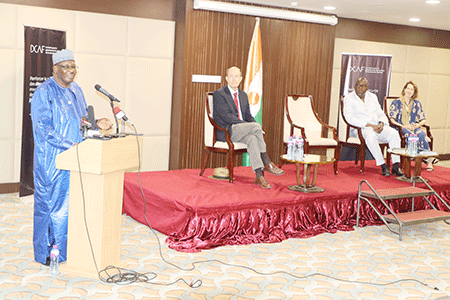
The National Human Rights Commission of Niger (CNDH) recently hosted a pivotal regional conference in Niamey, bringing together key stakeholders to address critical gaps in human rights protection across the Sahel. Held over two days, the event focused on equipping participants with effective tools to combat violations in the tri-border area shared by Burkina Faso, Mali and Niger—a region increasingly destabilized by asymmetric warfare and systemic abuses.
Among the distinguished attendees were the Deputy Secretary-General of Niger’s Ministry of Justice, the DCAF Africa Director, and the German Ambassador to Niger. Their presence underscored the urgency of collaborative action to safeguard civilians amid escalating violence.
Confronting systemic violations in the tri-border zone
In his opening address, Maty El Hadj Moussa, President of the CNDH, highlighted the dire situation in the tri-border region, where civilians endure unparalleled brutality. “Armed groups—both unidentified and those masquerading as security forces—inflict indiscriminate harm, turning communities into battlegrounds,” he stated. “The enemy hides among the population, making any attempt at reporting a potential death sentence.”
Moussa emphasized that the crisis demands immediate, coordinated responses from human rights defenders to restore peace, security, and stability for affected populations.
Uniting stakeholders for collective impact
The conference aimed to reinforce institutional capacities for monitoring and preventing rights violations while fostering good governance and the rule of law. Key objectives included:
- Training stakeholders on advanced human rights protection mechanisms and preventive tools;
- Enhancing collaboration between national and regional institutions to strengthen oversight roles;
- Promoting dialogue on adapting legal frameworks to address emerging threats.
Moussa Sahirou Tchida, Deputy Secretary-General of the Ministry of Justice, reiterated the necessity of unified efforts. “This conference exemplifies the vital partnership between Sahelian nations and international allies, particularly the European Union, whose support made this initiative possible. Together, we are committed to stabilizing the tri-border region,” he affirmed.
Addressing the Sahel’s multifaceted crises
Anne Benette, DCAF’s Africa Director, underscored how political instability, humanitarian emergencies, and transnational crime exacerbate human rights abuses in the Sahel. “The interplay of insecurity, armed conflict, and community tensions erodes social cohesion and undermines the rule of law,” she noted. “This gathering provides a vital platform to share best practices, identify shared challenges, and collectively strengthen our response.”
Germany’s role in supporting Sahelian resilience
Herman Nicolai, Germany’s Ambassador to Niger, painted a stark picture of the Sahel’s escalating violence. “The region faces an unprecedented surge in extremist violence and organized crime, resulting in thousands of civilian and military casualties and displacing countless families,” he warned. “Germany remains steadfast in supporting Sahelian nations to rebuild security and uphold human dignity.”
As the conference concluded, participants left equipped with actionable strategies to enhance human rights protections in one of Africa’s most perilous zones. The event served as a testament to the power of regional cooperation in addressing shared threats to peace and justice.