
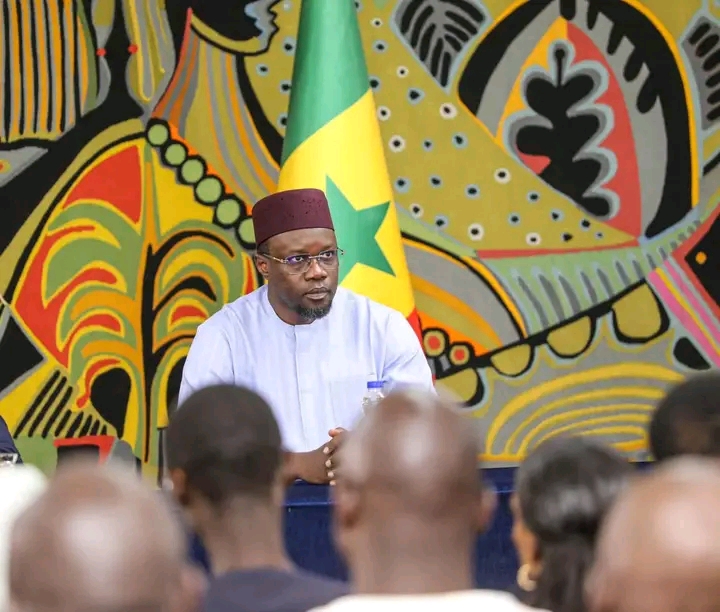
In Senegal, Prime Minister Ousmane Sonko convened an interministerial council on Thursday, May 21st. During this crucial meeting, the head of government emphatically conveyed his frustration regarding the handling of various national dossiers. He reiterated accusations against the previous administration of Macky Sall, alleging widespread prevarication and mismanagement of public resources.
Following the presentation of an audit detailing public assets and infrastructure, Sonko declared that ‘the facts are beyond comprehension.’ The inventory, compiled by the Prime Minister’s Office, revealed a startling 245 infrastructure projects and strategic assets currently stalled, incomplete, or significantly underutilized. The total financial impact of these issues is estimated to exceed 5,000 billion FCFA, a sum comparable to Senegal’s entire annual budget. ‘Some even believe this amount mirrors our national public debt,’ the Prime Minister lamented, condemning it as ‘pure and simple waste.’
A further striking revelation highlighted that out of 94 ongoing construction sites nationwide, 62 have effectively ground to a halt. These projects collectively consume over 5,227 billion FCFA. The Prime Minister expressed particular dismay over the Sandiara high school project, initiated in 2014, which remains unfinished. He passionately denounced the situation, stating, ‘Twelve years to construct a high school is an aberration.’
Prime Minister Sonko’s Stance on Accountability and JusticeSeizing the opportunity, the head of government intensified his criticism of the judiciary, alleging that it shields influential figures, or ‘barons,’ from the previous administration who are implicated in the embezzlement of public funds. Ousmane Sonko candidly admitted, ‘Sometimes, I harbor doubts. I question whether it’s truly worthwhile to persist. In this nation, individuals can seemingly act with impunity and remain well-protected. The system, as it stands, appears intact.’ He even suggested the presence of alleged ‘judicial sabotages’ involving certain magistrates. Emphasizing the public’s right to justice, he asserted, ‘These cases do not belong to the magistrates; they belong to the people.’ Sonko concluded by warning that he intends to ‘raise the tone’ on these issues in the weeks ahead.
You may also like
Le carnet de Malian relance l’enquête sur la migration clandestine au Sénégal
Mamadi Doumbouya de retour à Conakry après une visite d’État en Côte d’Ivoire
Elversberg vs Bayern Munich: kick-off time, tv channel and team news
Gabon : l’association Force ouvre un espace de propositions pour la rentrée
Dakar 2026 : Diomaye Faye confie la flamme olympique à la jeunesse sénégalaise