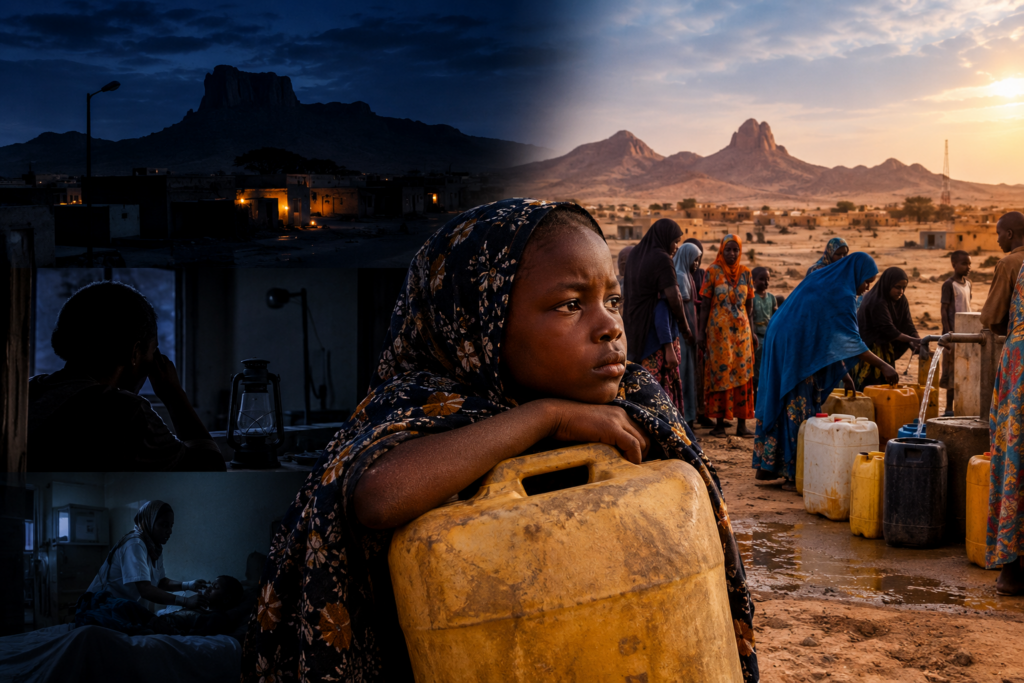
The human cost of darkness and thirst in northern Niger
For households across the Agadez region, the unrelenting shortage of electricity and clean water has moved beyond inconvenience to become a daily struggle that reshapes every aspect of life. For two months and counting, families in Agadez, Arlit, and Tchirozérine have endured repeated power cuts and dwindling water supplies, exposing the widening gulf between official pronouncements and the lived experience of citizens.
The consequences are not abstract. They are measured in interrupted medical treatments, shuttered businesses, children studying by dim lantern light, and households forced to seek water from unsafe sources. This is the reality that official statements about new energy capacity fail to capture.
When the grid fails, essential services collapse
The energy situation in Agadez has remained critically strained for months. By May, regional authorities had publicly acknowledged disruptions in both electricity and water provision, dispatching officials to the national power utility and the water company to assess the crisis.
By July, the problem had escalated. Arlit experienced repeated load-shedding that disrupted health services, prompting local officials to visit the health district to evaluate the impact on patient care. The national power utility attributed the outages to maintenance work at the Sonichar coal plant, but for residents, technical explanations offer little comfort when homes, shops, and essential services are plunged into darkness.
In more isolated communities, residents report going without power for weeks at a time. While these accounts require verification on a case-by-case basis, they underscore a growing sense of abandonment among populations that feel forgotten by the central government.
The water crisis: a direct consequence of power failures
The energy deficit directly exacerbates the water shortage. Pumping stations depend on electricity, and when the grid fails, water supply collapses with it.
In Agadez, water utility officials conceded in May that available production approximately 19,500 cubic meters fell short of the population’s needs. Weeks later, the situation remained dire. Reports from July described a simultaneous shortage of drinking water, electricity, domestic gas, and fuel across the region’s main towns.
For many residents, the fallout is severe: when piped water is unavailable, they must seek alternatives. In areas where options are scarce, families may be forced to rely on unprotected ponds and streams for their daily needs, raising serious health risks.
National figures mask a regional divide
The government maintains that it is expanding electricity production. In July, the energy minister announced a national installed capacity of 420 megawatts, with 294 megawatts effectively available. Yet the same presentation revealed that the northern zone receives only 16 megawatts of available power.
This discrepancy highlights a central problem: boosting national capacity means little if electricity does not reliably reach households in remote areas. The gap between national ambitions and the reality in northern towns could not be starker.
Two essential needs, one unanswered question
Water and electricity are not secondary services. They underpin health, economic activity, education, commerce, and the basic conditions of life. The regime of General Abdourahamane Tiani may highlight investments, new energy capacity, or infrastructure projects, but on the ground, people measure progress by a simpler standard: Is there water in the tap? Is there light when night falls?
In several communities across northern Niger, those questions remain unanswered. As families wait days or, by some accounts, weeks for power to return while water access remains inadequate, the promise of change collides with a reality that is increasingly difficult to conceal.
Northern Niger is not asking for announcements. It is asking for water, light, and services that work.
By Daniel Mbami — Politics and Security
You may also like
How Benin’s AEO customs status is reshaping export economics for local businesses
Air Sénégal smuggling inquiry: the real-world fallout for passengers, workers and the economy
Senegal’s delayed local elections: how the waiting game hits households, businesses and the wider economy
Senegal’s December 2 deadline: how a possible assembly dissolution could hit wallets and stability
Senegal’s 2026 budget revision: how the deficit surge hits households, businesses and the Pastef majority