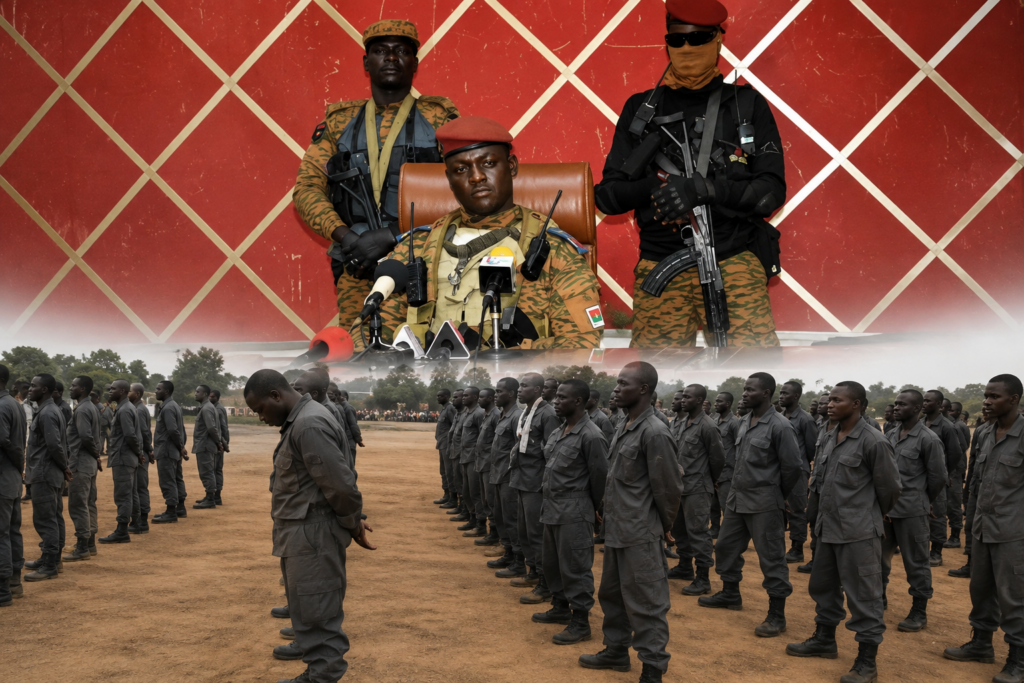
History has repeatedly shown that authoritarian regimes, no matter how powerful they appear, often face a bitter irony: the same instruments of repression designed to silence opponents eventually consume their creators. Niger’s current political landscape offers a stark illustration of this paradox. What began as a crackdown on traditional critics has expanded into a sweeping campaign that now ensnares former allies—including influential Muslim leaders, civil society figures, journalists, and online voices who once championed the ruling administration.
From repression tool to self-destructive force
The pattern is unmistakable. Arbitrary detentions, forced disappearances reported by credible observers, smear campaigns, intimidation summons, and media restrictions—all justified under the banner of national security—are no longer reserved for vocal opponents. Even those who once stood firmly behind the transitional government now find themselves targeted. The erosion of institutional safeguards has stripped away protections once assumed to be permanent, leaving loyalty as the sole measure of safety in a system where yesterday’s allies may become tomorrow’s suspects.
The illusion of guaranteed protection
Since assuming leadership, Niger’s head of state has cultivated a narrative rooted in sovereignty, patriotism, and security. This rhetoric, amplified across digital platforms by a vast network of supporters, framed dissent as a foreign-backed conspiracy or an act of treason against the nation. In this climate, public figures who defended government actions—whether out of conviction or convenience—helped normalize what would later become systemic repression.
Critics of arbitrary arrests were dismissed as undermining national unity. Reports of enforced disappearances were downplayed. Closures of independent media outlets were celebrated as assertions of sovereignty. Even the detention of judges, lawyers, or political figures was sometimes applauded as necessary sacrifices in the fight against terrorism. Over time, this gradual acceptance of exception has reshaped public discourse into a binary choice: unconditional support for the regime or immediate labeling as an enemy of the state. In such an environment, intellectual dissent is no longer seen as a democratic right but as a political betrayal.
The danger of personalized power
Niger’s political trajectory has become increasingly centered on the authority of a single leader. Policy debates have steadily given way to personality-driven governance, where questioning a decision is often interpreted as questioning the leader himself. This trend fosters a culture of perpetual suspicion. As security challenges persist—terrorist attacks, economic strain, social unrest, or international criticism—the search for internal scapegoats intensifies. The narrative shifts: failures are not attributed to policy flaws but to hidden conspiracies within the system.
This logic follows a predictable pattern. First, political opponents are targeted. Then come independent journalists, human rights defenders, academics, religious leaders, and finally, even former allies whose influence is deemed too independent or insufficiently aligned. In such a system, loyalty is never final—it must be constantly proven, and even that may not suffice.
Fear as a governing tool
The regime’s use of high-profile arrests, public summons, social media smear campaigns, administrative sanctions, and coercive measures serves a dual purpose. It neutralizes perceived threats while broadcasting a clear message to all: no one is beyond reach. Each detention sends a warning. Each unexplained disappearance fuels fear. Each summons reinforces the idea that compliance is mandatory. The cumulative effect is a society gripped by self-censorship. Journalists scale back investigations. Intellectuals hesitate to publish. Religious leaders tone down sermons. Citizens avoid public debate. When fear becomes the foundation of governance, innovation, accountability, and collective problem-solving wither away.
The weakening of institutional checks
This erosion of liberties is compounded by the gradual dismantling of institutional safeguards. Concerns persist about judicial independence, as legal proceedings increasingly appear to serve political ends rather than justice. Independent media face suspensions and restrictions, shrinking the space for diverse perspectives. Civil society organizations operate under growing constraints. Political parties function under tight controls imposed by the transitional context. With no credible counterbalance to executive power, the rights of citizens depend almost entirely on the regime’s discretion. Law is no longer a shield—it is a tool, applied selectively and enforced arbitrarily.
A historical pattern of self-destruction
Niger is not alone in this trajectory. Across history, regimes built on concentrated power have followed a similar arc. Revolutionaries purge their former comrades. Military leaders turn on their own officers. Political movements expel their founders. Ideologues are accused of betrayal. The root cause is simple: when loyalty to a single leader becomes the primary criterion for survival, no degree of allegiance is ever enough. The pursuit of absolute purity leads inevitably to purges, expulsions, and accusations—first against enemies, then against former allies, and eventually against anyone who fails to demonstrate sufficient devotion.
The false promise of selective justice
One of the most dangerous misconceptions among early supporters of the regime was the belief that their proximity to power would shield them indefinitely. In authoritarian systems, loyalty is not a contract—it is a temporary alliance, subject to the shifting needs of the moment. There is no such thing as permanent protection. The arrest of a critic today can be applauded; the arrest of a former ally tomorrow may be justified as necessary for national unity. But injustice remains injustice, regardless of the victim’s identity. Celebrating the erosion of rights for others plants the seeds for their application against oneself.
Security and rights are not opposing goals
Niger faces real and urgent threats from armed groups, and a strong state response is essential. However, the effectiveness of counter-terrorism cannot be measured solely by the number of coercive measures imposed. It also depends on the trust between citizens and their institutions. When people fear state repression more than the threat of violence itself, confidence erodes. Experience shows that no insurgency can be defeated if the population views the government as a greater danger than the enemy. Security and the rule of law are not contradictory—they are complementary. A state that fights terrorism while upholding legal norms strengthens its legitimacy. But when emergency measures become permanent, the fight against insecurity risks becoming a justification for total control.
The system’s ultimate betrayal
The recent difficulties faced by once-loyal figures—religious leaders, media personalities, civil society advocates—highlight a harsh truth: in a system built on fear and centralized power, no one is safe. Today’s defenders can become tomorrow’s suspects. The loudest supporters may be accused of insufficient loyalty. Communication channels can be shut down. Religious voices can be silenced if their messages diverge from official narratives. The regime that once relied on these allies now turns on them, proving that the problem is not the individuals involved, but the very structure of governance.
True national strength does not come from the proximity to a leader or ideological conformity. It is built on strong institutions, an independent judiciary, a free press, and laws applied equally to all. Only within such a framework can a nation confront its security challenges while preserving the dignity and rights of its people. When a state begins to consume its own supporters, it reveals a fundamental flaw—not in its enemies, but in its foundations.
You may also like
Mali’s 514 billion FCFA Russian mercenary contract sparks public outcry and doubts over Bamako’s next move
Molodo ambush fallout: Mali’s public debate shifts as Africa Corps credibility crumbles
United Russia’s 355 seats: the fallout, the debate, and what comes next for Russia’s Douma
After the flames: Moscow refinery strike sparks debate over where this war is heading
Benin’s ARS second term: the debate, the doubts and what happens next