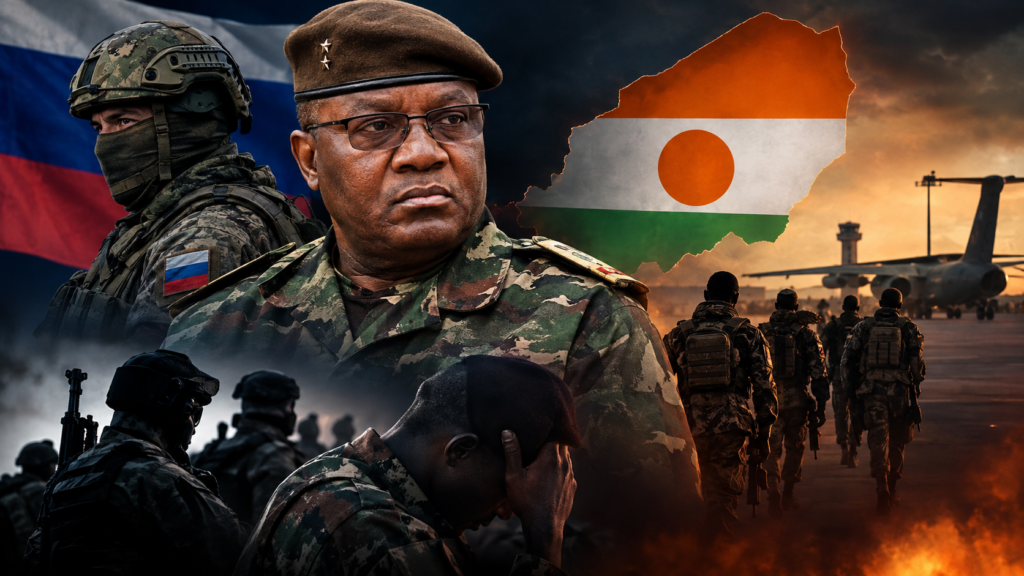
The events of the night of 28 to 29 August 2026 have left deep scars on Niger’s military regime. As details of the mutiny and its violent aftermath continue to emerge, the country is grappling with the consequences: a shaken army, a public demanding answers, and a leadership that remains silent on the most sensitive points. What happened inside the special forces, and what does it mean for the future?
A night of chaos and the battle for control
In Niamey, soldiers mostly young recruits from the special forces rose up against their command. Base 101 at Diori-Hamani International Airport, other strategic sites, and the presidential palace area became targets. For nearly twenty-four hours, the military government teetered on the brink.
What tipped the balance was the intervention of Russian Africa Corps personnel, who provided ground and air support to forces loyal to Abdourahamane Tiani, according to Reuters. Their role proved decisive in retaking the air base. But the reliance on foreign fighters to put down a domestic uprising has raised uncomfortable questions about the regime’s grip on its own military.
The purge that followed
Once the fighting ended, a wave of arrests swept through the ranks. More than 500 soldiers were detained, most of them from the special forces. Others are reported missing or have fled the country.
On 11 September, the head of the armed forces, Moussa Salaou Barmou, was dismissed. A former commander of the special forces himself, he was replaced by General Mamane Sani Kiaou. Days later, Barmou was placed under surveillance, effectively confined to his home.
Officially, the regime blamed “dysfunctions” in the chain of command during the mutiny. But that explanation leaves much unsaid. Barmou knew the special forces intimately. According to Le Monde, his opposition to a Russian-led operation against Nigerien soldiers during the crisis fuelled suspicions against him.
Russia’s deepening role
The mutiny has thrown a spotlight on Niger’s growing dependence on Moscow. Since 2023, Tiani has pivoted sharply toward Russia after severing ties with several Western partners. When his power was directly threatened, the Russian Africa Corps became central to the counterattack.
Reuters confirmed that the Africa Corps took part in operations to retake the air base. The Associated Press reported that the Russian intervention helped end the mutiny, with deaths and arrests among the mutineers.
The symbolism is stark: Nigerien soldiers rebelling against their own leadership, and a military regime calling on foreign fighters to restore order. Did the Russian intervention merely save Tiani, or did it also reshape the balance of power within the army?
Barmou: the general who became a liability
Moussa Salaou Barmou’s case is particularly telling. He was a key figure in the July 2023 coup and a pillar of the new regime. But his military background and ties to certain American networks set him apart from Tiani’s pro-Russian trajectory.
When the special forces became the epicentre of the mutiny, the chief of staff inevitably became a central figure. Could the regime trust him? Could his rivals blame him for the insubordination of units he once commanded? And what exactly transpired between him and Russian officials during the most critical hours?
Answers remain incomplete. But one fact is documented: days after the crisis, Barmou lost his post.
The ‘liquidation’ claim: a serious accusation
Some accounts now portray the events as Tiani’s desire to “liquidate” special forces units hostile to the regime. The accusation is extremely grave.
Available information does establish a major crackdown after the mutiny, with mass arrests and a restructuring of the military hierarchy. But it does not yet publicly prove that a general order to “liquidate” the special forces was given by Tiani.
That is where the real investigative work begins. Who gave the orders during the clashes? Which units opened fire? How many soldiers were killed? How many are detained, and under what conditions? Which officers were questioned or sidelined? And what exactly was the role of Russian fighters on the ground and in the air? The Nigerien regime has yet to provide full public answers.
The paradox of a regime that promised to restore the army
Tiani justified the 2023 takeover by citing the need to restore security and put the army back at the heart of national defence. Three years later, part of the armed forces turned against him. When the crisis erupted, the regime called on a foreign military partner to retake a strategic installation before carrying out a deep reorganisation of its own military apparatus.
The problem goes beyond Barmou. It touches the very core of the security model Tiani has built. When a military regime must rely on foreign forces to contain a mutiny of its own soldiers, and then remove part of its command after the fighting, it is no longer just a disciplinary crisis. It is a sign of a profound fracture within the apparatus that holds power.
And behind the official statements, the appointments, and the arrests, one question lingers: how much more blood will be spilled before the truth about the night of 28 to 29 August finally emerges from the barracks?
By Élise Ntamag — Regional policy
You may also like
Benin’s CCI budget for 2027 sparks debate: what the 6.6 billion FCFA plan means for businesses
Bambali agro park: what the launch means for Sédhiou and Senegal
Senegal’s palm oil deal with Indonesia: reactions, debate and what happens next
Burkina Faso’s militarisation debate: what the fallout means for displaced citizens
Gabon’s EU fisheries talks: mixed reactions as a new chapter begins